192 statblocks · 192 with token art. Type to filter. Avatars load from your local
cos-tokens/ folder first, then the CDN. Use Copy for a quick stat line; right-click an avatar to save it as a token.AcolyteAmber GolemAnastrasya KarelovaAnimated ArmorAnimated HalberdArabelleArcanalothArchmageArmored Saber-Toothed TigerArrigalAssassinBaba LysagaBaba Lysaga's Creeping HutBaba Lysaga's Giant SkullBansheeBaron Vargas VallakovichBarovian CommonerBarovian ScoutBarovian WitchBatBerserkerBeucephalusBlack PuddingBluto KrogarovBroom of Animated AttackCatClay GolemClimbing GhastClovin BelviewCommonerCrawling ClawCult FanaticCultistCyrus BelviewDavian MartikovDeath SlaadDire WolfDistended CorpseDonavichDoruDraft HorseDretchDruidDusk Elf GuardEmil ToranescuEscherExethanterEzmerelda d'AvenirFlameskullFlesh GolemFlying SwordGadof BlinskyGargoyleGate GuardGertrudaGhastGhostGhoulGiant Poisonous SnakeGiant SpiderGiant Wolf SpiderGladiatorGoatGray OozeGrickGuardGuardian PortraitHelga RuvakHell HoundHenrik van der VoortImpInvisible StalkerIreena KolyanaIron GolemIsmark KolyanovichIzek StrazniKasimir VelikovKiril StoyanovichKnightLady Fiona WachterLady Lydia PetrovnaLichLief LipsiegeLiving FireLudmilla VilisevicLuvashMad MaryMadam EvaMageMajestoMarzena BelviewMastiffMilivojMimicMishka BelviewMongrelfolkMorganthaMuleNeedle BlightNight HagNikolai WachterNobleNothicOtto BelviewParriwimplePatrina VelikovnaPhantom WarriorPhantom Warrior with Spectral LongbowPiccoloPidlwick IIPoltergeistPriestQuasitRahadinRavenRed Dragon WyrmlingRevenantRevenant with LongswordRictavioRiding HorseRocRosavalda "Rose" DurstRug of SmotheringSangzorSavidScarecrowScoutShadowShadow DemonShambling MoundShield GuardianSir Godfrey GwilymSir Klutz TripalotskySkeletal CatSkeletonSmoke MephitSnow MaidenSpecterSpirit Assassin, EvilSpirit Assassin, Non-evilSpirit GargoyleSpyStanimirStella WachterStrahd von ZarovichStrahd ZombieStrahd's Animated ArmorSwarm of BatsSwarm of CentipedesSwarm of InsectsSwarm of Poisonous SnakesSwarm of RatsSwarm of RavensSwarm of SpidersSwarm of WaspsSzoldar SzoldarovichThe AbbotThe Mad MageThornboldt "Thorn" DurstToadTree BlightTwig BlightVampireVampire SpawnVasilkaVeteranVictor VallakovichVilniusVine BlightVistana AssassinVistana BanditVistana Bandit CaptainVistana CommonerVistana GuardVistana SpyVistana ThugVladimir HorngaardVolenta PopofskyVrockWarhorseWarhorse SkeletonWereravenWerewolfWightWill-o'-WispWolfWraithYevgeni KrushkinYoung Blue DragonZombieZuleika ToranescuZygfrek Belview
Acolytes are junior members of a clergy, usually answerable to a priest. They perform a variety of functions in a temple and are granted minor spellcasting power by their deities.
• Cantrips (at will): light, sacred flame, thaumaturgy
• 1st level (3 slots): bless, cure wounds, sanctuary
Traits
Spellcasting: The acolyte is a 1st-level spellcaster. Its spellcasting ability is Wisdom (spell save DC 12, +4 to hit with spell attacks). The acolyte has following cleric spells prepared:• Cantrips (at will): light, sacred flame, thaumaturgy
• 1st level (3 slots): bless, cure wounds, sanctuary
Actions
Club: Melee Weapon Attack: +2 to hit, reach 5 ft., one target. Hit: 2 (1d4) bludgeoning damage.
"I am The Ancient, I am The Land. My beginnings are lost in the darkness of the past. I was the warrior, I was good and just. I thundered across the land like the wrath of a just god, but the war years and the killing years wore down my soul as the wind wears down stone into sand."
—Count Strahd von Zarovich
Vampires
Awakened to an endless night, vampires hunger for the life they have lost and sate that hunger by drinking the blood of the living. Vampires abhor sunlight, for its touch burns them. They never cast shadows or reflections, and any vampire wishing to move unnoticed among the living keeps to the darkness and far from reflective surfaces.Dark Desires. Whether or not a vampire retains any memories from its former life, its emotional attachments wither as once-pure feelings become twisted by undeath. Love turns into hungry obsession, while friendship becomes bitter jealousy. In place of emotion, vampires pursue physical symbols of what they crave, so that a vampire seeking love might fixate on a young beauty. A child might become an object of fascination for a vampire obsessed with youth and potential. Others surround themselves with art, books, or sinister items such as torture devices or trophies from creatures they have killed.
Born from Death. Most of a vampire’s victims become vampire spawn—ravenous creatures with a vampire’s hunger for blood, but under the control of the vampire that created them. If a true vampire allows a spawn to draw blood from its own body, the spawn transforms into a true vampire no longer under its master’s control. Few vampires are willing to relinquish their control in this manner. Vampire spawn become free-willed when their creator dies.
Chained to the Grave. Every vampire remains bound to its coffin, crypt, or grave site, where it must rest by day. If a vampire didn’t receive a formal burial, it must lie beneath a foot of earth at the place of its transition to undeath. A vampire can move its place of burial by transporting its coffin or a significant amount of grave dirt to another location. Some vampires set up multiple resting places this way.
Undead Nature. Neither a vampire nor a vampire spawn requires air.
Traits
Regeneration: The vampire regains 10 hit points at the start of its turn if it has at least 1 hit point and isn't in sunlight or running water. If the vampire takes radiant damage or damage from holy water, this trait doesn't function at the start of the vampire's next turn.Spider Climb: The vampire can climb difficult surfaces, including upside down on ceilings, without needing to make an ability check.
Vampire Weaknesses: The vampire has the following flaws:
• Forbiddance. The vampire can't enter a residence without an invitation from one of the occupants.
• Harmed by Running Water. The vampire takes 20 acid damage when it ends its turn in running water.
• Stake to the Heart. The vampire is destroyed if a piercing weapon made of wood is driven into its heart while it is incapacitated in its resting place.
• Sunlight Hypersensitivity. The vampire takes 20 radiant damage when it starts its turn in sunlight. While in sunlight, it has disadvantage on attack rolls and ability checks.
Actions
Multiattack: The vampire makes two attacks, only one of which can be a bite attack.Claws: Melee Weapon Attack: +6 to hit, reach 5 ft., one creature. Hit: 8 (2d4 + 3) slashing damage. Instead of dealing damage, the vampire can grapple the target, escape DC 13.
Bite: Melee Weapon Attack: +6 to hit, reach 5 ft., one willing creature, or a creature that is grappled by the vampire, incapacitated, or restrained. Hit: 6 (1d6 + 3) piercing damage plus 7 (2d6) necrotic damage. The target's hit point maximum is reduced by an amount equal to the necrotic damage taken, and the vampire regains hit points equal to that amount. The reduction lasts until the target finishes a long rest. The target dies if this effect reduces its hit point maximum to 0.
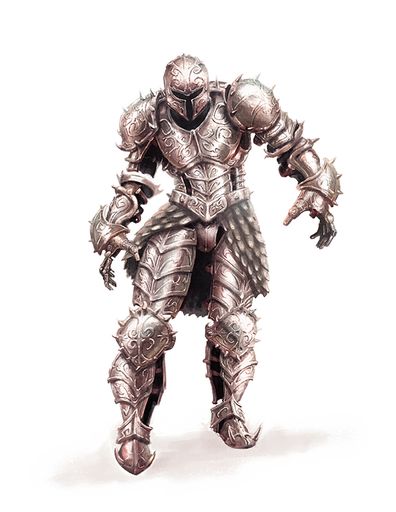
Picture: Handout: Animated Armor
Animated Objects
Animated objects are crafted with potent magic to follow the commands of their creators. When not commanded, they follow the last order they received to the best of their ability, and can act independently to fulfill simple instructions. Some animated objects (including many of those created in the Feywild) might converse fluently or adopt a persona, but most are simple automatons.Constructed Nature. An animated object doesn’t require air, food, drink, or sleep.
The magic that animates an object is dispelled when the construct drops to 0 hit points. An animated object reduced to 0 hit points becomes inanimate and is too damaged to be of much use or value to anyone.
Animated Armor
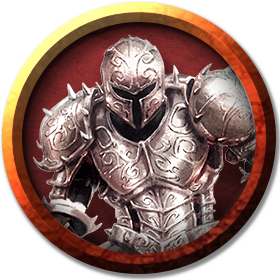
This empty steel shell clamors as it moves, heavy plates banging and grinding against one another like the vengeful spirit of a fallen knight. Ponderous but persistent, this magical guardian is almost always a suit of plate armor.To add to its menace, animated armor is frequently enchanted with scripted speech, so the armor can utter warnings, demand passwords, or deliver riddles. Rare suits of animated armor are able to carry on an actual conversation.
Traits
Antimagic Susceptibility: The armor is incapacitated while in the area of an antimagic field. If targeted by dispel magic, the armor must succeed on a Constitution saving throw against the caster's spell save DC or fall unconscious for 1 minute.False Appearance: While the armor remains motionless, it is indistinguishable from a normal suit of armor.
Actions
Multiattack: The armor makes two melee attacks.Slam: Melee Weapon Attack: +4 to hit, reach 5 ft., one target. Hit: 5 (1d6 + 2) bludgeoning damage.
Animated Objects
Animated objects are crafted with potent magic to follow the commands of their creators. When not commanded, they follow the last order they received to the best of their ability, and can act independently to fulfill simple instructions. Some animated objects (including many of those created in the Feywild) might converse fluently or adopt a persona, but most are simple automatons.Constructed Nature. An animated object doesn’t require air, food, drink, or sleep.
The magic that animates an object is dispelled when the construct drops to 0 hit points. An animated object reduced to 0 hit points becomes inanimate and is too damaged to be of much use or value to anyone.

(no bio)
"Power. We all crave it, but only a select few of us deserve it."
—Shemeshka the Marauder, arcanaloth in Sigil
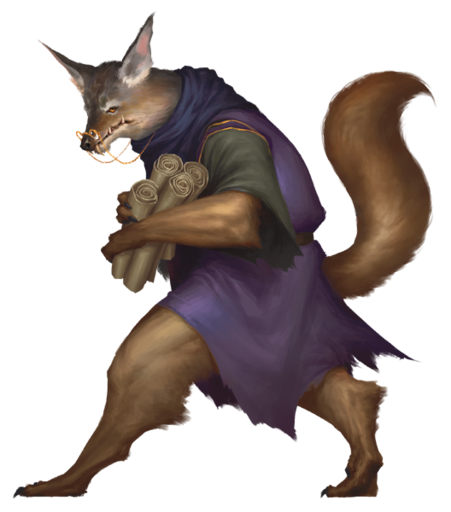
Picture: Handout: Arcanaloth
Yugoloths
Yugoloths are fickle fiends that inhabit the planes of Acheron, Gehenna, Hades, and Carceri. They act as mercenaries and are notorious for their shifting loyalties. They are the embodiments of avarice. Before serving under anyone’s banner, a yugoloth asks the only question on its mind: What’s in it for me?Spawn of Gehenna. The first yugoloths were created by a sisterhood of night hags on Gehenna. It is widely believed that Asmodeus, Lord of the Nine Hells, commissioned the work, in the hope of creating an army of fiends that were not bound to the Nine Hells. In the course of making this new army, the hags crafted four magic tomes and recorded the true names of every yugoloth they created, save one, the General of Gehenna. These tomes were called the Books of Keeping. Since knowing a fiend’s true name grants power over it, the hags used the books to ensure the yugoloths’ loyalty. They also used the books to capture the true names of other fiends that crossed them. It is rumored that the Books of Keeping contain the true names of a few demon lords and archdevils as well.
Petty jealousies and endless bickering caused the sisterhood to dissolve, and in the ensuing power grab, the Books of Keeping were lost or stolen. No longer indentured to anyone, the yugoloths gained independence, and they now offer their services to the highest bidder.
Fiendish Mercenaries. Summoned yugoloths demand much for their time and loyalty. Whatever promises a yugoloth makes are quickly broken when a better opportunity presents itself. Unlike demons, yugoloths can be reasoned with, but unlike devils, they are rarely true to their word.
Yugoloths can be found anywhere, but the high cost of maintaining a yugoloth army’s loyalty typically exceeds what any warlord on the Material Plane can pay.
Being self-serving creatures, yugoloths quarrel among themselves constantly. A yugoloth army is more organized than a ravening horde of demons, but far less orderly and regimented than a legion of devils. Without a powerful leader to keep them in line, yugoloths fight simply to indulge their violent predilections, and only as long as it benefits them to do so.
Back to Gehenna. When a yugoloth dies, it dissolves into a pool of ichor and reforms at full strength on the Bleak Eternity of Gehenna. Only on its native plane can a yugoloth be destroyed permanently. A yugoloth knows this and acts accordingly. When summoned to other planes, a yugoloth fights without concern for its own well-being. On Gehenna, it is more apt to retreat or plead for mercy if its demise seems imminent.
When a yugoloth is permanently destroyed, its name vanishes from every Book of Keeping. If a yugoloth is re-created by way of an unholy ritual requiring the expenditure of souls, its name reappears in the books.
The Books of Keeping. When all four copies of the Books of Keeping disappeared, Asmodeus and the night hags lost control of their yugoloth creations. Each Book of Keeping still exists, drifting from plane to plane, where the brave and the foolish occasionally stumble upon them. A yugoloth summoned using its true name, as inscribed in the Books of Keeping, is forced to serve its summoner obediently. The yugoloth hates being controlled in this manner and isn’t shy about making its displeasure known. Like a petulant child, it will follow its instructions to the letter while looking for opportunities to misinterpret them.
The General of Gehenna. Somewhere in the brimstone wastes of Gehenna, there roams an ultroloth so strong that none contests his power: the General of Gehenna. Many yugoloths search for this great general in the hope of serving with him. They believe that service with the General of Gehenna grants power and prestige among lower planar entities.
Whatever the case, no fiend finds the General unless the General desires it. His personal name is unknown, and even the Books of Keeping contain no mention of this powerful, thoroughly evil entity.
Arcanaloth
Arcanaloths are sly, jackal-headed beings with humanoid bodies, but they can employ magic to take any humanoid form. They do so to gain the trust of creatures with whom they negotiate, replacing jackal snarls with winsome smiles.Regardless of its chosen form, an arcanaloth appears well groomed, clothing itself in fine robes. Highly intelligent spellcasters who hunger for knowledge and power, arcanaloths command units of lesser yugoloths and maintain the contracts, records, and accounts of their kind.
Arcanaloths speak and write all languages, making them cunning diplomats and negotiators. An arcanaloth properly paid can broker treaties or alliances with subtlety and finesse, just as an arcanaloth who changes sides can easily turn the best-laid peace talks into all-out war. What the fiend demands in exchange for its time and talent is information, as well as powerful magic items that it can trade for even more information.
Variant: Yugoloth Summoning
Some yugoloths have an action option that allows them to summon other yugoloths. These are also represented in the associated creatures Actions section.Summon Yugoloth (1/Day): The yugoloth chooses what to summon and attempts a magical summoning.
• An arcanaloth has a 40 percent chance of summoning one arcanaloth.
• A mezzoloth has a 30 percent chance of summoning one mezzoloth.
• A nycaloth has a 50 percent chance of summoning 1d4 mezzoloths or one nycaloth.
• An ultroloth has a 50 percent chance of summoning 1d6 mezzoloths, 1d4 nycaloths, or one ultroloth.
A summoned yugoloth appears in an unoccupied space within 60 feet of its summoner, does as it pleases (unless its summoner is an ultroloth, in which case it acts as an ally of its summoner), and can’t summon other yugoloths. The summoned yugoloth remains for 1 minute, until it or its summoner dies, or until its summoner takes a bonus action to dismiss it.
Traits
Innate Spellcasting: The arcanaloth’s innate spellcasting ability is Charisma (spell save DC 15). The arcanaloth can innately cast the following spells, requiring no material components:• At will: alter self, darkness, heat metal, invisibility (self only), magic missile
Magic Resistance: The arcanaloth has advantage on saving throws against spells and other magical effects.
Magic Weapons: The arcanaloth’s weapon attacks are magical.
Spellcasting: The arcanaloth is a 16th-level spellcaster. Its spellcasting ability is Intelligence (spell save DC 17, +9 to hit with spell attacks). The arcanaloth has the following wizard spells prepared:
• Cantrips (at will): fire bolt, mage hand, minor illusion, prestidigitation
• 1st level (4 slots): detect magic, identify, shield, Tenser’s floating disk
• 2nd level (3 slots): detect thoughts, mirror image, phantasmal force, suggestion
• 3rd level (3 slots): counterspell, fear, fireball
• 4th level (3 slots): banishment, dimension door
• 5th level (2 slots): contact other plane, hold monster
• 6th level (1 slot): chain lightning
• 7th level (1 slot): finger of death
• 8th level (1 slot): mind blank
Actions
Fire Bolt: Ranged Spell Attack: +9 to hit, range 120 ft., one target. Hit: 16 (3d10) fire damage. A flammable object hit by this spell ignites if it isn't being worn or carried.Claws: Melee Weapon Attack: +7 to hit, reach 5 ft., one target. Hit: 8 (2d4 + 3) slashing damage. The target must make a DC 14 Constitution saving throw, taking 10, 3d6, poison damage on a failed save, or half as much damage on a successful one.
Teleport: The arcanaloth magically teleports, along with any equipment it is wearing or carrying, up to 60 feet to an unoccupied space it can see.
(Variant) Summon Yugoloth (1/Day): An arcanaloth has a 40 percent chance of summoning one arcanaloth. The summoned yugoloth appears in an unoccupied space within 60 feet of its summoner, does as it pleases, and can’t summon other yugoloths. The summoned yugoloth remains for 1 minute, until it or its summoner dies, or until its summoner takes a bonus action to dismiss it.

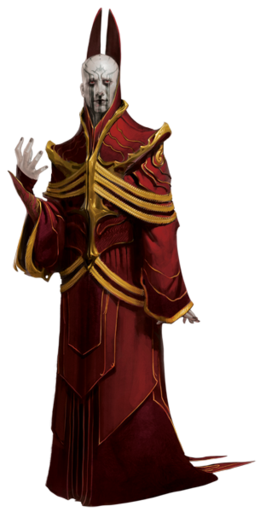
Archmages are powerful (and usually quite old) spellcasters dedicated to the study of the arcane arts. Benevolent ones counsel kings and queens, while evil ones rule as tyrants and pursue lichdom. Those who are neither good nor evil sequester themselves in remote towers to practice their magic without interruption.
An archmage typically has one or more apprentice mages, and an archmage’s abode has numerous magical wards and guardians to discourage interlopers.
Variant: Familiars
Any spellcaster that can cast the find familiar spell (such as an archmage or mage) is likely to have a familiar. The familiar can be one of the creatures described in the spell (see the Player’s Handbook) or some other Tiny monster, such as a crawling claw, imp, pseudodragon, or quasit.Traits
Magic Resistance: The archmage has advantage on saving throws against spells and other magical effects.Spellcasting: The archmage is an 18th-level spellcaster. Its spellcasting ability is Intelligence (spell save DC 17, +9 to hit with spell attacks). The archmage can cast disguise self and invisibility at will and has the following wizard spells prepared:
• Cantrips (at will): fire bolt, light, mage hand, prestidigitation, shocking grasp
• 1st level (4 slots): detect magic, identify, mage armor, magic missile
• 2nd level (3 slots): detect thoughts, mirror image, misty step
• 3rd level (3 slots): counterspell, fly, lightning bolt
• 4th level (3 slots): banishment, fire shield, stoneskin
• 5th level (3 slots): cone of cold, scrying, wall of force
• 6th level (1 slot): globe of invulnerability
• 7th level (1 slot): teleport
• 8th level (1 slot): mind blank*
• 9th level (1 slot): time stop
* The archmage casts these spells on itself before combat.
Actions
Dagger (Melee): Melee Weapon Attack: +6 to hit, reach 5 ft., one target. Hit: 4 (1d4 + 2) piercing damage.Dagger (Ranged): Ranged Weapon Attack: +6 to hit, range 20/60 ft., one target. Hit: 4 (1d4 + 2) piercing damage.
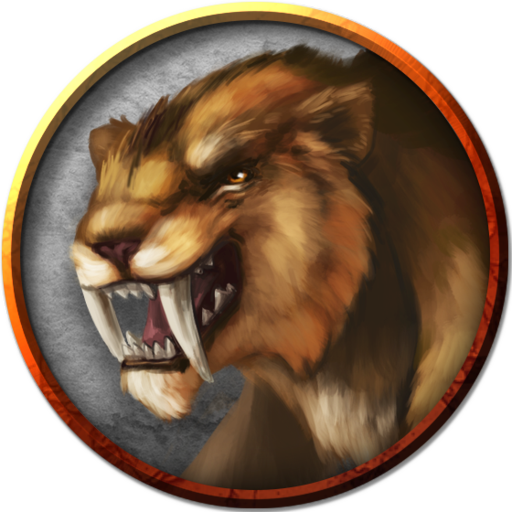
Traits
Keen Smell: The tiger has advantage on Wisdom (Perception) checks that rely on smell.Pounce: If the tiger moves at least 20 feet straight toward a creature and then hits it with a claw attack on the same turn, that target must succeed on a DC 14 Strength saving throw or be knocked prone. If the target is prone, the tiger can make one bite attack against it as a bonus action.
Actions
Bite: Melee Weapon Attack: +6 to hit, reach 5 ft., one target. Hit: 10 (1d10 + 5) piercing damage.Claw: Melee Weapon Attack: +6 to hit, reach 5 ft., one target. Hit: 12 (2d6 + 5) slashing damage.

Picture: Handout: Arrigal
Vistani are silversmiths, coppersmiths, haberdashers, cooks, weavers, musicians, entertainers, storytellers, toolmakers, and horse traders. They also earn money by telling fortunes and selling information. They spend whatever they earn to support a lavish lifestyle, display their wealth openly as a sign of prosperity, and share their good fortune with family and friends.
Each family or clan of Vistani is its own little gerontocracy, with the oldest member ruling the roost. This elder carries the bulk of the responsibility for enforcing traditions, settling disputes, setting the course for the group’s travels, and preserving the Vistani way of life. Vistani elders make all the important decisions, but whether by choice or because of their age, tend to speak in cryptic, flowing riddles.
Vistani families and clans are closely knit. They resolve disagreements through contests that end with reconciliatory singing, dancing, and storytelling. Although they can seem lazy and irresponsible to outsiders, the Vistani are serious people, quick to act when their lives or traditions are threatened. They are merciless when they believe they must be. Vistani who knowingly bring harm or misfortune to others of their kind are banished—the worst punishment a Vistana can imagine, even worse than death.
Vistani
The Vistani (singular: Vistana) are wanderers who live outside civilization, traveling about in horse-drawn, barrel-topped wagons called vardos, which they build themselves. Compared to Barovians, they are flamboyant. Vistani dress in bright clothes, laugh often, and drink heartily. As much as they feel at home in Strahd’s dreary land, they know they can leave it whenever they please and aren’t damned to spend eternity there.Vistani are silversmiths, coppersmiths, haberdashers, cooks, weavers, musicians, entertainers, storytellers, toolmakers, and horse traders. They also earn money by telling fortunes and selling information. They spend whatever they earn to support a lavish lifestyle, display their wealth openly as a sign of prosperity, and share their good fortune with family and friends.
Each family or clan of Vistani is its own little gerontocracy, with the oldest member ruling the roost. This elder carries the bulk of the responsibility for enforcing traditions, settling disputes, setting the course for the group’s travels, and preserving the Vistani way of life. Vistani elders make all the important decisions, but whether by choice or because of their age, tend to speak in cryptic, flowing riddles.
Vistani families and clans are closely knit. They resolve disagreements through contests that end with reconciliatory singing, dancing, and storytelling. Although they can seem lazy and irresponsible to outsiders, the Vistani are serious people, quick to act when their lives or traditions are threatened. They are merciless when they believe they must be. Vistani who knowingly bring harm or misfortune to others of their kind are banished—the worst punishment a Vistana can imagine, even worse than death.

Trained in the use of poison, assassins are remorseless killers who work for nobles, guildmasters, sovereigns, and anyone else who can afford them.
Evasion: If the assassin is subjected to an effect that allows it to make a Dexterity saving throw to take only half damage, the assassin instead takes no damage if it succeeds on the saving throw, and only half damage if it fails.
Sneak Attack (1/Turn): The assassin deals an extra 14 (4d6) damage when it hits a target with a weapon attack and has advantage on the attack roll, or when the target is within 5 ft. of an ally of the assassin that isn't incapacitated and the assassin doesn't have disadvantage on the attack roll.

Shortsword: Melee Weapon Attack: +6 to hit, reach 5 ft., one target. Hit: 6 (1d6 + 3) piercing damage, and the target must make a DC 15 Constitution saving throw, taking 24 (7d6) poison damage on a failed save, or half as much damage on a successful one.
Light Crossbow: Ranged Weapon Attack: +6 to hit, range 80/320 ft., one target. Hit: 7 (1d8 + 3) piercing damage, and the target must make a DC 15 Constitution saving throw, taking 24 (7d6) poison damage on a failed save, or half as much damage on a successful one.
Traits
Assassinate: During its first turn, the assassin has advantage on attack rolls against any creature that hasn't taken a turn. Any hit the assassin scores against a surprised creature is a critical hit.Evasion: If the assassin is subjected to an effect that allows it to make a Dexterity saving throw to take only half damage, the assassin instead takes no damage if it succeeds on the saving throw, and only half damage if it fails.
Sneak Attack (1/Turn): The assassin deals an extra 14 (4d6) damage when it hits a target with a weapon attack and has advantage on the attack roll, or when the target is within 5 ft. of an ally of the assassin that isn't incapacitated and the assassin doesn't have disadvantage on the attack roll.
Actions
Multiattack: The assassin makes two shortsword attacks.Shortsword: Melee Weapon Attack: +6 to hit, reach 5 ft., one target. Hit: 6 (1d6 + 3) piercing damage, and the target must make a DC 15 Constitution saving throw, taking 24 (7d6) poison damage on a failed save, or half as much damage on a successful one.
Light Crossbow: Ranged Weapon Attack: +6 to hit, range 80/320 ft., one target. Hit: 7 (1d8 + 3) piercing damage, and the target must make a DC 15 Constitution saving throw, taking 24 (7d6) poison damage on a failed save, or half as much damage on a successful one.
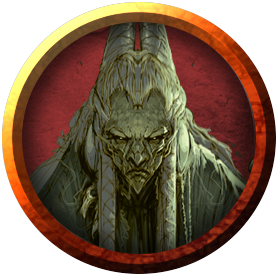
Picture: Handout: Baba Lysaga
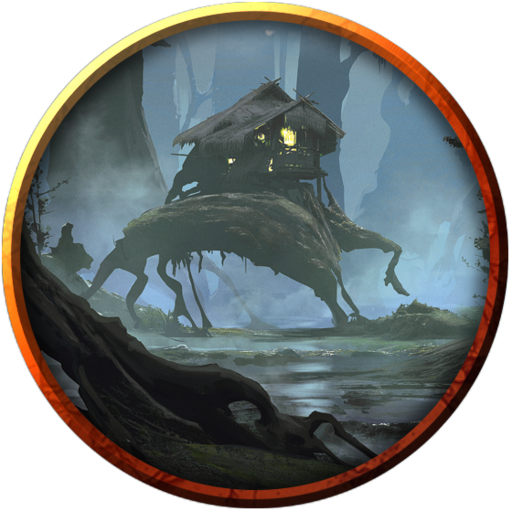
Picture: Handout: Baba Lysaga’s Creeping Hut
Constructed Nature. An animated object doesn’t require air, food, drink, or sleep.
The magic that animates an object is dispelled when the construct drops to 0 hit points. An animated object reduced to 0 hit points becomes inanimate and is too damaged to be of much use or value to anyone.
Animated Objects
Animated objects are crafted with potent magic to follow the commands of their creators. When not commanded, they follow the last order they received to the best of their ability, and can act independently to fulfill simple instructions. Some animated objects might converse fluently or adopt a persona, but most are simple automatons.Constructed Nature. An animated object doesn’t require air, food, drink, or sleep.
The magic that animates an object is dispelled when the construct drops to 0 hit points. An animated object reduced to 0 hit points becomes inanimate and is too damaged to be of much use or value to anyone.
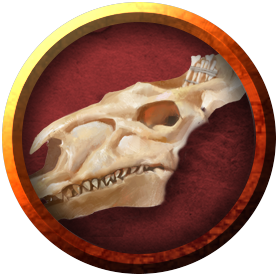
(no bio)

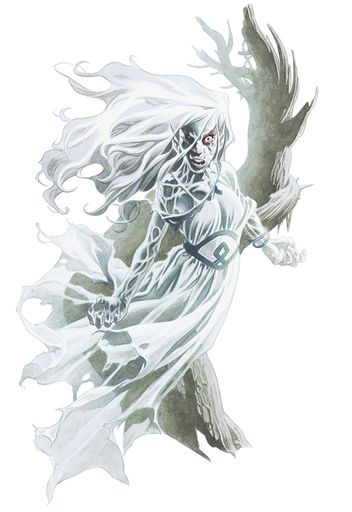
Picture: Handout: Banshee
When night falls, unlucky travelers hear the faint cries of the forlorn dead. This woeful spirit is a banshee, a spiteful creature formed from the spirit of a female elf.
Banshees appear as luminous, wispy forms that vaguely recall their mortal features. A banshee’s face is wreathed in a wild tangle of hair, its body clad in wispy rags that flutter and stream around it.
Divine Wrath. Banshees are the undead remnants of elves who, blessed with great beauty, failed to use their gift to bring joy to the world. Instead, they used their beauty to corrupt and control others. Elves afflicted by the banshee’s curse experience no gladness, feeling only distress in the presence of the living. As the curse takes its toll, their minds and bodies decay, until death completes their transformation into undead monsters.
Sorrow Bound. A banshee becomes forever bound to the place of its demise, unable to venture more than five miles from there. It is forced to relive every moment of its life with perfect recall, yet always refuses to accept responsibility for its doom.
Beauty Hoarders. The vanity that inspired the banshee’s cursed creation persists in undeath. These creatures covet beautiful objects: fine jewelry, paintings, statues, and other objects of art. At the same time, a banshee abhors any mirrored surface, for it can’t bear to see the horror of its own existence. A single glimpse of itself is enough to send a banshee into a rage.
Undead Nature. A banshee doesn’t require air, food, drink, or sleep.
Traits
Detect Life: The banshee can magically sense the presence of living creatures up to 5 miles away. She knows the general direction they’re in but not their exact locations.Incorporeal Movement: The banshee can move through other creatures and objects as if they were difficult terrain. She takes 5 (1d10) force damage if she ends her turn inside an object.
Actions
Corrupting Touch: Melee Spell Attack: +4 to hit, reach 5 ft., one target. Hit: 12 (3d6 + 2) necrotic damage.Horrifying Visage: Each non-undead creature within 60 feet of the banshee that can see her must succeed on a DC 13 Wisdom saving throw or be frightened for 1 minute. A frightened target can repeat the saving throw at the end of each of its turns, with disadvantage if the banshee is within line of sight, ending the effect on itself on a success. If a target’s saving throw is successful or the effect ends for it, the target is immune to the banshee’s Horrifying Visage for the next 24 hours.
Wail (1/Day): The banshee releases a mournful wail, provided that she isn’t in sunlight. This wail has no effect on constructs and undead. All other creatures within 30 feet of her that can hear her must make a DC 13 Constitution saving throw. On a failure, a creature drops to 0 hit points. On a success, a creature takes 10 (3d6) psychic damage.
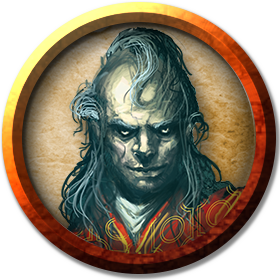
(no bio)
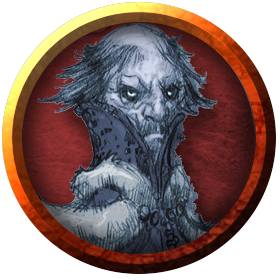
Commoners include peasants, serfs, slaves, servants, pilgrims, merchants, artisans, and hermits.
Actions
Pitchfork: Melee Weapon Attack: +2 to hit, reach 5 ft., one target. Hit: 3 (1d6) piercing damage.
Scouts are skilled hunters and trackers who offer their services for a fee. Most hunt wild game, but a few work as bounty hunters, serve as guides, or provide military reconnaissance.
Traits
Keen Hearing and Sight: The scout has advantage on Wisdom (Perception) checks that rely on hearing or sight.Actions
Multiattack: The scout makes two melee attacks or two ranged attacks.Shortsword: Melee Weapon Attack: +4 to hit, reach 5 ft., one target. Hit: 5 (1d6 + 2) piercing damage.
Light Crossbow: Ranged Weapon Attack: +4 to hit, ranged 80/320 ft., one target. Hit: 6 (1d8 + 2) piercing damage.
Picture: Handout: Barovian Witch
Brothers and Sisters of Strahd. Barovian witches have no scruples. They will deal with anyone in return for power. They will also betray anyone for the same reason. The only thing they fear is Strahd, and his wish is their command. Barovian witches sometimes refer to themselves as the brothers and sisters of Strahd, though never to Strahd’s face.
Pack Rats with Cats. Barovian witches are obsessive collectors, each believing that almost anything found—a piece of broken bone, a dead rodent, a handful of dust, or some other worthless item or substance—could be valuable or useful as a spell component, a ritual object, or a potion ingredient.
Barovian witches use the find familiar spell to call forth familiars. They are particularly fond of cats, though snakes and toads are also common. These animals lurk amid the clutter of the witches’ lairs, seldom wandering far from their vile masters.
Barovian Witch
The mad women and men known as Barovian witches forge pacts with Strahd and the Dark Powers of Ravenloft in exchange for magic and longevity. They prefer to live in the shadows and can see in the dark. When traveling in the open, they use alter self spells to assume less conspicuous forms. They also use these spells to grow long, sharp claws with which they can attack.Brothers and Sisters of Strahd. Barovian witches have no scruples. They will deal with anyone in return for power. They will also betray anyone for the same reason. The only thing they fear is Strahd, and his wish is their command. Barovian witches sometimes refer to themselves as the brothers and sisters of Strahd, though never to Strahd’s face.
Pack Rats with Cats. Barovian witches are obsessive collectors, each believing that almost anything found—a piece of broken bone, a dead rodent, a handful of dust, or some other worthless item or substance—could be valuable or useful as a spell component, a ritual object, or a potion ingredient.
Barovian witches use the find familiar spell to call forth familiars. They are particularly fond of cats, though snakes and toads are also common. These animals lurk amid the clutter of the witches’ lairs, seldom wandering far from their vile masters.

Traits
Echolocation: The bat can't use its blindsight while deafened.Keen Hearing: The bat has advantage on Wisdom (Perception) checks that rely on hearing.
Actions
Bite: Melee Weapon Attack: +0 to hit, reach 5 ft., one creature. Hit: 1 (1d1) piercing damage.
Hailing from uncivilized lands, unpredictable berserkers come together in war parties and seek conflict wherever they can find it.
Traits
Reckless: At the start of its turn, the berserker can gain advantage on all melee weapon attack rolls during that turn, but attack rolls against it have advantage until the start of its next turn.Actions
Greataxe: Melee Weapon Attack: +5 to hit, reach 5 ft., one target. Hit: 9 (1d12 + 3) slashing damage.
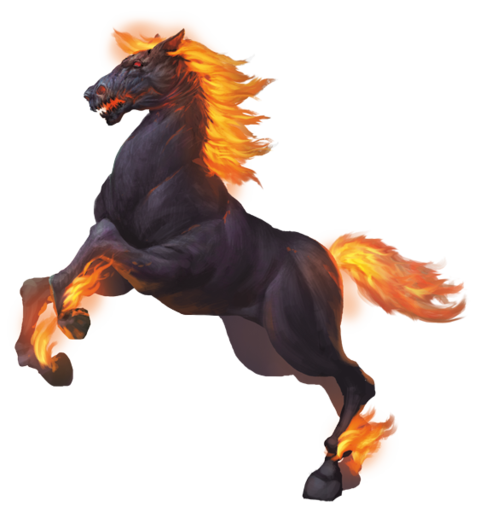
Picture: Handout: Beucephalus
A nightmare appears in a cloud of roiling smoke, its mane, tail, and hooves wreathed in flame. The creature’s unearthly black form moves with supernatural speed, vanishing in a cloud of brimstone as quickly as it appeared.
Dread Steed. Also called a “demon horse” or “hell horse,” the nightmare serves as a steed for creatures of exceptional evil, carrying demons, devils, death knights, liches, night hags, and other vile monsters. It resembles a fiendish horse, and a nightmare’s fiery red eyes betray its malevolent intelligence.
A nightmare can be summoned from the Lower Planes, but unless a worthy sacrifice is offered to it as food upon its arrival, the nightmare displays no special loyalty to the creature it serves.
Creating a Nightmare. Nightmares don’t appear naturally in the multiverse. They must be created from pegasi. The ritual that creates a nightmare requires the torturous removal of a pegasus’s wings, driving that noble creature to evil as it is transformed by dark magic.
Traits
Confer Fire Resistance: The nightmare can grant resistance to fire damage to anyone riding it.Illumination: The nightmare sheds bright light in a 10-foot radius and dim light for an additional 10 feet.
Actions
Hooves: Melee Weapon Attack: +6 to hit, reach 5 ft., one target. Hit: 13 (2d8 + 4) bludgeoning damage plus 7 (2d6) fire damage.Ethereal Stride: The nightmare and up to three willing creatures within 5 feet of it magically enter the Ethereal Plane from the Material Plane, or vice versa.
“The dungeon’s floors were spotless. That should have been our first clue.”
—from the journal of Jaster Hollowquill, on his first exploration of Undermountain
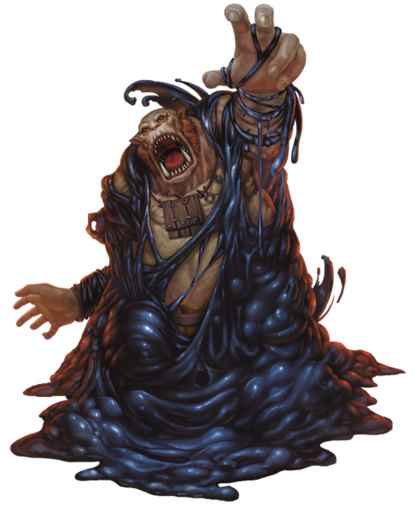
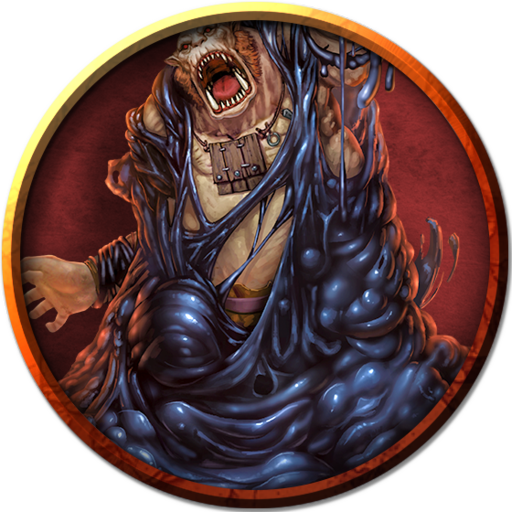
Picture: Handout: Black Pudding
Oozes
Oozes thrive in the dark, shunning areas of bright light and extreme temperatures. They flow through the damp underground, feeding on any creature or object that can be dissolved, slinking along the ground, dripping from walls and ceilings, spreading across the edges of underground pools, and squeezing through cracks. The first warning an adventurer receives of an ooze’s presence is often the searing pain of its acidic touch.Oozes are drawn to movement and warmth. Organic material nourishes them, and when prey is scarce they feed on grime, fungus, and offal. Veteran explorers know that an immaculately clean passageway is a likely sign that an ooze lairs nearby.
Slow Death. An ooze kills its prey slowly. Some varieties, such as black puddings and gelatinous cubes, engulf creatures to prevent escape. The only upside of this torturous death is that a victim’s comrades can come to the rescue before it is too late.
Since not every ooze digests every type of substance, some have coins, metal gear, bones, and other debris suspended within their quivering bodies. A slain ooze can be a rich source of treasure for its killers.
Unwitting Servants. Although an ooze lacks the intelligence to ally itself with other creatures, others that understand an ooze’s need to feed might lure it into a location where it can be of use to them. Clever monsters keep oozes around to defend passageways or consume refuse. Likewise, an ooze can be enticed into a pit trap, where its captors feed it often enough to prevent it from coming after them. Crafty creatures place torches and flaming braziers in strategic areas to dissuade an ooze from leaving a particular tunnel or room.
Spawn of Juiblex. According to the Demonomicon of Iggwilv and other sources, oozes are scattered fragments or offspring of the demon lord Juiblex. Whether this is true or not, the Faceless Lord is one of the few beings that can control oozes and imbue them with a modicum of intelligence. Most of the time, oozes have no sense of tactics or self-preservation. They are direct and predictable, attacking and eating without cunning. Under the control of Juiblex, they exhibit glimmers of sentience and malevolent intent.
Ooze Nature. An ooze doesn’t require sleep.
Black Pudding
A black pudding resembles a heaving mound of sticky black sludge. In dim passageways, the pudding appears to be little more than a blot of shadow.Flesh, wood, metal, and bone dissolve when the pudding ebbs over them. Stone remains behind, wiped clean.
Traits
Amorphous: The pudding can move through a space as narrow as 1 inch wide without squeezing.Corrosive Form: A creature that touches the pudding or hits it with a melee attack while within 5 feet of it takes 4 (1d8) acid damage. Any nonmagical weapon made of metal or wood that hits the pudding corrodes. After dealing damage, the weapon takes a permanent and cumulative -1 penalty to damage rolls. If its penalty drops to -5, the weapon is destroyed. Nonmagical ammunition made of metal or wood that hits the pudding is destroyed after dealing damage.
The pudding can eat through 2-inch-thick, nonmagical wood or metal in 1 round.
Spider Climb: The pudding can climb difficult surfaces, including upside down on ceilings, without needing to make an ability check.
Actions
Pseudopod: Melee Weapon Attack: +5 to hit, reach 5 ft., one target. Hit: 6 (1d6 + 3) bludgeoning damage plus 18 (4d8) acid damage. In addition, nonmagical armor worn by the target is partly dissolved and takes a permanent and cumulative -1 penalty to the AC it offers. The armor is destroyed if the penalty reduces its AC to 10.Reactions
Split: When a pudding that is Medium or larger is subjected to lightning or slashing damage, it splits into two new puddings if it has at least 10 hit points. Each new pudding has hit points equal to half the original pudding's, rounded down. New puddings are one size smaller than the original pudding.
Commoners include peasants, serfs, slaves, servants, pilgrims, merchants, artisans, and hermits.
Actions
Club: Melee Weapon Attack: +2 to hit, reach 5 ft., one target. Hit: 2 (1d4) bludgeoning damage.
Animated Objects
Animated objects are crafted with potent magic to follow the commands of their creators. When not commanded, they follow the last order they received to the best of their ability, and can act independently to fulfill simple instructions. Some animated objects might converse fluently or adopt a persona, but most are simple automatons.Constructed Nature. An animated object doesn’t require air, food, drink, or sleep.
The magic that animates an object is dispelled when the construct drops to 0 hit points. An animated object reduced to 0 hit points becomes inanimate and is too damaged to be of much use or value to anyone.
Broom of Animated Attack
A broom of animated attack is easily mistaken for a broom of flying. It attacks any creature that grabs it or tries to ride it.Flying Broom. Some brooms of animated attack allow their creators to ride them, in which case they behave like typical brooms of flying. A broom of animated attack, however, can carry only half the weight that a broom of flying.
Traits
Keen Smell: The cat has advantage on Wisdom (Perception) checks that rely on smell.Actions
Claws: Melee Weapon Attack: +0 to hit, reach 5 ft., one target. Hit: 1 (1d1) slashing damage.
"Beyond the unopenable doors lay a grand hall ending before a towering stone throne, upon which sat an iron statue taller and wider than two men. In one hand it clutched an iron sword, in the other, a feather whip. We should have turned back then."
—Mordenkainen the Archmage, chronicling his party’s harrowing exploits in the dungeons below Maure Castle
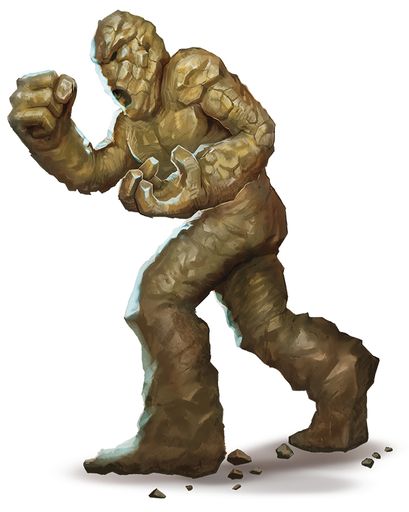
Picture: Handout: Clay Golem
Golems
Golems are made from humble materials—clay, flesh and bones, iron, or stone—but they possess astonishing power and durability. A golem has no ambitions, needs no sustenance, feels no pain, and knows no remorse. An unstoppable juggernaut, it exists to follow its creator’s orders, and it protects or attacks as that creator demands.To create a golem, one requires a manual of golems (see the Dungeon Master’s Guide). The comprehensive illustrations and instructions in a manual detail the process for creating a golem of a particular type.
Elemental Spirit in Material Form. The construction of a golem begins with the building of its body, requiring great command of the craft of sculpting, stonecutting, ironworking, or surgery. Sometimes a golem’s creator is the master of the art, but often the individual who desires a golem must enlist master artisans to do the work.
After constructing the body from clay, flesh, iron, or stone, the golem’s creator infuses it with a spirit from the Elemental Plane of Earth. This tiny spark of life has no memory, personality, or history. It is simply the impetus to move and obey. This process binds the spirit to the artificial body and subjects it to the will of the golem’s creator.
Ageless Guardians. Golems can guard sacred sites, tombs, and treasure vaults long after the deaths of their creators, carrying out their appointed tasks for all eternity while brushing off physical damage and ignoring all but the most potent spells.
A golems can be created with a special amulet or other item that allows the possessor of the item to control the golem. Golems whose creators are long dead can thus be harnessed to serve a new master.
Blind Obedience. When its creator or possessor is on hand to command it, a golem performs flawlessly. If the golem is left without instructions or is incapacitated, it continues to follow its last orders to the best of its ability. When it can’t fulfill its orders, a golem might react violently—or stand and do nothing. A golem that has been given conflicting orders sometimes alternates between them.
A golem can’t think or act for itself. Though it understands its commands perfectly, it has no grasp of language beyond that understanding, and can’t be reasoned with or tricked with words.
Constructed Nature. A golem doesn’t require air, food, drink, or sleep.
"The more rigid its physical form, the less likely the golem is to lose its sense of purpose. The clay ones can be a bit twitchy."
—Words of warning in the Manual of Clay Golems
Clay Golem
Sculpted from clay, this bulky golem stands head and shoulders taller than most human-sized creatures. It is human shaped, but its proportions are off.Clay golems are often divinely endowed with purpose by priests of great faith. However, clay is a weak vessel for life force. If the golem is damaged, the elemental spirit bound into it can break free. Such a golem runs amok, smashing everything around it until it is destroyed or completely repaired.
Traits
Acid Absorption: Whenever the golem is subjected to acid damage, it takes no damage and instead regains a number of hit points equal to the acid damage dealt.Berserk: Whenever the golem starts its turn with 60 hit points or fewer, roll a d6. On a 6, the golem goes berserk. On each of its turns while berserk, the golem attacks the nearest creature it can see. If no creature is near enough to move to and attack, the golem attacks an object, with preference for an object smaller than itself. Once the golem goes berserk, it continues to do so until it is destroyed or regains all its hit points.
Immutable Form: The golem is immune to any spell or effect that would alter its form.
Magic Resistance: The golem has advantage on saving throws against spells and other magical effects.
Magic Weapons: The golem's weapon attacks are magical.
Actions
Multiattack: The golem makes two slam attacks.Slam: Melee Weapon Attack: +8 to hit, reach 5 ft., one target. Hit: 16 (2d10 + 5) bludgeoning damage. If the target is a creature, it must succeed on a DC 15 Constitution saving throw or have its hit point maximum reduced by an amount equal to the damage taken. The target dies if this attack reduces its hit point maximum to 0. The reduction lasts until removed by the greater restoration spell or other magic.
Haste (Recharge 5-6): Until the end of its next turn, the golem magically gains a +2 bonus to its AC, has advantage on Dexterity saving throws, and can use its slam attack as a bonus action.

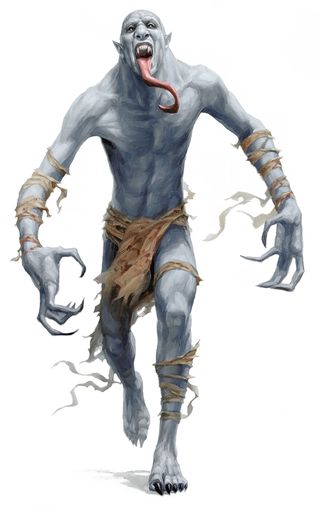
Ghouls roam the night in packs, driven by an insatiable hunger for humanoid flesh.
Devourers of Flesh. Like maggots or carrion beetles, ghouls thrive in places rank with decay and death. A ghoul haunts a place where it can gorge on dead flesh and decomposing organs. When it can’t feed on the dead, it pursues living creatures and attempts to make corpses of them. Though they gain no nourishment from the corpses they devour, ghouls are driven by an unending hunger that compels them to consume. A ghoul’s undead flesh never rots, and this monster can persist in a crypt or tomb for untold ages without feeding.
Abyssal Origins. Ghouls trace their origins to the Abyss. Doresain, the first of their kind, was an elf worshiper of Orcus. Turning against his own people, he feasted on humanoid flesh to honor the Demon Prince of Undeath. As a reward for his service, Orcus transformed Doresain into the first ghoul. Doresain served Orcus faithfully in the Abyss, creating ghouls from the demon lord’s other servants until an incursion by Yeenoghu, the demonic Gnoll Lord, robbed Doresain of his abyssal domain. When Orcus would not intervene on his behalf, Doresain turned to the elf gods for salvation, and they took pity on him and helped him escape certain destruction. Since then, elves have been immune to the ghouls’ paralytic touch.
Ghasts. Orcus sometimes infuses a ghoul with a stronger dose of abyssal energy, making a ghast. Whereas ghouls are little more than savage beasts, a ghast is cunning and can inspire a pack of ghouls to follow its commands.
Picture: Handout: Clovin Belview
Sound Mimicry. Mongrelfolk have misshapen mouths and vocal cords. They speak fragmented Common mixed with various animal cries and nonsense. They can effectively imitate sounds made by beasts and humanoids that they’ve heard. Mongrelfolk aren’t sophisticated enough to use these sounds as a covert form of communication, but they can use the sounds to lure enemies into a trap or otherwise distract them.
Outcasts. Mongrelfolk are seldom welcome in other humanoid societies, where they are abused, enslaved, or shunned. They typically live on the fringes of civilization in ruins, deserted buildings, or other places that other humanoid races once lived in or built. They tend to be timid and skittish outside their homes and fiercely territorial within their lairs.
Camouflage Experts. Mongrelfolk often hide their deformities under cloaks and cowls. In this way, they can sometimes pass as stout humans or thin dwarves. They are fond of camouflage, attaching leaves and twigs to their cloaks, making brown paint to cover their skin, and weaving grass nets under which they can hide. They use such camouflage while hunting in the wild or while standing guard outside their lairs. Until it is seen, a camouflaged mongrelfolk has advantage on Stealth checks made to hide.
Horrific Offspring. It’s possible to restore a mongrelfolk to its original form using a greater restoration spell, but the same can’t be said for a mongrelfolk’s offspring. Only mongrelfolk that are made by magic can be restored to their original forms. Mongrelfolk that are born are true mongrelfolk and not the subjects of a spell or an effect that can be undone.
Mongrelfolk can breed with other humanoids, but nearly all children born to such parents are mongrelfolk. (About one child in every hundred is born looking like its non-mongrelfolk parent.)
Mongrelfolk
Mongrelfolk are humanoids that have undergone, or whose ancestors underwent, horrific magical transformations, to the extent that they retain only a fraction of their original being. Their humanoid bodies incorporate the features of various beasts. For example, one mongrelfolk might have the basic body shape of a dwarf with a head that combines the features of a cat and a lizard, one arm that ends in a crab’s pincer, and one leg that ends in a cloven hoof. Another might have the skin and horns of a cow, the eyes of a spider, frog’s legs, and a scaly lizard’s tail. Each mongrelfolk’s mad combination of humanoid and animal forms results in its having a slow, awkward gait.Sound Mimicry. Mongrelfolk have misshapen mouths and vocal cords. They speak fragmented Common mixed with various animal cries and nonsense. They can effectively imitate sounds made by beasts and humanoids that they’ve heard. Mongrelfolk aren’t sophisticated enough to use these sounds as a covert form of communication, but they can use the sounds to lure enemies into a trap or otherwise distract them.
Outcasts. Mongrelfolk are seldom welcome in other humanoid societies, where they are abused, enslaved, or shunned. They typically live on the fringes of civilization in ruins, deserted buildings, or other places that other humanoid races once lived in or built. They tend to be timid and skittish outside their homes and fiercely territorial within their lairs.
Camouflage Experts. Mongrelfolk often hide their deformities under cloaks and cowls. In this way, they can sometimes pass as stout humans or thin dwarves. They are fond of camouflage, attaching leaves and twigs to their cloaks, making brown paint to cover their skin, and weaving grass nets under which they can hide. They use such camouflage while hunting in the wild or while standing guard outside their lairs. Until it is seen, a camouflaged mongrelfolk has advantage on Stealth checks made to hide.
Horrific Offspring. It’s possible to restore a mongrelfolk to its original form using a greater restoration spell, but the same can’t be said for a mongrelfolk’s offspring. Only mongrelfolk that are made by magic can be restored to their original forms. Mongrelfolk that are born are true mongrelfolk and not the subjects of a spell or an effect that can be undone.
Mongrelfolk can breed with other humanoids, but nearly all children born to such parents are mongrelfolk. (About one child in every hundred is born looking like its non-mongrelfolk parent.)

Commoners include peasants, serfs, slaves, servants, pilgrims, merchants, artisans, and hermits.
Actions
Club: Melee Weapon Attack: +2 to hit, reach 5 ft., one target. Hit: 2 (1d4) bludgeoning damage.
"Makes you wonder what can be done with all those other murderer parts, doesn’t it?"
—Evangeliza Lavain, necromancer
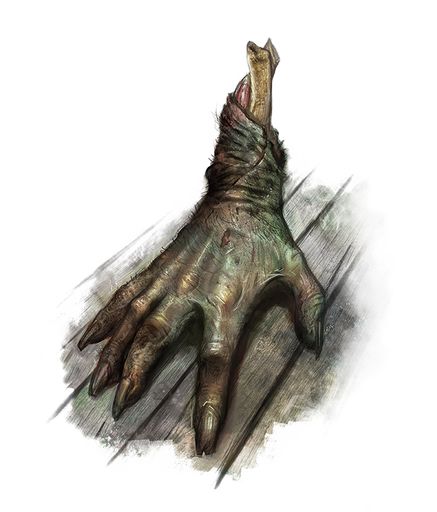
Picture: Handout: Crawling Claw
Crawling claws are the severed hands of murderers animated by dark magic so that they can go on killing. Wizards and warlocks of a dark bent use crawling claws as extra hands in their labors.
Magical Origins. Through dark necromantic rituals, the life force of a murderer is bound to its severed hand, haunting and animating it. If a dead murderer’s spirit already manifests as another undead creature, if the murderer is raised from death, or if the spirit has long passed on to another plane, the ritual fails.
The ritual invoked to create a crawling claw works best with a hand recently severed from a murderer. To this end, ritualists and their servants frequent public executions to gain possession of suitable hands, or make bargains with assassins and torturers.
Creator’s Control. A crawling claw can’t be turned, nor can it be controlled by spells that control undead. These foul monsters are entirely bound to the will of their creator, which can concentrate on a claw in sight to mentally command its every action. If the crawling claw’s creator doesn’t command it, the claw follows its last command to the best of its ability.
Commands given to a crawling claw must be simple. A claw can’t be tasked with finding and killing a particular person, because its limited senses and intelligence prevent it from tracking and picking out specific individuals. However, a command to kill all creatures in a particular locale works. A crawling claw can easily feel out the contours of keys and doorknobs, crawling from room to room on a blind killing spree.
Malign Intelligence. A crawling claw possesses little of the intellect and memories of the individual of which it was once a living part. The hate, jealousy, or greed that drove that person to murder lingers on, however, amplified by the claw’s torturous fragmented state. Left to its own devices, a crawling claw imitates and recreates the same murderous acts it committed in life. Living Claws. If a crawling claw is animated from the severed hand of a still-living murderer, the ritual binds the claw to the murderer’s soul. The disembodied hand can then return to its former limb, its undead flesh knitting to the living arm from which it was severed.
Made whole again, the murderer acts as though the hand had never been severed and the ritual had never taken place. When the crawling claw separates again, the living body falls into a coma. Destroying the crawling claw while it is away from the body kills the murderer. However, killing the murderer has no effect on the crawling claw.
Undead Nature. A crawling claw doesn’t require air, food, drink, or sleep.
Traits
Turn Immunity: The claw is immune to effects that turn undead.Actions
Claw: Melee Weapon Attack: +3 to hit, reach 5 ft., one target. Hit: 3 (1d4 + 1) bludgeoning or slashing damage, claw’s choice.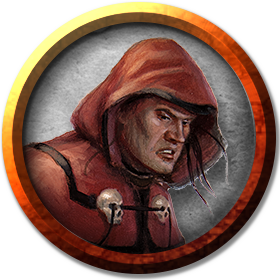
Picture: Handout: Cult Fanatic
Fanatics are often part of a cult’s leadership, using their charisma and dogma to influence and prey on those of weak will. Most are interested in personal power above all else.
Spellcasting: The fanatic is a 4th-level spellcaster. Its spell casting ability is Wisdom (spell save DC 11, +3 to hit with spell attacks). The fanatic has the following cleric spells prepared:
• Cantrips (at will): light, sacred flame, thaumaturgy
• 1st level (4 slots): command, inflict wounds, shield of faith
• 2nd level (3 slots): hold person, spiritual weapon
Dagger (Melee): Melee Weapon Attack: +4 to hit, reach 5 ft., one creature. Hit: 4 (1d4 + 2) piercing damage.
Dagger (Ranged): Ranged Weapon Attack: +4 to hit, range 20/60 ft., one creature. Hit: 4 (1d4 + 2) piercing damage.
Fanatics are often part of a cult’s leadership, using their charisma and dogma to influence and prey on those of weak will. Most are interested in personal power above all else.
Traits
Dark Devotion: The fanatic has advantage on saving throws against being charmed or frightened.Spellcasting: The fanatic is a 4th-level spellcaster. Its spell casting ability is Wisdom (spell save DC 11, +3 to hit with spell attacks). The fanatic has the following cleric spells prepared:
• Cantrips (at will): light, sacred flame, thaumaturgy
• 1st level (4 slots): command, inflict wounds, shield of faith
• 2nd level (3 slots): hold person, spiritual weapon
Actions
Multiattack: The fanatic makes two melee attacks.Dagger (Melee): Melee Weapon Attack: +4 to hit, reach 5 ft., one creature. Hit: 4 (1d4 + 2) piercing damage.
Dagger (Ranged): Ranged Weapon Attack: +4 to hit, range 20/60 ft., one creature. Hit: 4 (1d4 + 2) piercing damage.
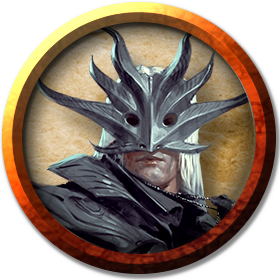
Cultists swear allegiance to dark powers such as elemental princes, demon lords, or archdevils. Most conceal their loyalties to avoid being ostracized, imprisoned, or executed for their beliefs. Unlike evil acolytes, cultists often show signs of insanity in their beliefs and practices.
Traits
Dark Devotion: The cultist has advantage on saving throws against being charmed or frightened.Actions
Scimitar: Melee Weapon Attack: +3 to hit, reach 5 ft., one creature. Hit: 4 (1d6 + 1) slashing damage.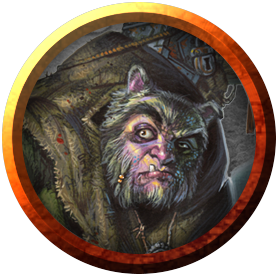
Picture: Handout: Cyrus Belview
Sound Mimicry. Mongrelfolk have misshapen mouths and vocal cords. They speak fragmented Common mixed with various animal cries and nonsense. They can effectively imitate sounds made by beasts and humanoids that they’ve heard. Mongrelfolk aren’t sophisticated enough to use these sounds as a covert form of communication, but they can use the sounds to lure enemies into a trap or otherwise distract them.
Outcasts. Mongrelfolk are seldom welcome in other humanoid societies, where they are abused, enslaved, or shunned. They typically live on the fringes of civilization in ruins, deserted buildings, or other places that other humanoid races once lived in or built. They tend to be timid and skittish outside their homes and fiercely territorial within their lairs.
Camouflage Experts. Mongrelfolk often hide their deformities under cloaks and cowls. In this way, they can sometimes pass as stout humans or thin dwarves. They are fond of camouflage, attaching leaves and twigs to their cloaks, making brown paint to cover their skin, and weaving grass nets under which they can hide. They use such camouflage while hunting in the wild or while standing guard outside their lairs. Until it is seen, a camouflaged mongrelfolk has advantage on Stealth checks made to hide.
Horrific Offspring. It’s possible to restore a mongrelfolk to its original form using a greater restoration spell, but the same can’t be said for a mongrelfolk’s offspring. Only mongrelfolk that are made by magic can be restored to their original forms. Mongrelfolk that are born are true mongrelfolk and not the subjects of a spell or an effect that can be undone.
Mongrelfolk can breed with other humanoids, but nearly all children born to such parents are mongrelfolk. (About one child in every hundred is born looking like its non-mongrelfolk parent.)
Mongrelfolk
Mongrelfolk are humanoids that have undergone, or whose ancestors underwent, horrific magical transformations, to the extent that they retain only a fraction of their original being. Their humanoid bodies incorporate the features of various beasts. For example, one mongrelfolk might have the basic body shape of a dwarf with a head that combines the features of a cat and a lizard, one arm that ends in a crab’s pincer, and one leg that ends in a cloven hoof. Another might have the skin and horns of a cow, the eyes of a spider, frog’s legs, and a scaly lizard’s tail. Each mongrelfolk’s mad combination of humanoid and animal forms results in its having a slow, awkward gait.Sound Mimicry. Mongrelfolk have misshapen mouths and vocal cords. They speak fragmented Common mixed with various animal cries and nonsense. They can effectively imitate sounds made by beasts and humanoids that they’ve heard. Mongrelfolk aren’t sophisticated enough to use these sounds as a covert form of communication, but they can use the sounds to lure enemies into a trap or otherwise distract them.
Outcasts. Mongrelfolk are seldom welcome in other humanoid societies, where they are abused, enslaved, or shunned. They typically live on the fringes of civilization in ruins, deserted buildings, or other places that other humanoid races once lived in or built. They tend to be timid and skittish outside their homes and fiercely territorial within their lairs.
Camouflage Experts. Mongrelfolk often hide their deformities under cloaks and cowls. In this way, they can sometimes pass as stout humans or thin dwarves. They are fond of camouflage, attaching leaves and twigs to their cloaks, making brown paint to cover their skin, and weaving grass nets under which they can hide. They use such camouflage while hunting in the wild or while standing guard outside their lairs. Until it is seen, a camouflaged mongrelfolk has advantage on Stealth checks made to hide.
Horrific Offspring. It’s possible to restore a mongrelfolk to its original form using a greater restoration spell, but the same can’t be said for a mongrelfolk’s offspring. Only mongrelfolk that are made by magic can be restored to their original forms. Mongrelfolk that are born are true mongrelfolk and not the subjects of a spell or an effect that can be undone.
Mongrelfolk can breed with other humanoids, but nearly all children born to such parents are mongrelfolk. (About one child in every hundred is born looking like its non-mongrelfolk parent.)
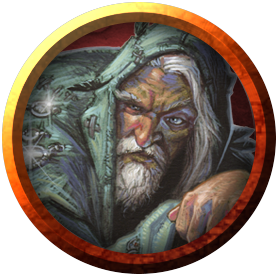
Picture: Handout: Davian Martikov
In their human and hybrid forms, wereravens favor light weapons. They are reluctant to make bite attacks in raven form for fear of spreading their curse to those who don’t deserve it or who would abuse it.
A Kindness of Wereravens. Wereravens refer to their tightly knit groups as kindnesses. A kindness of wereravens usually numbers between seven and twelve individuals. Not surprisingly, wereravens get along well with ravens and often hide in plain sight among them.
Charitable Collectors. Wereravens like to collect shiny trinkets and precious baubles. They are fond of sharing their wealth with those in need and, in their humanoid forms, modestly give money to charity. They take steps to keep magic items out of evil hands by stashing them in secret hiding places.
Characters as Wereravens. The Monster Manual has rules for characters afflicted with lycanthropy. The following text applies to wereraven characters specifically.
A character cursed with wereraven lycanthropy gains a Dexterity of 15 if his or her score isn’t already higher. Attack and damage rolls for the wereraven’s bite are based on whichever is higher of the character’s Strength and Dexterity. The bite of a wereraven in raven form deals 1 piercing damage (no ability modifier applies to this damage) and carries the curse of lycanthropy; see the Player Characters as Lycanthropes for details.
Wereraven
Wereravens are secretive and extraordinarily cautious lycanthropes that trust one another but are wary of just about everyone else. Although skilled at blending into society, they keep mostly to themselves, respect local laws, and strive to do good whenever possible.In their human and hybrid forms, wereravens favor light weapons. They are reluctant to make bite attacks in raven form for fear of spreading their curse to those who don’t deserve it or who would abuse it.
A Kindness of Wereravens. Wereravens refer to their tightly knit groups as kindnesses. A kindness of wereravens usually numbers between seven and twelve individuals. Not surprisingly, wereravens get along well with ravens and often hide in plain sight among them.
Charitable Collectors. Wereravens like to collect shiny trinkets and precious baubles. They are fond of sharing their wealth with those in need and, in their humanoid forms, modestly give money to charity. They take steps to keep magic items out of evil hands by stashing them in secret hiding places.
Characters as Wereravens. The Monster Manual has rules for characters afflicted with lycanthropy. The following text applies to wereraven characters specifically.
A character cursed with wereraven lycanthropy gains a Dexterity of 15 if his or her score isn’t already higher. Attack and damage rolls for the wereraven’s bite are based on whichever is higher of the character’s Strength and Dexterity. The bite of a wereraven in raven form deals 1 piercing damage (no ability modifier applies to this damage) and carries the curse of lycanthropy; see the Player Characters as Lycanthropes for details.
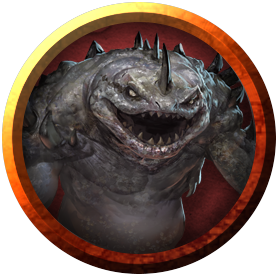
Embedded in a slaad’s brain is a magic gem. Acquire it, and the slaad is yours to command.
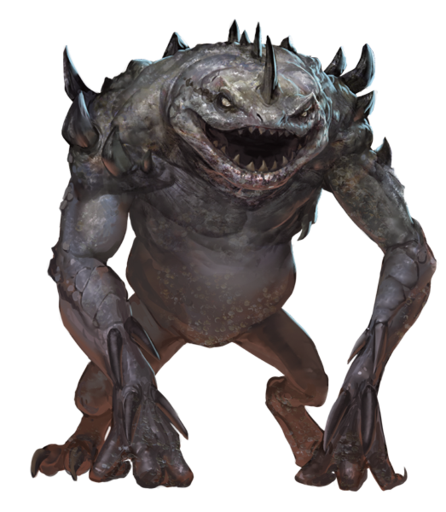
Slaadi
In the Ever-Changing Chaos of Limbo, bits of forest and meadow, ruined castles, and isolated islands drift through a tumult of fire, water, earth, and wind. The foremost inhabitants of this inhospitable plane are the toad-like slaadi. Slaadi are undisciplined and have no formal hierarchy, although weaker slaadi obey stronger ones under threat of annihilation.The Spawning Stone. Long ago, Primus, overlord of the modrons, created a gigantic, geometrically complex stone imbued with the power of law. He then cast it adrift in Limbo, believing that the stone would bring order to the chaos of that plane and halt the spread of chaos to other planes. As the stone’s power grew, it became possible for creatures with ordered minds, such as modrons and githzerai, to create enclaves in Limbo. However, Primus’s creation had an unforeseen side effect: the chaotic energy absorbed by the stone spawned the horrors that came to be known as slaadi. Sages refer to Primus’s massive creation as the Spawning Stone for this reason.
The slaadi wiped out every last modron enclave in Limbo. As creatures of utter chaos, slaadi loathe modrons and attack them on sight. Nonetheless, Primus stands by his creation and either doesn’t perceive the slaadi as threats or chooses to ignore them.
Birth and Transformation. Slaadi have horrific cycles of reproduction. Slaadi reproduce either by implanting humanoid hosts with eggs or by infecting them with a transformative disease called chaos phage. Each color of slaad reproduces or transforms in a different way, with red slaadi spawning blue and green slaadi, and blue slaadi spawning red and green. Each green slaad undergoes a lifelong cycle of transformation into the more powerful gray and death slaadi. With each transformation, the slaad retains its memories.
Shapechangers. Some slaadi can transform into the humanoid creatures from which they were originally spawned. These slaadi return to the Material Plane to sow discord in the guise of their former selves.
Death Slaad
Death slaadi are suffused with energy from the Negative Energy Plane and exemplify evil’s corruption of chaos, and they take sadistic pleasure in bringing harm to others. They propagate their race by dragooning mobs of red and blue slaadi and invading other planes. Humanoids who survive the incursion become incubators for new slaadi.Variant: Slaad Control Gems
As a slaad emerges from the Spawning Stone, the stone magically implants a fragment of itself in the slaad’s brain. This fragment takes the form of a magic gem roughly the size and shape of a human child’s fist. The gem is the same color as the slaad. Another creature can use magic to draw forth a slaad’s gem and use it to subjugate the slaad. The slaad must obey whoever possesses its gem. If a slaad’s gem is destroyed, the slaad can no longer be controlled in this way.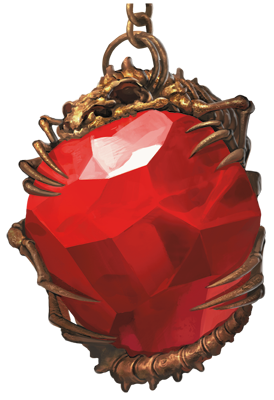 A slaad born from something other than the Spawning Stone has no gem in its brain, but it gains one if it ever comes into contact with the Spawning Stone. Slaadi on Limbo are attracted to the Spawning Stone, so most end up with a gem. A slaad with a control gem in its brain has the following additional trait.
Control Gem: Implanted in the slaad’s brain is a magic control gem. The slaad must obey whoever possesses the gem and is immune to being charmed while so controlled.
Certain spells can be used to acquire the gem. If the slaad fails its saving throw against imprisonment, the spell can transfer the gem to the spellcaster’s open hand, instead of imprisoning the slaad. A wish spell, if cast in the slaad’s presence, can be worded to acquire the gem.
A greater restoration spell cast on the slaad destroys the gem without harming the slaad.
Someone who is proficient in Wisdom (Medicine) can remove the gem from an incapacitated slaad. Each try requires 1 minute of uninterrupted work and a successful DC 20 Wisdom (Medicine) check. Each failed attempt deals 22 (4d10) psychic damage to the slaad.
Traits
Shapechanger: The slaad can use its action to polymorph into a Small or Medium humanoid, or back into its true form. Its statistics, other than its size, are the same in each form. Any equipment it is wearing or carrying isn’t transformed. It reverts to its true form if it dies.Innate Spellcasting: The slaad’s innate spellcasting ability is Charisma (spell save DC 15, +7 to hit with spell attacks). The slaad can innately cast the following spells, requiring no material components:
• At will: detect magic, detect thoughts, invisibility (self only), mage hand, major image
• 2/day each: fear, fireball, fly, tongues
• 1/day each: cloudkill, plane shift
Magic Resistance: The slaad has advantage on saving throws against spells and other magical effects.
Regeneration: The slaad regains 10 hit points at the start of its turn if it has at least 1 hit point.
Actions
Multiattack: The slaad makes three attacks: one with its bite and two with its claws or greatsword.Bite (Slaad Form Only): Melee Weapon Attack: +9 to hit, reach 5 ft., one target. Hit: 9 (1d8 + 5) piercing damage plus 7 (2d6) necrotic damage.
Claws (Slaad Form Only): Melee Weapon Attack: +9 to hit, reach 5 ft., one target. Hit: 10 (1d10 + 5) slashing damage plus 7 (2d6) necrotic damage.
Greatsword: Melee Weapon Attack: +9 to hit, reach 5 ft., one target. Hit: 12 (2d6 + 5) slashing damage plus 7 (2d6) necrotic damage.
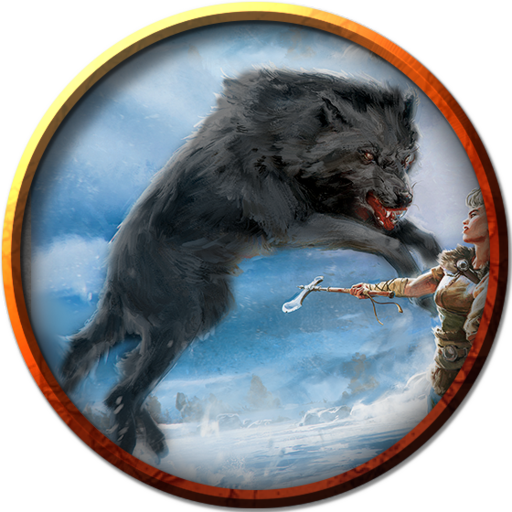
Traits
Keen Hearing and Smell: The wolf has advantage on Wisdom (Perception) checks that rely on hearing or smell.Pack Tactics: The wolf has advantage on an attack roll against a creature if at least one of the wolf's allies is within 5 ft. of the creature and the ally isn't incapacitated.
Actions
Bite: Melee Weapon Attack: +5 to hit, reach 5 ft., one target. Hit: 10 (2d6 + 3) piercing damage. If the target is a creature, it must succeed on a DC 13 Strength saving throw or be knocked prone.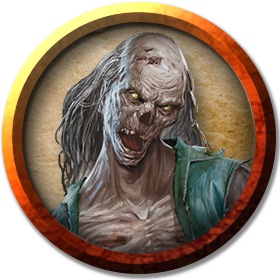
(no bio)
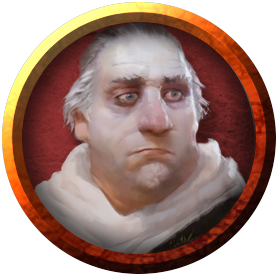
Picture: Handout: Donavich
In the village of Barovia's church, Donavich has been praying throughout the night. His voice is hoarse and weak. He is, in a word, insane. A little more than a year ago, his twenty-year-old son Doru and several other villagers stormed Castle Ravenloft in revolt, having been lured there by a wizard in black robes who came to Barovia from a faraway land (see Areas of Barovia, area M, for more information on the wizard). By all accounts, the wizard died by Strahd’s hand, and so too did Doru, who returned to his father as a vampire spawn. Donavich was able to trap his son in the church’s undercroft, where he remains to this day.
In the village of Barovia's church, Donavich has been praying throughout the night. His voice is hoarse and weak. He is, in a word, insane. A little more than a year ago, his twenty-year-old son Doru and several other villagers stormed Castle Ravenloft in revolt, having been lured there by a wizard in black robes who came to Barovia from a faraway land (see Areas of Barovia, area M, for more information on the wizard). By all accounts, the wizard died by Strahd’s hand, and so too did Doru, who returned to his father as a vampire spawn. Donavich was able to trap his son in the church’s undercroft, where he remains to this day.
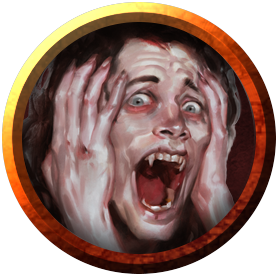
"I am The Ancient, I am The Land. My beginnings are lost in the darkness of the past. I was the warrior, I was good and just. I thundered across the land like the wrath of a just god, but the war years and the killing years wore down my soul as the wind wears down stone into sand."
—Count Strahd von Zarovich
Picture: Handout: Doru
Vampires
Awakened to an endless night, vampires hunger for the life they have lost and sate that hunger by drinking the blood of the living. Vampires abhor sunlight, for its touch burns them. They never cast shadows or reflections, and any vampire wishing to move unnoticed among the living keeps to the darkness and far from reflective surfaces.Dark Desires. Whether or not a vampire retains any memories from its former life, its emotional attachments wither as once-pure feelings become twisted by undeath. Love turns into hungry obsession, while friendship becomes bitter jealousy. In place of emotion, vampires pursue physical symbols of what they crave, so that a vampire seeking love might fixate on a young beauty. A child might become an object of fascination for a vampire obsessed with youth and potential. Others surround themselves with art, books, or sinister items such as torture devices or trophies from creatures they have killed.
Born from Death. Most of a vampire’s victims become vampire spawn—ravenous creatures with a vampire’s hunger for blood, but under the control of the vampire that created them. If a true vampire allows a spawn to draw blood from its own body, the spawn transforms into a true vampire no longer under its master’s control. Few vampires are willing to relinquish their control in this manner. Vampire spawn become free-willed when their creator dies.
Chained to the Grave. Every vampire remains bound to its coffin, crypt, or grave site, where it must rest by day. If a vampire didn’t receive a formal burial, it must lie beneath a foot of earth at the place of its transition to undeath. A vampire can move its place of burial by transporting its coffin or a significant amount of grave dirt to another location. Some vampires set up multiple resting places this way.
Undead Nature. Neither a vampire nor a vampire spawn requires air.
Traits
Regeneration: The vampire regains 10 hit points at the start of its turn if it has at least 1 hit point and isn't in sunlight or running water. If the vampire takes radiant damage or damage from holy water, this trait doesn't function at the start of the vampire's next turn.Spider Climb: The vampire can climb difficult surfaces, including upside down on ceilings, without needing to make an ability check.
Vampire Weaknesses: The vampire has the following flaws:
• Forbiddance. The vampire can't enter a residence without an invitation from one of the occupants.
• Harmed by Running Water. The vampire takes 20 acid damage when it ends its turn in running water.
• Stake to the Heart. The vampire is destroyed if a piercing weapon made of wood is driven into its heart while it is incapacitated in its resting place.
• Sunlight Hypersensitivity. The vampire takes 20 radiant damage when it starts its turn in sunlight. While in sunlight, it has disadvantage on attack rolls and ability checks.
Actions
Multiattack: The vampire makes two attacks, only one of which can be a bite attack.Claws: Melee Weapon Attack: +6 to hit, reach 5 ft., one creature. Hit: 8 (2d4 + 3) slashing damage. Instead of dealing damage, the vampire can grapple the target, escape DC 13.
Bite: Melee Weapon Attack: +6 to hit, reach 5 ft., one willing creature, or a creature that is grappled by the vampire, incapacitated, or restrained. Hit: 6 (1d6 + 3) piercing damage plus 7 (2d6) necrotic damage. The target's hit point maximum is reduced by an amount equal to the necrotic damage taken, and the vampire regains hit points equal to that amount. The reduction lasts until the target finishes a long rest. The target dies if this effect reduces its hit point maximum to 0.
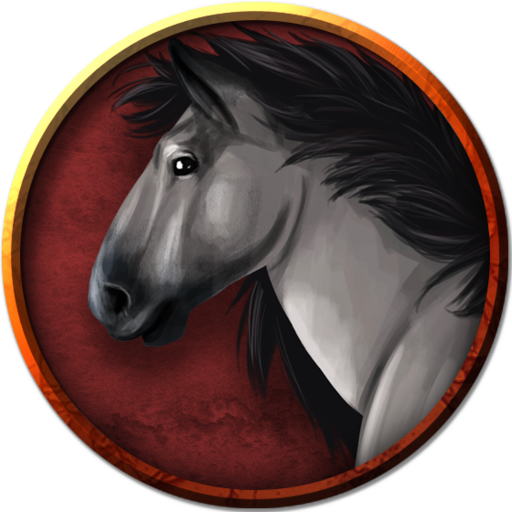
Actions
Hooves: Melee Weapon Attack: +6 to hit, reach 5 ft., one target. Hit: 9 (2d4 + 4) bludgeoning damage.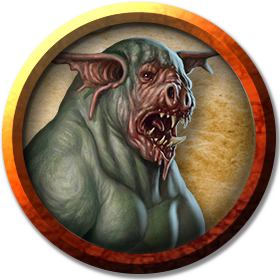
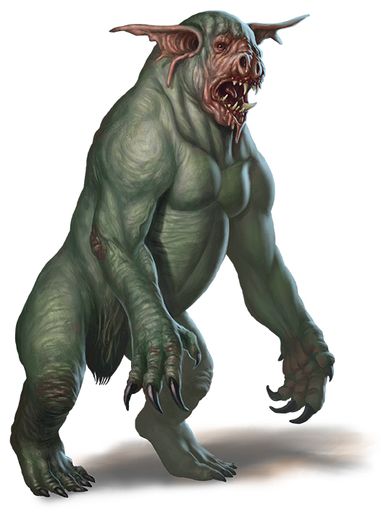
Picture: Handout: Dretch
Demons
Spawned in the Infinite Layers of the Abyss, demons are the embodiment of chaos and evil—engines of destruction barely contained in monstrous form. Possessing no compassion, empathy, or mercy, they exist only to destroy.Spawn of Chaos. The Abyss creates demons as extensions of itself, spontaneously forming fiends out of filth and carnage. Some are unique monstrosities, while others represent uniform strains virtually identical to each other. Other demons (such as manes) are created from mortal souls shunned or cursed by the gods, or which are otherwise trapped in the Abyss.
 Capricious Elevation. Demons respect power and power alone. A greater demon commands shrieking mobs of lesser demons because it can destroy any lesser demon that dares to refuse its commands. A demon’s status grows with the blood it spills; the more enemies that fall before it, the greater it becomes.
A demon might spawn as a manes, then become a dretch, and eventually transform to a vrock after untold time spent fighting and surviving in the Abyss. Such elevations are rare, however, for most demons are destroyed before they attain significant power. The greatest of those that do survive make up the ranks of the demon lords that threaten to tear the Abyss apart with their endless warring.
By expending considerable magical power, demon lords can raise lesser demons into greater forms, though such promotions never stem from a demon’s deeds or accomplishments. Rather, a demon lord might warp a manes into a quasit when it needs an invisible spy, or turn an army of dretches into hezrous when marching against a rival lord. Demon lords only rarely elevate demons to the highest ranks, fearful of inadvertently creating rivals to their own power.
Abyssal Invasions. Wherever they wander across the Abyss, demons search for portals to the other planes. They crave the chance to slip free of their native realm and spread their dark influence across the multiverse, undoing the works of the gods, tearing down civilizations, and reducing the cosmos to despair and ruin.
Some of the darkest legends of the mortal realm are built around the destruction wrought by demons set loose in the world. As such, even nations embroiled in bitter conflict will set their differences aside to help contain an outbreak of demons, or to seal off abyssal breaches before these fiends can break free.
Signs of Corruption. Demons carry the stain of abyssal corruption with them, and their mere presence changes the world for the worse. Plants wither and die in areas where abyssal breaches and demons appear. Animals shun the sites where a demon has made a kill. The site of a demonic infestation might be fouled by a stench that never abates, by areas of bitter cold or burning heat, or by permanent shadows that mark the places where these fiends lingered.
Eternal Evil. Outside the Abyss, death is a minor nuisance that no demon fears. Mundane weapons can’t stop these fiends, and many demons are resistant to the energy of the most potent spells. When a lucky hero manages to drop a demon in combat, the fiend dissolves into foul ichor. It then instantly reforms in the Abyss, its mind and essence intact even as its hatred is inflamed. The only way to truly destroy a demon is to seek it in the Abyss and kill it there.
Protected Essence. A powerful demon can take steps to safeguard its life essence, using secret methods and abyssal metals to create an amulet into which part of that essence is ceded. If the demon’s abyssal form is ever destroyed, the amulet allows the fiend to reform at a time and place of its choosing.
Obtaining a demonic amulet is a dangerous enterprise, and simply seeking such a device risks drawing the attention of the demon that created it. A creature possessing a demonic amulet can exact favors from the demon whose life essence the amulet holds—or inflict great pain if the fiend resists. If an amulet is destroyed, the demon that created it is trapped in the Abyss for a year and a day.
Demonic Cults. Despite the dark risks involved in dealing with fiends, the mortal realm is filled with creatures that covet demonic power. Demon lords manipulate these mortal servants into performing ever greater acts of depravity, furthering the demon lord’s ambitions in exchange for magic and other boons. However, a demon regards any mortals in its service as tools to use and then discard at its whim, consigning their mortal souls to the Abyss.
Demon Summoning. Few acts are as dangerous as summoning a demon, and even mages who bargain freely with devils fear the fiends of the Abyss. Though demons yearn to sow chaos on the Material Plane, they show no gratitude when brought there, raging against their prisons and demanding release.
Those who would risk summoning a demon might do so to wrest information from it, press it into service, or send it on a mission that only a creature of absolute evil can complete. Preparation is key, and experienced summoners know the specific spells and magic items that can force a demon to bend to another’s will. If a single mistake is made, a demon that breaks free shows no mercy as it makes its summoner the first victim of its wrath.
Bound Demons. The Book of Vile Darkness, the Black Scrolls of Ahm, and the Demonomicon of Iggwilv are the foremost authorities on demonic matters. These ancient tomes describe techniques that can trap the essence of a demon on the Material Plane, placing it within a weapon, idol, or piece of jewelry and preventing the fiend’s return to the Abyss.
An object that binds a demon must be specially prepared with unholy incantations and innocent blood. It radiates a palpable evil, chilling and fouling the air around it. A creature that handles such an object experiences unsettling dreams and wicked impulses, but is able to control the demon whose essence is trapped within the object. Destroying the object frees the demon, which immediately seeks revenge against its binder.
Demonic Possession. No matter how secure its bindings, a powerful demon often finds a way to escape an object that holds it. When a demonic essence emerges from its container, it can possess a mortal host. Sometimes a fiend employs stealth to hide a successful possession. Other times, it unleashes the full brunt of its fiendish drives through its new form.
As long as the demon remains in possession of its host, the soul of that host is in danger of being dragged to the Abyss with the demon if it is exorcised from the flesh, or if the host dies. If a demon possesses a creature and the object binding the demon is destroyed, the possession lasts until powerful magic is used to drive the demonic spirit out of its host.
Demon True Names
Though demons all have common names, every demon lord and every demon of type 1 through 6 has a true name that it keeps secret. A demon can be forced to disclose its true name if charmed, and ancient scrolls and tomes are said to exist that list the true names of the most powerful demons.A mortal who learns a demon’s true name can use powerful summoning magic to call the demon from the Abyss and exercise some measure of control over it. However, most demons brought to the Material Plane in this manner do everything in their power to wreak havoc or sow discord and strife.
Demon Lords
The chaotic power of the Abyss rewards demons of particular ruthlessness and ingenuity with a dark blessing, transforming them into unique fiends whose power can rival the gods. These demon lords rule through cunning or brute force, hoping to one day claim the prize of absolute control over all the Abyss.Reward for Outsiders. Although most demon lords rise up from the vast and uncountable mobs of demons rampaging across the Abyss, the plane also rewards outsiders that conquer any of its infinite layers. The elven goddess Lolth became a demon lord after Corellon Larethian cast her into the Abyss for betraying elvenkind. Sages claim that the Dark Prince Graz’zt originated on some other plane before stealing his abyssal title from another long-forgotten demon lord.
Power and Control. The greatest sign of a demon lord’s power is its ability to reshape an abyssal realm. A layer of the Abyss controlled by a demon lord becomes a twisted reflection of that fiend’s vile personality, and demon lords seldom leave their realms for fear of allowing another creature to reshape and seize it.
As with other demons, a demon lord that dies on another plane has its essence return to the Abyss, where it reforms into a new body. Likewise, a demon lord that dies in the Abyss is permanently destroyed. Most demon lords keep a portion of their essence safely stored away to prevent such a fate.
Baphomet
The demon lord Baphomet, also known as the Horned King and the Prince of Beasts, rules over minotaurs and other savage creatures. If he had his way, civilization would crumble and all races would embrace their base animal savagery.The Prince of Beasts appears as a huge, black-furred minotaur with iron horns, red eyes, and a blood-soaked mouth. His iron crown is topped with the rotting heads of his enemies, while his dark armor is set with spikes and skull-like serrations. He carries a huge glaive named Heartcleaver, but often hurls it into the fray so as to face his enemies with horns and hooves.
Demogorgon
The Sibilant Beast and the self-styled Prince of Demons, Demogorgon yearns for nothing less than undoing the order of the multiverse. An insane assemblage of features and drives, the Prince of Demons inspires fear and hatred among other demons and demon lords.Demogorgon towers three times the height of a human, his body as sinuous as a snake’s and as powerful as a great ape’s. Suckered tentacles take the place of his arms. His saurian lower torso ends in webbed and clawed feet, and a forked tail whose whip-like tips are armed with cruel blades. The Prince of Demons has two baleful baboon heads, both of them mad. It is only the conflict between the two halves of his dual nature that keeps the demon lord’s ambitions in check.
Graz’zt
The demon lord Graz’zt appears as a darkly handsome figure nearly nine feet tall. Those who refer to the Dark Prince as the most humanoid of the demon lords vastly underestimate the capacity for evil in his scheming heart.Graz’zt is a striking physical specimen, whose demonic nature shows in his ebon skin, pointed ears, yellow fangs, crown of horns, and six-fingered hands. He delights in finery, pageantry, and sating his decadent desires with subjects and consorts alike, among whom incubi and succubi are often his favorites.
Juiblex
The demon lord of slimes and oozes, Juiblex is a stew of noxious fluids that lurks in the abyssal depths. The wretched Faceless Lord cares nothing for cultists or mortal servants, and its sole desire is to turn all creatures into formless copies of its horrid self.In its resting state, Juiblex spreads out in a noxious mass, bubbling and filling the air with a profound stench. On the rare occasions when creatures confront the demon lord, Juiblex draws itself up into a shuddering cone of slime striated with veins of black and green. Baleful red eyes swim within its gelatinous body, while dripping pseudopods of ooze lash out hungrily at any creature they can reach.
Lolth
The Demon Queen of Spiders is the evil matron of the drow. Her every thought is touched by malice, and the depth of her viciousness can surprise even her most faithful priestesses. She directs her faithful while she weaves plots across the worlds of the Material Plane, looking forward to the time when her drow followers bring those worlds under her control.Lolth appears as a lithe, imperious drow matriarch when she manifests to her followers in the mortal realm, which she does with unusual frequency. When battle breaks out—or if she has a reason to remind her followers to fear her—Lolth’s lower body transforms into that of a huge demonic spider, whose spike-tipped legs and mandibles tear foes apart.
Orcus
Known as the Demon Prince of Undeath and the Blood Lord, the demon lord Orcus is worshiped by the undead and by living creatures that channel the power of undeath. A brooding and nihilistic entity, Orcus yearns to make the multiverse a place of death and darkness, forever unchanging except by his will.The Demon Prince of Undeath is a foul and corpulent creature, with a humanoid torso, powerful goat legs, and the desiccated head of a ram. His sore-ridden body stinks of disease, but his decaying head and glowing red eyes are as a creature already dead. Great black bat wings sprout from his back, stirring reeking air as he moves.
Orcus wields a malevolent artifact known as the Wand of Orcus, a mace-like rod of obsidian topped by a humanoid skull. He surrounds himself with undead, and living creatures not under his control are anathema to him.
Yeenoghu
Known as the Gnoll Lord and the Beast of Butchery, the demon lord Yeenoghu hungers for slaughter and senseless destruction. Gnolls are his mortal instruments, and he drives them to ever-greater atrocities in his name. Delighting in sorrow and hopelessness, the Gnoll Lord yearns to turn the world into a wasteland in which the last surviving gnolls tear each other apart for the right to feast upon the dead.Yeenoghu appears as a huge, scarred gnoll with a spiky crest of black spines, and eyes that burn with emerald flame. His armor is a patchwork of shields and breastplates claimed from fallen foes, and decorated by those foes’ flayed skins. Yeenoghu can summon a triple flail he calls the Butcher, which he wields to deadly effect or wills to fly independently into battle as he tears foes apart with teeth and claws.
Other Demon Lords
No one knows the full number of demon lords that rage in the Abyss. Given the infinite depths of that plane, powerful demons constantly rise to become demon lords, then fall almost as quickly. Among the demon lords whose power has endured long enough for demonologists to name them are Fraz-Urb’luu, the Prince of Deception; Kostchtchie, the Prince of Wrath; Pazuzu, Prince of the Lower Aerial Kingdoms; and Zuggtmoy, Lady of Fungi.Dretch
Dretches are among the weakest of demons—repulsive, self-loathing creatures doomed to spend eternity in a state of perpetual discontent. Their low intelligence makes dretches unsuitable for anything but the simplest tasks. However, what they lack in potential, they make up for in sheer malice. Dretches mill about in mobs, voicing their displeasure as an unsettling din of hoots, snarls, and grunts.Demon Types
Demonologists organize the chaotic distribution of demons into broad categories of power known as types. Most demons fit into one of six major types, with the weakest categorized as Type 1 and the strongest as Type 6. Demons outside the six main types are categorized as minor demons and demon lords.Demons by Type
| Type | Examples |
| 1 | barlgura, shadow demon, vrock |
| 2 | chasme, hezrou |
| 3 | glabrezu, yochlol |
| 4 | nalfeshnee |
| 5 | marilith |
| 6 | balor, goristro |
Actions
Multiattack: The dretch makes two attacks: one with its bite and one with its claws.Bite: Melee Weapon Attack: +2 to hit, reach 5 ft., one target. Hit: 3 (1d6) piercing damage.
Claws: Melee Weapon Attack: +2 to hit, reach 5 ft., one target. Hit: 5 (2d4) slashing damage.
Fetid Cloud (1/Day): A 10-foot radius of disgusting green gas extends out from the dretch. The gas spreads around corners, and its area is lightly obscured. It lasts for 1 minute or until a strong wind disperses it. Any creature that starts its turn in that area must succeed on a DC 11 Constitution saving throw or be poisoned until the start of its next turn. While poisoned in this way, the target can take either an action or a bonus action on its turn, not both, and can't take reactions.
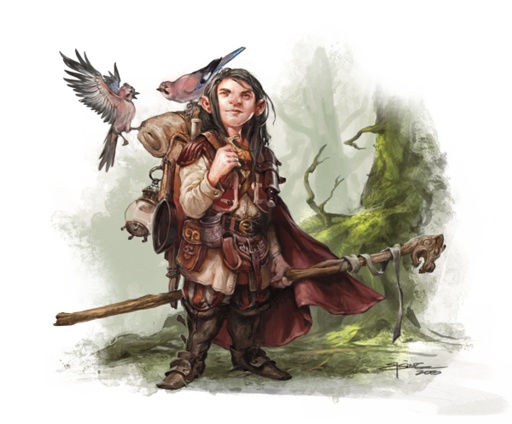
Druids dwell in forests and other secluded wilderness locations, where they protect the natural world from monsters and the encroachment of civilization. Some are tribal shamans who heal the sick, pray to animal spirits, and provide spiritual guidance.
Traits
Spellcasting: The druid is a 4th-level spellcaster. Its spellcasting ability is Wisdom (spell save DC 12, +4 to hit with spell attacks). It has the following druid spells prepared:• Cantrips (at will): druidcraft, produce flame, shillelagh
• 1st level (4 slots): entangle, longstrider, speak with animals, thunderwave
• 2nd level (3 slots): animal messenger, barkskin
Actions
Quarterstaff (One-Handed): Melee Weapon Attack: +2 to hit, reach 5 ft., one target. Hit: 3 (1d6) bludgeoning damage.Quarterstaff (Two-Handed): Melee Weapon Attack: +2 to hit, reach 5 ft., one target. Hit: 4 (1d8) bludgeoning damage.
Quarterstaff (with Shillelagh): Melee Weapon Attack: +4 to hit, reach 5 ft., one target. Hit: 6 (1d8 + 2) bludgeoning damage.
Produce Flame: Ranged Spell Attack: +4 to hit, range 30 ft., one creature. Hit: 4 (1d8) fire damage.
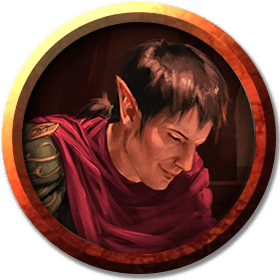
The dusk elf race is all but forgotten, and the few survivors live in secret places such as this. They have dark skin and hair, but otherwise they are similar to wood elves (as described in the Player’s Handbook). One of Strahd’s old brides, Patrina Velikovna, used to live here. Her brother, Kasimir Velikov, still does.
The dusk elves reside in small homes built into the hillside and are mostly self-sufficient. They are skilled trackers, and many of them are away from camp when the characters arrive, helping the Vistani search for Arabelle. Strahd has tasked the Vistani with keeping an eye on the dusk elves, and the dusk elves know they aren’t safe in Barovia without the Vistani’s “protection.” Strahd has also forbidden the Vistani from helping the dusk elves escape his domain.
There are no women or children among the dusk elves. Strahd had all the female dusk elves put to death around four centuries ago as a punishment for Patrina’s murder. Thus, the remaining elves can’t procreate. A broken people, they are aware of the vampire’s absolute hold over the land of Barovia. They keep a low profile and have no desire to incur Strahd’s wrath again.
The dusk elves reside in small homes built into the hillside and are mostly self-sufficient. They are skilled trackers, and many of them are away from camp when the characters arrive, helping the Vistani search for Arabelle. Strahd has tasked the Vistani with keeping an eye on the dusk elves, and the dusk elves know they aren’t safe in Barovia without the Vistani’s “protection.” Strahd has also forbidden the Vistani from helping the dusk elves escape his domain.
There are no women or children among the dusk elves. Strahd had all the female dusk elves put to death around four centuries ago as a punishment for Patrina’s murder. Thus, the remaining elves can’t procreate. A broken people, they are aware of the vampire’s absolute hold over the land of Barovia. They keep a low profile and have no desire to incur Strahd’s wrath again.

"The Company of the Black Moon—they used to be adventurers loyal to the realm. Now they roam the woods as a pack of werewolves. The king has promised estates, titles, and gold to anyone who can undo the curse afflicting them. I, for one, have no interest in such rewards."
—Thornstaff, elf druid
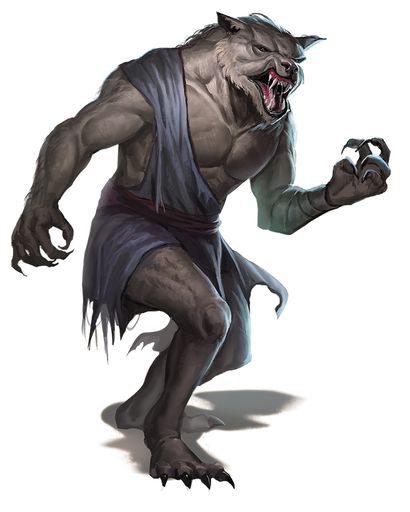
Picture: Handout: Emil Toranescu
Lycanthropes
One of the most ancient and feared of all curses, lycanthropy can transform the most civilized humanoid into a ravening beast. In its natural humanoid form, a creature cursed by lycanthropy appears as its normal self. Over time, however, many lycanthropes acquire features suggestive of their animal form. In that animal form, a lycanthrope resembles a powerful version of a normal animal. On close inspection, its eyes show a faint spark of unnatural intelligence and might glow red in the dark.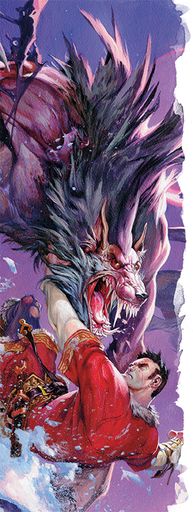 Evil lycanthropes hide among normal folk, emerging in animal form at night to spread terror and bloodshed, especially under a full moon. Good lycanthropes are reclusive and uncomfortable around other civilized creatures, often living alone in wilderness areas far from villages and towns.
Curse of Lycanthropy. A humanoid creature can be afflicted with the curse of lycanthropy after being wounded by a lycanthrope, or if one or both of its parents are lycanthropes. A remove curse spell can rid an afflicted lycanthrope of the curse, but a natural born lycanthrope can be freed of the curse only with a wish.
A lycanthrope can either resist its curse or embrace it. By resisting the curse, a lycanthrope retains its normal alignment and personality while in humanoid form. It lives its life as it always has, burying deep the bestial urges raging inside it. However, when the full moon rises, the curse becomes too strong to resist, transforming the individual into its beast form—or into a horrible hybrid form that combines animal and humanoid traits. When the moon wanes, the beast within can be controlled once again. Especially if the cursed creature is unaware of its condition, it might not remember the events of its transformation, though those memories often haunt a lycanthrope as bloody dreams.
Some individuals see little point in fighting the curse and accept what they are. With time and experience, they learn to master their shapechanging ability and can assume beast form or hybrid form at will. Most lycanthropes that embrace their bestial natures succumb to bloodlust, becoming evil, opportunistic creatures that prey on the weak.
Werewolf
A werewolf is a savage predator. In its humanoid form, a werewolf has heightened senses, a fiery temper, and a tendency to eat rare meat. Its wolf form is a fearsome predator, but its hybrid form is more terrifying by far—a furred and well-muscled humanoid body topped by a ravening wolf’s head. A werewolf can wield weapons in hybrid form, though it prefers to tear foes apart with its powerful claws and bite.Most werewolves flee civilized lands not long after becoming afflicted. Those that reject the curse fear what will happen if they remain among their friends and family. Those that embrace the curse fear discovery and the consequences of their murderous acts. In the wild, werewolves form packs that also include wolves and dire wolves.
Variant: Nonhuman Lycanthropes
The statistics presented in this section assume a base creature of human. However, you can also use the statistics to represent nonhuman lycanthropes, adding verisimilitude by allowing a nonhuman lycanthrope to retain one or more of its humanoid racial traits. For example, an elf werewolf might have the Fey Ancestry trait.Player Characters as Lycanthropes
A character who becomes a lycanthrope retains his or her statistics except as specified by lycanthrope type. The character gains the lycanthrope’s speeds in nonhumanoid form, damage immunities, traits, and actions that don’t involve equipment. The character is proficient with the lycanthrope’s natural attacks, such as its bite or claws, which deal damage as shown in the lycanthrope’s statistics. The character can’t speak while in animal form.A humanoid hit by an attack that carries the curse of lycanthropy must succeed on a Constitution saving throw (DC 8 + the lycanthrope’s proficiency bonus + the lycanthrope’s Constitution modifier) or be cursed. If the character embraces the curse, his or her alignment becomes the one defined for the lycanthrope. The DM is free to decide that a change in alignment places the character under DM control until the curse of lycanthropy is removed.
The following information applies to specific lycanthropes.
Werebear. The character gains a Strength of 19 if his or her score isn’t already higher, and a +1 bonus to AC while in bear or hybrid form (from natural armor). Attack and damage rolls for the natural weapons are based on Strength.
Wereboar. The character gains a Strength of 17 if his or her score isn’t already higher, and a +1 bonus to AC while in boar or hybrid form (from natural armor). Attack and damage rolls for the tusks are based on Strength. For the Charge trait, the DC is 8 + the character’s proficiency bonus + Strength modifier.
Wererat. The character gains a Dexterity of 15 if his or her score isn’t already higher. Attack and damage rolls for the bite are based on whichever is higher of the character’s Strength and Dexterity.
Weretiger. The character gains a Strength of 17 if his or her score isn’t already higher. Attack and damage rolls for the natural weapons are based on Strength. For the Pounce trait, the DC is 8 + the character’s proficiency bonus + Strength modifier.
Werewolf. The character gains a Strength of 15 if his or her score isn’t already higher, and a +1 bonus to AC while in wolf or hybrid form (from natural armor). Attack and damage rolls for the natural weapons are based on Strength.
Traits
Shapechanger: The werewolf can use its action to polymorph into a wolf-humanoid hybrid or into a wolf, or back into its true form, which is humanoid. Its statistics, other than its AC, are the same in each form. Any equipment it is wearing or carrying isn't transformed. It reverts to its true form if it dies.Keen Hearing and Smell: The werewolf has advantage on Wisdom (Perception) checks that rely on hearing or smell.
Actions
Multiattack (Humanoid or Hybrid Form Only): The werewolf makes two attacks: one with its bite and one with its claws or spear.Bite (Wolf or Hybrid Form Only): Melee Weapon Attack: +4 to hit, reach 5 ft., one target. Hit: 6 (1d8 + 2) piercing damage. If the target is a humanoid, it must succeed on a DC 12 Constitution saving throw or be cursed with werewolf lycanthropy.
Claws (Hybrid Form Only): Melee Weapon Attack: +4 to hit, reach 5 ft., one creature. Hit: 7 (2d4 + 2) slashing damage.
Spear (Humanoid Form Only; Melee; One-Handed): Melee Weapon Attack: +4 to hit, reach 5 ft., one creature. Hit: 5 (1d6 + 2) piercing damage.
Spear (Humanoid Form Only; Melee; Two-Handed): Melee Weapon Attack: +4 to hit, reach 5 ft., one creature. Hit: 6 (1d8 + 2) piercing damage.
Spear (Humanoid Form Only; Ranged): Ranged Weapon Attack: +4 to hit, range 20/60 ft., one creature. Hit: 5 (1d6 + 2) piercing damage.
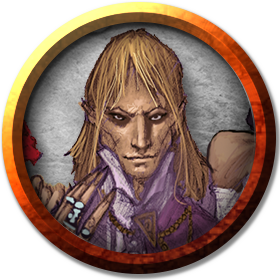
"I am The Ancient, I am The Land. My beginnings are lost in the darkness of the past. I was the warrior, I was good and just. I thundered across the land like the wrath of a just god, but the war years and the killing years wore down my soul as the wind wears down stone into sand."
—Count Strahd von Zarovich
Vampires
Awakened to an endless night, vampires hunger for the life they have lost and sate that hunger by drinking the blood of the living. Vampires abhor sunlight, for its touch burns them. They never cast shadows or reflections, and any vampire wishing to move unnoticed among the living keeps to the darkness and far from reflective surfaces.Dark Desires. Whether or not a vampire retains any memories from its former life, its emotional attachments wither as once-pure feelings become twisted by undeath. Love turns into hungry obsession, while friendship becomes bitter jealousy. In place of emotion, vampires pursue physical symbols of what they crave, so that a vampire seeking love might fixate on a young beauty. A child might become an object of fascination for a vampire obsessed with youth and potential. Others surround themselves with art, books, or sinister items such as torture devices or trophies from creatures they have killed.
Born from Death. Most of a vampire’s victims become vampire spawn—ravenous creatures with a vampire’s hunger for blood, but under the control of the vampire that created them. If a true vampire allows a spawn to draw blood from its own body, the spawn transforms into a true vampire no longer under its master’s control. Few vampires are willing to relinquish their control in this manner. Vampire spawn become free-willed when their creator dies.
Chained to the Grave. Every vampire remains bound to its coffin, crypt, or grave site, where it must rest by day. If a vampire didn’t receive a formal burial, it must lie beneath a foot of earth at the place of its transition to undeath. A vampire can move its place of burial by transporting its coffin or a significant amount of grave dirt to another location. Some vampires set up multiple resting places this way.
Undead Nature. Neither a vampire nor a vampire spawn requires air.
Traits
Regeneration: The vampire regains 10 hit points at the start of its turn if it has at least 1 hit point and isn't in sunlight or running water. If the vampire takes radiant damage or damage from holy water, this trait doesn't function at the start of the vampire's next turn.Spider Climb: The vampire can climb difficult surfaces, including upside down on ceilings, without needing to make an ability check.
Vampire Weaknesses: The vampire has the following flaws:
• Forbiddance. The vampire can't enter a residence without an invitation from one of the occupants.
• Harmed by Running Water. The vampire takes 20 acid damage when it ends its turn in running water.
• Stake to the Heart. The vampire is destroyed if a piercing weapon made of wood is driven into its heart while it is incapacitated in its resting place.
• Sunlight Hypersensitivity. The vampire takes 20 radiant damage when it starts its turn in sunlight. While in sunlight, it has disadvantage on attack rolls and ability checks.
Actions
Multiattack: The vampire makes two attacks, only one of which can be a bite attack.Claws: Melee Weapon Attack: +6 to hit, reach 5 ft., one creature. Hit: 8 (2d4 + 3) slashing damage. Instead of dealing damage, the vampire can grapple the target, escape DC 13.
Bite: Melee Weapon Attack: +6 to hit, reach 5 ft., one willing creature, or a creature that is grappled by the vampire, incapacitated, or restrained. Hit: 6 (1d6 + 3) piercing damage plus 7 (2d6) necrotic damage. The target's hit point maximum is reduced by an amount equal to the necrotic damage taken, and the vampire regains hit points equal to that amount. The reduction lasts until the target finishes a long rest. The target dies if this effect reduces its hit point maximum to 0.
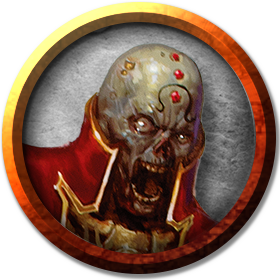
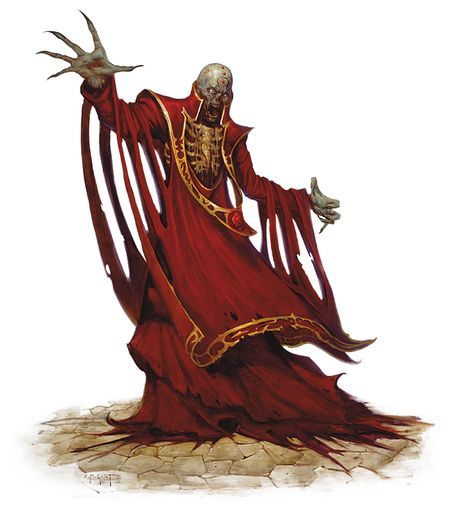
Liches are the remains of great wizards who embrace undeath as a means of preserving themselves. They further their own power at any cost, having no interest in the affairs of the living except where those affairs interfere with their own. Scheming and insane, they hunger for long-forgotten knowledge and the most terrible secrets. Because the shadow of death doesn’t hang over them, they can conceive plans that take years, decades, or centuries to come to fruition.
A lich is a gaunt and skeletal humanoid with withered flesh stretched tight across its bones. Its eyes succumbed to decay long ago, but points of light burn in its empty sockets. It is often garbed in the moldering remains of fine clothing and jewelry worn and dulled by the passage of time.
Secrets of Undeath. No wizard takes up the path to lichdom on a whim, and the process of becoming a lich is a well-guarded secret. Wizards that seek lichdom must make bargains with fiends, evil gods, or other foul entities. Many turn to Orcus, Demon Prince of Undeath, whose power has created countless liches. However, those that control the power of lichdom always demand fealty and service for their knowledge.
A lich is created by an arcane ritual that traps the wizard’s soul within a phylactery. Doing so binds the soul to the mortal world, preventing it from traveling to the Outer Planes after death. A phylactery is traditionally an amulet in the shape of a small box, but it can take the form of any item possessing an interior space into which arcane sigils of naming, binding, immortality, and dark magic are scribed in silver.
With its phylactery prepared, the future lich drinks a potion of transformation—a vile concoction of poison mixed with the blood of a sentient creature whose soul is sacrificed to the phylactery. The wizard falls dead, then rises as a lich as its soul is drawn into the phylactery, where it forever remains.
Soul Sacrifices. A lich must periodically feed souls to its phylactery to sustain the magic preserving its body and consciousness. It does this using the imprisonment spell. Instead of choosing one of the normal options of the spell, the lich uses the spell to magically trap the target’s body and soul inside its phylactery. The phylactery must be on the same plane as the lich for the spell to work. A lich’s phylactery can hold only one creature at a time, and a dispel magic cast as a 9th-level spell upon the phylactery releases any creature imprisoned within it. A creature imprisoned in the phylactery for 24 hours is consumed and destroyed utterly, whereupon nothing short of divine intervention can restore it to life.
A lich that fails or forgets to maintain its body with sacrificed souls begins to physically fall apart, and might eventually become a demilich.
Death and Restoration. When a lich’s body is broken by accident or assault, the will and mind of the lich drains from it, leaving only a lifeless corpse behind. Within days, a new body reforms next to the lich’s phylactery, coalescing out of glowing smoke that issues from the device. Because the destruction of its phylactery means the possibility of eternal death, a lich usually keeps its phylactery in a hidden, well-guarded location.
Destroying a lich’s phylactery is no easy task and often requires a special ritual, item, or weapon. Every phylactery is unique, and discovering the key to its destruction can be a quest in and of itself.
Lonely Existence. From time to time, a lich might be stirred from its single-minded pursuit of power to take an interest in the world around it, most often when some great event reminds it of the life it once led. It otherwise lives in isolation, engaging only with those creatures whose service helps secure its lair.
Few liches call themselves by their former names, instead adopting monikers such as the Black Hand or the Forgotten King.
Magic Collectors. Liches collect spells and magic items. In addition to its spell repertoire, a lich has ready access to potions, scrolls, libraries of spellbooks, one or more wands, and perhaps a staff or two. It has no qualms about putting these treasures to use whenever its lair comes under attack.
Undead Nature. A lich doesn’t require air, food, drink, or sleep.
A Lich’s Lair
A lich often haunts the abode it favored in life, such as a lonely tower, a haunted ruin, or an academy of black magic. Alternatively, some liches construct secret tombs filled with powerful guardians and traps.Everything about a lich’s lair reflects its keen mind and wicked cunning, including the magic and mundane traps that secure it. Undead, constructs, and bound demons lurk in shadowy recesses, emerging to destroy those who dare to disturb the lich’s work.
A lich encountered in its lair has a challenge rating of 22 (41,000 XP).
Lair Actions
On initiative count 20 (losing initiative ties), the lich can take a lair action to cause one of the following magical effects; the lich can’t use the same effect two rounds in a row:- The lich rolls a d8 and regains a spell slot of that level or lower. If it has no spent spell slots of that level or lower, nothing happens.
- The lich targets one creature it can see within 30 feet of it. A crackling cord of negative energy tethers the lich to the target. Whenever the lich takes damage, the target must make a DC 18 Constitution saving throw. On a failed save, the lich takes half the damage (rounded down), and the target takes the remaining damage. This tether lasts until initiative count 20 on the next round or until the lich or the target is no longer in the lich’s lair.
- The lich calls forth the spirits of creatures that died in its lair. These apparitions materialize and attack one creature that the lich can see within 60 feet of it. The target must succeed on a DC 18 Constitution saving throw, taking 52 (15d6) necrotic damage on a failed save, or half as much damage on a success. The apparitions then disappear.
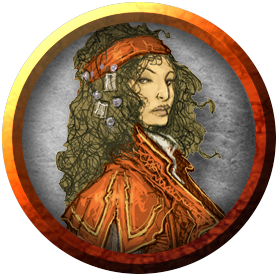
Picture: Handout: Ezmerelda D'avenir
Witness to Tragedy. When Ezmerelda was a little girl, her family kidnapped van Richten’s teenage son, Erasmus, and delivered him into the clutches of a vampire. Even today, years later, she can still hear Erasmus’s pleas for mercy. That event haunted her childhood.
Van Richten tracked down Ezmerelda’s family soon after the kidnapping, but not before the Vistani had sold the boy. Though van Richten could have done them harm, he instead interrogated Ezmerelda’s mother and father on the whereabouts of his missing son. Satisfied with their answers, he spared their lives before departing with the information they had given him. Ezmerelda witnessed van Richten’s act of mercy and was deeply moved by it.
Van Richten’s Tragic Tale. At the age of fifteen, Ezmerelda, still troubled by what her family had done to van Richten, ran away from home. After many harrowing adventures, she tracked down van Richten two years later. Thinking she was a Vistana assassin, he put a sword to her throat and threatened to spill her blood. Ezmerelda convinced him that she genuinely wanted to help him find his missing son, whereupon van Richten told her the saddest of tales. He had found his son, who had been transformed into a vampire spawn. When Erasmus pleaded to his father for salvation, van Richten granted his request by ending his existence.
Farewell. Ezmerelda remained by van Richten’s side for two years, helping him track down and slay many creatures of the night. But because van Richten could never bring himself to fully trust a Vistana, he kept secrets from her. The two vampire hunters got on each other’s nerves, and their arguments became more frequent. At last, Ezmerelda suggested that they part company with some shred of their friendship still intact, and van Richten agreed.
The Great Vampire Hunt. While in the company of a Vistani caravan, Ezmerelda heard a rumor that Rudolph van Richten had gone to Barovia to slay the most powerful vampire of them all. She decided that he might need help and traveled for months to reach Strahd’s domain. She rode her wagon to Vallaki and learned about an old tower that seemed the sort of place van Richten would use as a base. When she arrived there, she found some of van Richten’s belongings, but of the vampire hunter there was no sign. Although she is anxious to learn the whereabouts of her mentor, she is also eager to earn his trust and respect. To that end, she has been poring over van Richten’s research and learning about Strahd and Castle Ravenloft, with every intention of dispatching the vampire herself.
Tarokka Deck. Ezmerelda keeps a deck of tarokka cards in her wagon (chapter 11, area V1). Although the cards aren’t magical, Ezmerelda can use them to perform a card reading for the characters (see chapter 1), like the one that can be performed by Madam Eva.
Ezmerelda d’Avenir
Ezmerelda d’Avenir, a Vistana, is the prot�g� of Rudolph van Richten—despite the fact that her first encounter with the vampire hunter was anything but pleasant.Witness to Tragedy. When Ezmerelda was a little girl, her family kidnapped van Richten’s teenage son, Erasmus, and delivered him into the clutches of a vampire. Even today, years later, she can still hear Erasmus’s pleas for mercy. That event haunted her childhood.
Van Richten tracked down Ezmerelda’s family soon after the kidnapping, but not before the Vistani had sold the boy. Though van Richten could have done them harm, he instead interrogated Ezmerelda’s mother and father on the whereabouts of his missing son. Satisfied with their answers, he spared their lives before departing with the information they had given him. Ezmerelda witnessed van Richten’s act of mercy and was deeply moved by it.
Van Richten’s Tragic Tale. At the age of fifteen, Ezmerelda, still troubled by what her family had done to van Richten, ran away from home. After many harrowing adventures, she tracked down van Richten two years later. Thinking she was a Vistana assassin, he put a sword to her throat and threatened to spill her blood. Ezmerelda convinced him that she genuinely wanted to help him find his missing son, whereupon van Richten told her the saddest of tales. He had found his son, who had been transformed into a vampire spawn. When Erasmus pleaded to his father for salvation, van Richten granted his request by ending his existence.
Farewell. Ezmerelda remained by van Richten’s side for two years, helping him track down and slay many creatures of the night. But because van Richten could never bring himself to fully trust a Vistana, he kept secrets from her. The two vampire hunters got on each other’s nerves, and their arguments became more frequent. At last, Ezmerelda suggested that they part company with some shred of their friendship still intact, and van Richten agreed.
The Great Vampire Hunt. While in the company of a Vistani caravan, Ezmerelda heard a rumor that Rudolph van Richten had gone to Barovia to slay the most powerful vampire of them all. She decided that he might need help and traveled for months to reach Strahd’s domain. She rode her wagon to Vallaki and learned about an old tower that seemed the sort of place van Richten would use as a base. When she arrived there, she found some of van Richten’s belongings, but of the vampire hunter there was no sign. Although she is anxious to learn the whereabouts of her mentor, she is also eager to earn his trust and respect. To that end, she has been poring over van Richten’s research and learning about Strahd and Castle Ravenloft, with every intention of dispatching the vampire herself.
Tarokka Deck. Ezmerelda keeps a deck of tarokka cards in her wagon (chapter 11, area V1). Although the cards aren’t magical, Ezmerelda can use them to perform a card reading for the characters (see chapter 1), like the one that can be performed by Madam Eva.

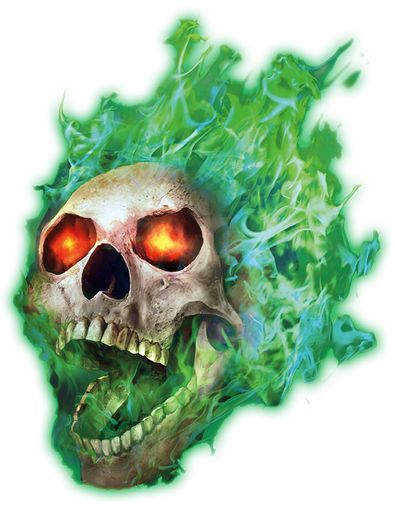
Picture: Handout: Flameskull
Blazing green flames and mad, echoing laughter follow a disembodied skull as it patrols its demesne. When the undead flameskull discovers trespassers, it blasts the intruders with fiery rays from its eyes and dreadful spells called up from the dark recesses of its memory.
Dark spellcasters fashion flameskulls from the remains of dead wizards. When the ritual is complete, green flames erupt from the skull to complete its ghastly transformation.
Legacy of Life. A flameskull only dimly recalls its former life. Though it might speak in its old voice and recount key events from its past, it is but an echo of its former self. However, its undead transformation grants it full access to the magic it wielded in life, letting it cast spells while ignoring the material and somatic components it can no longer employ.
Eternally Bound. Intelligent and vigilant, a flameskull serves its creator by protecting a hidden treasure hoard, a secret chamber, or a specific individual. A flameskull carries out the directives given to it when it was created, and it interprets those commands to the letter. A flameskull’s master must craft its instructions with care to ensure that the creature carries out its tasks properly.
Wreathed in Flame. The fire wreathing a flameskull burns continually, giving off bright light that the creature controls. It uses those flames as a weapon, focusing them to loose them as fiery rays from its eye sockets.
Eldritch Rejuvenation. A flameskull’s shattered fragments reform unless they are splashed with holy water or subjected to a dispel magic or remove curse spell. If it can no longer fulfill its intended purpose, the re-formed flameskull is beholden to no one and becomes autonomous.
Undead Nature. A flameskull doesn’t require air, food, drink, or sleep.
Traits
Illumination: The flameskull sheds either dim light in a 15-foot radius, or bright light in a 15-foot radius and dim light for an additional 15 feet. It can switch between the options as an action.Magic Resistance: The flameskull has advantage on saving throws against spells and other magical effects.
Rejuvenation: If the flameskull is destroyed, it regains all its hit points in 1 hour unless holy water is sprinkled on its remains or a dispel magic or remove curse spell is cast on them.
Spellcasting: The flameskull is a 5th-level spellcaster. Its spellcasting ability is Intelligence (spell save DC 13, +5 to hit with spell attacks). It requires no somatic or material components to cast its spells. The flameskull has the following wizard spells prepared:
• Cantrip (at will): mage hand
• 1st level (3 slots): magic missile, shield
• 2nd level (2 slots): blur, flaming sphere
• 3rd level (1 slot): fireball
Actions
Multiattack: The flameskull uses Fire Ray twice.Fire Ray: Ranged Spell Attack: +5 to hit, range 30 ft., one target. Hit: 10 (3d6) fire damage.

"Beyond the unopenable doors lay a grand hall ending before a towering stone throne, upon which sat an iron statue taller and wider than two men. In one hand it clutched an iron sword, in the other, a feather whip. We should have turned back then."
—Mordenkainen the Archmage, chronicling his party’s harrowing exploits in the dungeons below Maure Castle
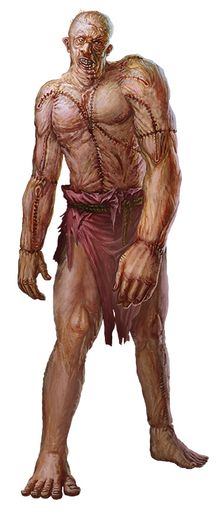
Picture: Handout: Flesh Golem
Golems
Golems are made from humble materials—clay, flesh and bones, iron, or stone—but they possess astonishing power and durability. A golem has no ambitions, needs no sustenance, feels no pain, and knows no remorse. An unstoppable juggernaut, it exists to follow its creator’s orders, and it protects or attacks as that creator demands.To create a golem, one requires a manual of golems (see the Dungeon Master’s Guide). The comprehensive illustrations and instructions in a manual detail the process for creating a golem of a particular type.
Elemental Spirit in Material Form. The construction of a golem begins with the building of its body, requiring great command of the craft of sculpting, stonecutting, ironworking, or surgery. Sometimes a golem’s creator is the master of the art, but often the individual who desires a golem must enlist master artisans to do the work.
After constructing the body from clay, flesh, iron, or stone, the golem’s creator infuses it with a spirit from the Elemental Plane of Earth. This tiny spark of life has no memory, personality, or history. It is simply the impetus to move and obey. This process binds the spirit to the artificial body and subjects it to the will of the golem’s creator.
Ageless Guardians. Golems can guard sacred sites, tombs, and treasure vaults long after the deaths of their creators, carrying out their appointed tasks for all eternity while brushing off physical damage and ignoring all but the most potent spells.
A golems can be created with a special amulet or other item that allows the possessor of the item to control the golem. Golems whose creators are long dead can thus be harnessed to serve a new master.
Blind Obedience. When its creator or possessor is on hand to command it, a golem performs flawlessly. If the golem is left without instructions or is incapacitated, it continues to follow its last orders to the best of its ability. When it can’t fulfill its orders, a golem might react violently—or stand and do nothing. A golem that has been given conflicting orders sometimes alternates between them.
A golem can’t think or act for itself. Though it understands its commands perfectly, it has no grasp of language beyond that understanding, and can’t be reasoned with or tricked with words.
Constructed Nature. A golem doesn’t require air, food, drink, or sleep.
"Two of my gravediggers were caught and hanged yesterday. The other two are understandably reluctant to meet a similar fate, but I shan’t let their concerns stall my progress. I need fresh corpses, and if those bumpkins can’t get them for me, I’ll use theirs instead."
—From the diary of Evangeliza Lavain, necromancer
Flesh Golem
A flesh golem is a grisly assortment of humanoid body parts stitched and bolted together into a muscled brute imbued with formidable strength. Its brain is capable of simple reason, though its thoughts are no more sophisticated than those of a young child. The golem’s muscle tissue responds to the power of lightning, invigorating the creature with vitality and strength. Powerful enchantments protect the golem’s skin, deflecting spells and all but the most potent weapons.A flesh golem lurches with a stiff-jointed gait, as if not in complete control of its body. Its dead flesh isn’t an ideal container for an elemental spirit, which sometimes howls incoherently to vent its outrage. If the spirit breaks free of its creator’s will, the golem goes berserk until calmed, or until its shell of flesh is destroyed or completely healed.
Traits
Berserk: Whenever the golem starts its turn with 40 hit points or fewer, roll a d6. On a 6, the golem goes berserk. On each of its turns while berserk, the golem attacks the nearest creature it can see. If no creature is near enough to move to and attack, the golem attacks an object, with preference for an object smaller than itself. Once the golem goes berserk, it continues to do so until it is destroyed or regains all its hit points.The golem's creator, if within 60 feet of the berserk golem, can try to calm it by speaking firmly and persuasively. The golem must be able to hear its creator, who must take an action to make a DC 15 Charisma (Persuasion) check. If the check succeeds, the golem ceases being berserk. If it takes damage while still at 40 hit points or fewer, the golem might go berserk again.
Aversion of Fire: If the golem takes fire damage, it has disadvantage on attack rolls and ability checks until the end of its next turn.
Immutable Form: The golem is immune to any spell or effect that would alter its form.
Lightning Absorption: Whenever the golem is subjected to lightning damage, it takes no damage and instead regains a number of hit points equal to the lightning damage dealt.
Magic Resistance: The golem has advantage on saving throws against spells and other magical effects.
Magic Weapons: The golem's weapon attacks are magical.
Actions
Multiattack: The golem makes two slam attacks.Slam: Melee Weapon Attack: +7 to hit, reach 5 ft., one target. Hit: 13 (2d8 + 4) bludgeoning damage.
"Lyin' next to the chest were the bones of Cap'n Scornblade himself, still clutchin' his rusty sword. Imagine my surprise when the blade flew from his bony grasp! Still got the scar."
- Levity Quickstitch, Halfling Rogue
Picture: Handout: Flying Sword
Animated Objects
Animated objects are crafted with potent magic to follow the commands of their creators. When not commanded, they follow the last order they received to the best of their ability, and can act independently to fulfill simple instructions. Some animated objects (including many of those created in the Feywild) might converse fluently or adopt a persona, but most are simple automatons.Constructed Nature. An animated object doesn’t require air, food, drink, or sleep.
The magic that animates an object is dispelled when the construct drops to 0 hit points. An animated object reduced to 0 hit points becomes inanimate and is too damaged to be of much use or value to anyone.
Flying Sword
A flying sword dances through the air, fighting with the confidence of a warrior that can’t be injured. Swords are the most common weapons animated with magic. Axes, clubs, daggers, maces, spears, and even self-loading crossbows are also known to exist in animated object form.Traits
Antimagic Susceptibility: The sword is incapacitated while in the area of an antimagic field. If targeted by dispel magic, the sword must succeed on a Constitution saving throw against the caster's spell save DC or fall unconscious for 1 minute.False Appearance: While the sword remains motionless and isn't flying, it is indistinguishable from a normal sword.
Actions
Longsword: Melee Weapon Attack: +3 to hit, reach 5 ft., one target. Hit: 5 (1d8 + 1) slashing damage.
Picture: Handout: Gadof Blinsky
Vallaki’s toymaker, Gadof Blinsky (CG male human), calls himself “a wizard of tiny wonders,” but he has been consumed by despair lately because no one seems to like him or want his toys. His fascination for eerie playthings causes most other locals to avoid him. The burgomaster enables Blinsky to stay in business by giving him a couple of gold pieces a month to make festival decorations.
Blinsky is a heavyset man who wears a moth-eaten jester’s cap during store hours, more out of habit than to humor visitors. In the past six months, the only paying customer who has set foot in the store is a visitor from a faraway land named Rictavio (see area N2 in chapter 5), who came in two weeks ago and bought a stuffed Vistana doll. Realizing that the toymaker was lonely, Rictavio gave Blinsky his pet monkey, Piccolo. Overjoyed, Blinsky has begun training the monkey to fetch toys from hard-to-reach shelves. The toymaker has also fitted Piccolo with a custom-tailored ballerina tutu.
When he meets new customers, Blinsky recites a well-rehearsed greeting: “Wyelcome, friends, to the House of Blinsky, where hyappiness and smiles can be bought at bargain prices. Perhaps you know a leetle child in need of joy? A leetle toy for a girl or boy?”
Vallaki’s toymaker, Gadof Blinsky (CG male human), calls himself “a wizard of tiny wonders,” but he has been consumed by despair lately because no one seems to like him or want his toys. His fascination for eerie playthings causes most other locals to avoid him. The burgomaster enables Blinsky to stay in business by giving him a couple of gold pieces a month to make festival decorations.
Blinsky is a heavyset man who wears a moth-eaten jester’s cap during store hours, more out of habit than to humor visitors. In the past six months, the only paying customer who has set foot in the store is a visitor from a faraway land named Rictavio (see area N2 in chapter 5), who came in two weeks ago and bought a stuffed Vistana doll. Realizing that the toymaker was lonely, Rictavio gave Blinsky his pet monkey, Piccolo. Overjoyed, Blinsky has begun training the monkey to fetch toys from hard-to-reach shelves. The toymaker has also fitted Piccolo with a custom-tailored ballerina tutu.
When he meets new customers, Blinsky recites a well-rehearsed greeting: “Wyelcome, friends, to the House of Blinsky, where hyappiness and smiles can be bought at bargain prices. Perhaps you know a leetle child in need of joy? A leetle toy for a girl or boy?”
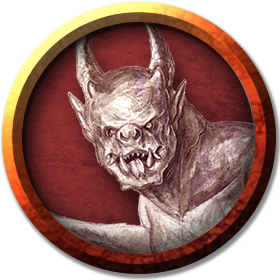
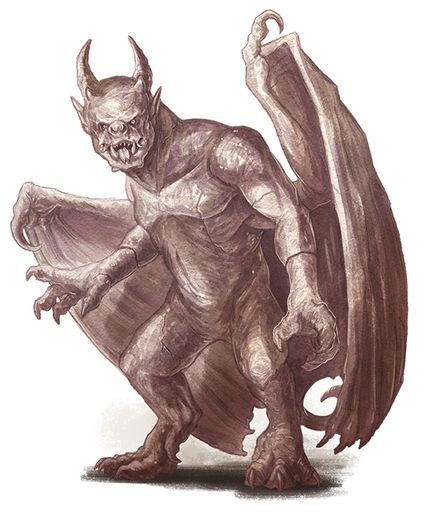
Picture: Handout: Gargoyle
The inanimate gargoyles that perch atop great buildings are inspired by these malevolent creatures of elemental earth that resemble grotesque, fiendish statues. A gargoyle lurks among masonry and ruins, as still as any stone sculpture, and delights in the terror it creates when it breaks from its suspended pose, as well as the pain it inflicts on its victims.
Animate Stone. Gargoyles cling to rocky cliffs and mountains, or roost on ledges in underground caves. They haunt city rooftops, perching vulture-like among the high stone arches and buttresses of castles and cathedrals, and they can hold themselves so still that they appear inanimate. Able to maintain this state for years, a gargoyle makes an ideal sentry.
Deadly Reputation. Gargoyles have a reputation for cruelty. Statues carved into the likenesses of gargoyles appear in the architecture of countless cultures to frighten away trespassers. Although such sculptures are only decorative, real gargoyles can hide among them to ambush unsuspecting victims. A gargoyle might alleviate the tedium of its watch by catching and tormenting birds or rodents, but its long wait only increases its craving for harming sentient creatures.
Cruel Servants. Gargoyles are easily inspired by the cunning of an intelligent master. They enjoy simple tasks such as guarding a master’s home, torturing and killing interlopers, and anything else that involves minimum effort and maximum pain and carnage.
Gargoyles sometimes serve demons for their propensity for wanton chaos and destruction. Powerful spellcasters can also easily enlist gargoyle guardians to keep watch over their gates and walls. Gargoyles have the patience and fortitude of stone, and will serve even the cruelest master for years without complaint.
Elemental Nature. A gargoyle doesn’t require air, food, drink, or sleep.
Shards of Elemental Evil
As Ogr�moch, the evil Prince of Elemental Earth, treads his stony realm, it leaves shards of broken rock in his wake. Imbued with slivers of sentience, these shards thrum with the essence of the elemental prince, growing over long years into vaguely humanoid rock formations that resolve at last into the hard, cruel shapes of gargoyles.Ogr�moch doesn’t create gargoyles deliberately, but they are a physical manifestation of his evil. Gargoyles are mockeries of the elemental air that Ogr�moch despises. They are heavy creatures of living stone, yet capable of flight. Like their creator, they possess a fundamental hatred for beings of elemental air, aarakocra in particular, and relish every opportunity to destroy such creatures.
On their home plane, gargoyles carve out earth motes that Ogr�moch hurtles into Aaqa, the domain of the aarakocra and the benevolent Wind Dukes the bird folk serve in the Elemental Plane of Air.
Traits
False Appearance: While the gargoyle remains motion less, it is indistinguishable from an inanimate statue.Actions
Multiattack: The gargoyle makes two attacks: one with its bite and one with its claws.Bite: Melee Weapon Attack: +4 to hit, reach 5 ft., one target. Hit: 5 (1d6 + 2) piercing damage.
Claws: Melee Weapon Attack: +4 to hit, reach 5 ft., one target. Hit: 5 (1d6 + 2) slashing damage.
Guards include members of a city watch, sentries in a citadel or fortified town, and the bodyguards of merchants and nobles.

Picture: Handout: Gertruda
Gertruda is oblivious to any danger to herself—especially from Strahd, who has charmed her. Sheltered by her mother, she was never allowed to leave home as a child. She finally slipped away and made her way to the castle, drawn by its majesty.
Gertruda is oblivious to any danger to herself—especially from Strahd, who has charmed her. Sheltered by her mother, she was never allowed to leave home as a child. She finally slipped away and made her way to the castle, drawn by its majesty.

Picture: Handout: Ghast
Ghouls roam the night in packs, driven by an insatiable hunger for humanoid flesh.
Devourers of Flesh. Like maggots or carrion beetles, ghouls thrive in places rank with decay and death. A ghoul haunts a place where it can gorge on dead flesh and decomposing organs. When it can’t feed on the dead, it pursues living creatures and attempts to make corpses of them. Though they gain no nourishment from the corpses they devour, ghouls are driven by an unending hunger that compels them to consume. A ghoul’s undead flesh never rots, and this monster can persist in a crypt or tomb for untold ages without feeding.
Abyssal Origins. Ghouls trace their origins to the Abyss. Doresain, the first of their kind, was an elf worshiper of Orcus. Turning against his own people, he feasted on humanoid flesh to honor the Demon Prince of Undeath. As a reward for his service, Orcus transformed Doresain into the first ghoul. Doresain served Orcus faithfully in the Abyss, creating ghouls from the demon lord’s other servants until an incursion by Yeenoghu, the demonic Gnoll Lord, robbed Doresain of his abyssal domain. When Orcus would not intervene on his behalf, Doresain turned to the elf gods for salvation, and they took pity on him and helped him escape certain destruction. Since then, elves have been immune to the ghouls’ paralytic touch.
Ghasts. Orcus sometimes infuses a ghoul with a stronger dose of abyssal energy, making a ghast. Whereas ghouls are little more than savage beasts, a ghast is cunning and can inspire a pack of ghouls to follow its commands.
Traits
Stench: Any creature that starts its turn within 5 ft. of the ghast must succeed on a DC 10 Constitution saving throw or be poisoned until the start of its next turn. On a successful saving throw, the creature is immune to the ghast's Stench for 24 hours.Turn Defiance: The ghast and any ghouls within 30 ft. of it have advantage on saving throws against effects that turn undead.
Actions
Bite: Melee Weapon Attack: +3 to hit, reach 5 ft., one creature. Hit: 12 (2d8 + 3) piercing damage.Claws: Melee Weapon Attack: +5 to hit, reach 5 ft., one target. Hit: 10 (2d6 + 3) slashing damage. If the target is a creature other than an undead, it must succeed on a DC 10 Constitution saving throw or be paralyzed for 1 minute. The target can repeat the saving throw at the end of each of its turns, ending the effect on itself on a success.
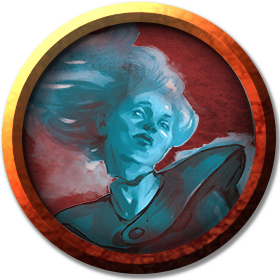
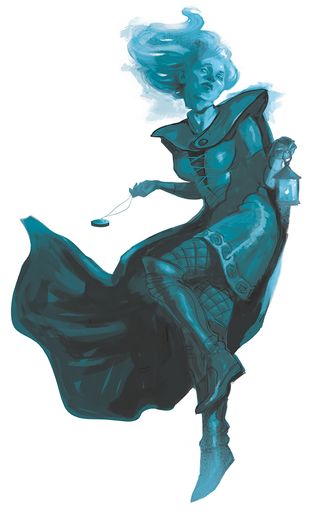
Picture: Handout: Ghost
A ghost is the soul of a once-living creature, bound to haunt a specific location, creature, or object that held significance to it in its life.
Unfinished Business. A ghost yearns to complete some unresolved task from its life. It might seek to avenge its own death, fulfill an oath, or relay a message to a loved one. A ghost might not realize that it has died and continue the everyday routine of its life. Others are driven by wickedness or spite, as with a ghost that refuses to rest until every member of a certain family or organization is dead.
The surest way to rid an area of a ghost is to resolve its unfinished business. A ghost can be destroyed more easily by invoking a weakness tied to its former life. The ghost of a person tortured to death might be killed again by the implements of that torture. The ghost of a gardener might become more vulnerable when exposed to a potent floral fragrance.
Ghostly Manifestations. Sensations of profound sadness, loneliness, and unfulfilled yearning emanate from places where ghostly hauntings occur. Strange sounds or unnatural silences create an unsettling atmosphere. Cold spots settle in rooms that have roaring fires. A choking stench might seep into the area, inanimate objects might move of their own accord, and corpses might rise from the grave. The ghost has no control over these manifestations; they simply occur.
Undead Nature. A ghost doesn’t require air, food, drink, or sleep.
Traits
Ethereal Sight: The ghost can see 60 ft. into the Ethereal Plane when it is on the Material Plane, and vice versa.Incorporeal Movement: The ghost can move through other creatures and objects as if they were difficult terrain. It takes 5 (1d10) force damage if it ends its turn inside an object.
Actions
Withering Touch: Melee Weapon Attack: +5 to hit, reach 5 ft., one target. Hit: 17 (4d6 + 3) necrotic damage.Etherealness: The ghost enters the Ethereal Plane from the Material Plane, or vice versa. It is visible on the Material Plane while it is in the Border Ethereal, and vice versa, yet it can't affect or be affected by anything on the other plane.
Horrifying Visage: Each non-undead creature within 60 ft. of the ghost that can see it must succeed on a DC 13 Wisdom saving throw or be frightened for 1 minute. If the save fails by 5 or more, the target also ages 1d4 x 10 years. A frightened target can repeat the saving throw at the end of each of its turns, ending the frightened condition on itself on a success. If a target's saving throw is successful or the effect ends for it, the target is immune to this ghost's Horrifying Visage for the next 24 hours. The aging effect can be reversed with a greater restoration spell, but only within 24 hours of it occurring.
Possession (Recharge 6): One humanoid that the ghost can see within 5 ft. of it must succeed on a DC 13 Charisma saving throw or be possessed by the ghost; the ghost then disappears, and the target is incapacitated and loses control of its body. The ghost now controls the body but doesn't deprive the target of awareness. The ghost can't be targeted by any attack, spell, or other effect, except ones that turn undead, and it retains its alignment, Intelligence, Wisdom, Charisma, and immunity to being charmed and frightened. It otherwise uses the possessed target's statistics, but doesn't gain access to the target's knowledge, class features, or proficiencies.
The possession lasts until the body drops to 0 hit points, the ghost ends it as a bonus action, or the ghost is turned or forced out by an effect like the dispel evil and good spell. When the possession ends, the ghost reappears in an unoccupied space within 5 ft. of the body. The target is immune to this ghost's Possession for 24 hours after succeeding on the saving throw or after the possession ends.
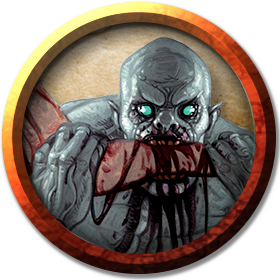
Ghouls roam the night in packs, driven by an insatiable hunger for humanoid flesh.
Devourers of Flesh. Like maggots or carrion beetles, ghouls thrive in places rank with decay and death. A ghoul haunts a place where it can gorge on dead flesh and decomposing organs. When it can’t feed on the dead, it pursues living creatures and attempts to make corpses of them. Though they gain no nourishment from the corpses they devour, ghouls are driven by an unending hunger that compels them to consume. A ghoul’s undead flesh never rots, and this monster can persist in a crypt or tomb for untold ages without feeding.
Abyssal Origins. Ghouls trace their origins to the Abyss. Doresain, the first of their kind, was an elf worshiper of Orcus. Turning against his own people, he feasted on humanoid flesh to honor the Demon Prince of Undeath. As a reward for his service, Orcus transformed Doresain into the first ghoul. Doresain served Orcus faithfully in the Abyss, creating ghouls from the demon lord’s other servants until an incursion by Yeenoghu, the demonic Gnoll Lord, robbed Doresain of his abyssal domain. When Orcus would not intervene on his behalf, Doresain turned to the elf gods for salvation, and they took pity on him and helped him escape certain destruction. Since then, elves have been immune to the ghouls’ paralytic touch.
Ghasts. Orcus sometimes infuses a ghoul with a stronger dose of abyssal energy, making a ghast. Whereas ghouls are little more than savage beasts, a ghast is cunning and can inspire a pack of ghouls to follow its commands.
Claws: Melee Weapon Attack: +4 to hit, reach 5 ft., one target. Hit: 7 (2d4 + 2) slashing damage. If the target is a creature other than an elf or undead, it must succeed on a DC 10 Constitution saving throw or be paralyzed for 1 minute. The target can repeat the saving throw at the end of each of its turns, ending the effect on itself on a success.
Devourers of Flesh. Like maggots or carrion beetles, ghouls thrive in places rank with decay and death. A ghoul haunts a place where it can gorge on dead flesh and decomposing organs. When it can’t feed on the dead, it pursues living creatures and attempts to make corpses of them. Though they gain no nourishment from the corpses they devour, ghouls are driven by an unending hunger that compels them to consume. A ghoul’s undead flesh never rots, and this monster can persist in a crypt or tomb for untold ages without feeding.
Abyssal Origins. Ghouls trace their origins to the Abyss. Doresain, the first of their kind, was an elf worshiper of Orcus. Turning against his own people, he feasted on humanoid flesh to honor the Demon Prince of Undeath. As a reward for his service, Orcus transformed Doresain into the first ghoul. Doresain served Orcus faithfully in the Abyss, creating ghouls from the demon lord’s other servants until an incursion by Yeenoghu, the demonic Gnoll Lord, robbed Doresain of his abyssal domain. When Orcus would not intervene on his behalf, Doresain turned to the elf gods for salvation, and they took pity on him and helped him escape certain destruction. Since then, elves have been immune to the ghouls’ paralytic touch.
Ghasts. Orcus sometimes infuses a ghoul with a stronger dose of abyssal energy, making a ghast. Whereas ghouls are little more than savage beasts, a ghast is cunning and can inspire a pack of ghouls to follow its commands.
Actions
Bite: Melee Weapon Attack: +2 to hit, reach 5 ft., one creature. Hit: 9 (2d6 + 2) piercing damage.Claws: Melee Weapon Attack: +4 to hit, reach 5 ft., one target. Hit: 7 (2d4 + 2) slashing damage. If the target is a creature other than an elf or undead, it must succeed on a DC 10 Constitution saving throw or be paralyzed for 1 minute. The target can repeat the saving throw at the end of each of its turns, ending the effect on itself on a success.

Actions
Bite: Melee Weapon Attack: +6 to hit, reach 10 ft., one target. Hit: 6 (1d4 + 4) piercing damage, and the target must make a DC 11 Constitution saving throw, taking 10 (3d6) poison damage on a failed save, or half as much damage on a successful one.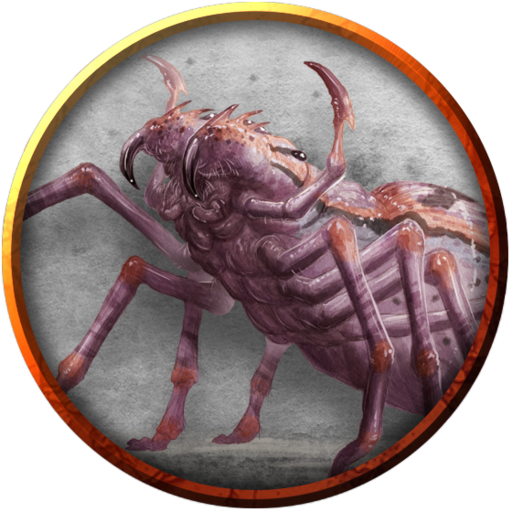
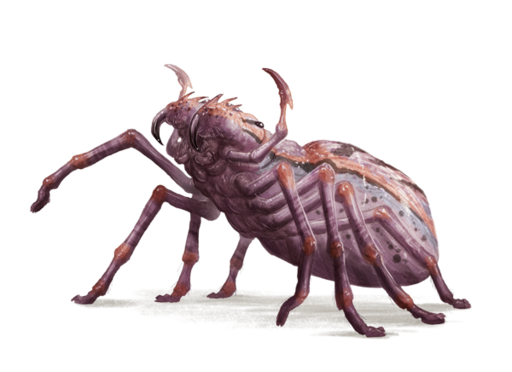
Picture: Handout: Giant Spider
To snare its prey, a giant spider spins elaborate webs or shoots sticky strands of webbing from its abdomen. Giant spiders are most commonly found underground, making their lairs on ceilings or in dark, web-filled crevices. Such lairs are often festooned with web cocoons holding past victims.
Traits
Spider Climb: The spider can climb difficult surfaces, including upside down on ceilings, without needing to make an ability check.Web Sense: While in contact with a web, the spider knows the exact location of any other creature in contact with the same web.
Web Walker: The spider ignores movement restrictions caused by webbing.
Actions
Bite: Melee Weapon Attack: +5 to hit, reach 5 ft., one creature. Hit: 7 (1d8 + 3) piercing damage, and the target must make a DC 11 Constitution saving throw, taking 9 (2d8) poison damage on a failed save, or half as much damage on a successful one. If the poison damage reduces the target to 0 hit points, the target is stable but poisoned for 1 hour, even after regaining hit points, and is paralyzed while poisoned in this way.Web (Recharge 5-6): Ranged Weapon Attack: +5 to hit, range 30/60 ft., one creature. Hit: The target is restrained by webbing. As an action, the restrained target can make a DC 12 Strength check, bursting the webbing on a success. The webbing can also be attacked and destroyed - AC 10; hp 5; vulnerability to fire damage; immunity to bludgeoning, poison, and psychic damage.
Smaller than a giant spider, a giant wolf spider hunts prey across open ground or hides in a burrow or crevice, or in a hidden cavity beneath debris.
Web Sense: While in contact with a web, the spider knows the exact location of any other creature in contact with the same web.
Web Walker: The spider ignores movement restrictions caused by webbing.
Traits
Spider Climb: The spider can climb difficult surfaces, including upside down on ceilings, without needing to make an ability check.Web Sense: While in contact with a web, the spider knows the exact location of any other creature in contact with the same web.
Web Walker: The spider ignores movement restrictions caused by webbing.
Actions
Bite: Melee Weapon Attack: +3 to hit, reach 5 ft., one creature. Hit: 4 (1d6 + 1) piercing damage, and the target must make a DC 11 Constitution saving throw, taking 7 (2d6) poison damage on a failed save, or half as much damage on a successful one. If the poison damage reduces the target to 0 hit points, the target is stable but poisoned for 1 hour, even after regaining hit points, and is paralyzed while poisoned in this way.
Gladiators battle for the entertainment of raucous crowds. Some gladiators are brutal pit fighters who treat each match as a life-or-death struggle, while others are professional duelists who command huge fees but rarely fight to the death.
Brute: A melee weapon deals one extra die of its damage when the gladiator hits with it (included in the attack).
Spear (Melee; One-Handed): Melee Weapon Attack: +7 to hit, reach 5 ft., one target. Hit: 11 (2d6 + 4) piercing damage.
Spear (Melee; Two-Handed): Melee Weapon Attack: +7 to hit, reach 5 ft., one target. Hit: 13 (2d8 + 4) piercing damage.
Spear (Ranged): Ranged Weapon Attack: +7 to hit, range 20/60 ft., one target. Hit: 11 (2d6 + 4) piercing damage.
Shield Bash: Melee Weapon Attack: +7 to hit, reach 5 ft., one creature. Hit: 9 (2d4 + 4) bludgeoning damage. If the target is a Medium or smaller creature, it must succeed on a DC 15 Strength saving throw or be knocked prone.
Traits
Brave: The gladiator has advantage on saving throws against being frightened.Brute: A melee weapon deals one extra die of its damage when the gladiator hits with it (included in the attack).
Actions
Multiattack: The gladiator makes three melee attacks or two ranged attacks.Spear (Melee; One-Handed): Melee Weapon Attack: +7 to hit, reach 5 ft., one target. Hit: 11 (2d6 + 4) piercing damage.
Spear (Melee; Two-Handed): Melee Weapon Attack: +7 to hit, reach 5 ft., one target. Hit: 13 (2d8 + 4) piercing damage.
Spear (Ranged): Ranged Weapon Attack: +7 to hit, range 20/60 ft., one target. Hit: 11 (2d6 + 4) piercing damage.
Shield Bash: Melee Weapon Attack: +7 to hit, reach 5 ft., one creature. Hit: 9 (2d4 + 4) bludgeoning damage. If the target is a Medium or smaller creature, it must succeed on a DC 15 Strength saving throw or be knocked prone.
Reactions
Parry: The gladiator adds 3 to its AC against one melee attack that would hit it. To do so, the gladiator must see the attacker and be wielding a melee weapon.
Traits
Charge: If the goat moves at least 20 ft. straight toward a target and then hits it with a ram attack on the same turn, the target takes an extra 2 (1d4) bludgeoning damage. If the target is a creature, it must succeed on a DC 10 Strength saving throw or be knocked prone.Sure-Footed: The goat has advantage on Strength and Dexterity saving throws made against effects that would knock it prone.
Actions
Ram: Melee Weapon Attack: +3 to hit, reach 5 ft., one target. Hit: 3 (1d4 + 1) bludgeoning damage.
“The dungeon’s floors were spotless. That should have been our first clue.”
—from the journal of Jaster Hollowquill, on his first exploration of Undermountain
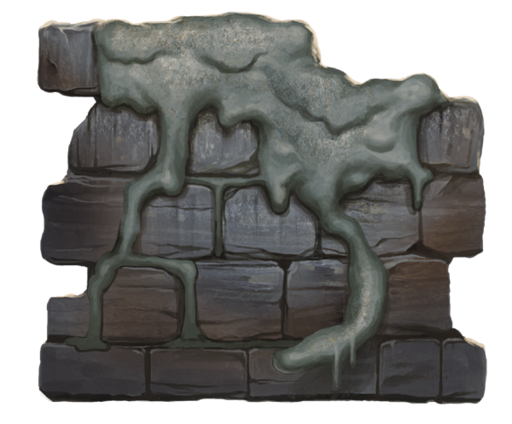
Oozes
Oozes thrive in the dark, shunning areas of bright light and extreme temperatures. They flow through the damp underground, feeding on any creature or object that can be dissolved, slinking along the ground, dripping from walls and ceilings, spreading across the edges of underground pools, and squeezing through cracks. The first warning an adventurer receives of an ooze’s presence is often the searing pain of its acidic touch.Oozes are drawn to movement and warmth. Organic material nourishes them, and when prey is scarce they feed on grime, fungus, and offal. Veteran explorers know that an immaculately clean passageway is a likely sign that an ooze lairs nearby.
Slow Death. An ooze kills its prey slowly. Some varieties, such as black puddings and gelatinous cubes, engulf creatures to prevent escape. The only upside of this torturous death is that a victim’s comrades can come to the rescue before it is too late.
Since not every ooze digests every type of substance, some have coins, metal gear, bones, and other debris suspended within their quivering bodies. A slain ooze can be a rich source of treasure for its killers.
Unwitting Servants. Although an ooze lacks the intelligence to ally itself with other creatures, others that understand an ooze’s need to feed might lure it into a location where it can be of use to them. Clever monsters keep oozes around to defend passageways or consume refuse. Likewise, an ooze can be enticed into a pit trap, where its captors feed it often enough to prevent it from coming after them. Crafty creatures place torches and flaming braziers in strategic areas to dissuade an ooze from leaving a particular tunnel or room.
Spawn of Juiblex. According to the Demonomicon of Iggwilv and other sources, oozes are scattered fragments or offspring of the demon lord Juiblex. Whether this is true or not, the Faceless Lord is one of the few beings that can control oozes and imbue them with a modicum of intelligence. Most of the time, oozes have no sense of tactics or self-preservation. They are direct and predictable, attacking and eating without cunning. Under the control of Juiblex, they exhibit glimmers of sentience and malevolent intent.
Ooze Nature. An ooze doesn’t require sleep.
Gray Ooze
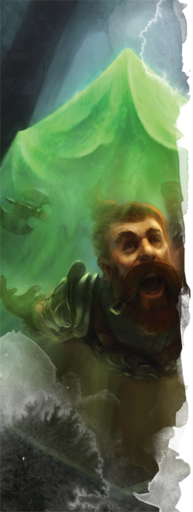 A gray ooze is stone turned to liquid by chaos. When it moves, it slithers like a liquid snake, rising to strike.
Variant: Psychic Gray Ooze
A gray ooze that lives a long time can evolve to become more intelligent and develop limited psionic ability. Such occurrences are more common in gray oozes that live near psionic creatures such as mind flayers, suggesting that the ooze can sense and mimic psionic ability. See the Psychic Gray Ooze entry.Traits
Amorphous: The ooze can move through a space as narrow as 1 inch wide without squeezing.Corrode Metal: Any nonmagical weapon made of metal that hits the ooze corrodes. After dealing damage, the weapon takes a permanent and cumulative -1 penalty to damage rolls. If its penalty drops to -5, the weapon is destroyed. Nonmagical ammunition made of metal that hits the ooze is destroyed after dealing damage.
The ooze can eat through 2-inch-thick, nonmagical metal in 1 round.
False Appearance: While the ooze remains motionless, it is indistinguishable from an oily pool or wet rock.
Actions
Pseudopod: Melee Weapon Attack: +3 to hit, reach 5 ft., one target. Hit: 4 (1d6 + 1) bludgeoning damage plus 7 (2d6) acid damage, and if the target is wearing nonmagical metal armor, its armor is partly corroded and takes a permanent and cumulative -1 penalty to the AC it offers. The armor is destroyed if the penalty reduces its AC to 10.
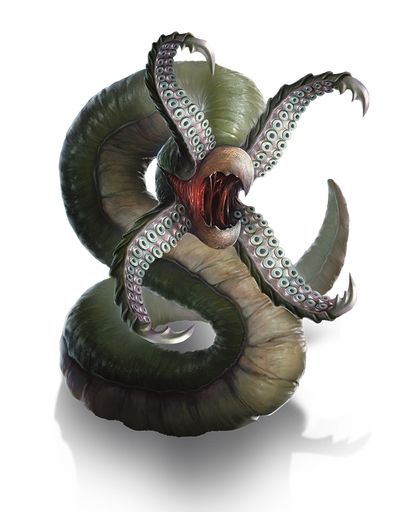
Picture: Handout: Grick
Grick
The wormlike grick waits unseen, blending in with the rock of the caves and caverns it haunts. Only when prey comes near does it rear up, its four barbed tentacles unfurling to reveal its hungry, snapping beak.Passive Predators. Gricks rarely hunt. Instead, they drag their rubbery bodies to places where creatures regularly pass, lurking out of sight amid rocky rubble and debris, squeezing into burrows, holes, or crevices, climbing up to ledges, or coiling around stalactites to drop on unwary prey. A grick consumes virtually anything that moves except for other gricks. It targets the nearest prey, grabbing a fallen creature with its tentacles and dragging it off to eat alone.
Roving Ambushers. Gricks remain in an area until the food supply dwindles, often because sentient creatures become aware of their presence and plot alternate routes around their lairs. When prey is scarce in the Underdark, gricks venture aboveground to hunt in the wilderness, lurking in trees or on cliff-side ledges. A grick pack is often led by a single well-fed, oversized alpha around which the others congregate.
Spoils of Slaughter. Over time, grick lairs accumulate the cast-off possessions of intelligent prey, and expert guides know to look out for these telltale signs. Underdark explorers sometimes seal off the routes leading to and from a grick lair to starve them, then claim the wealth of the foul creatures’ victims.
Traits
Stone Camouflage: The grick has advantage on Dexterity (Stealth) checks made to hide in rocky terrain.Actions
Multiattack: The grick makes one attack with its tentacles. If that attack hits, the grick can make one beak attack against the same target.Tentacles: Melee Weapon Attack: +4 to hit, reach 5 ft., one target. Hit: 9 (2d6 + 2) slashing damage.
Beak: Melee Weapon Attack: +4 to hit, reach 5 ft., one target. Hit: 5 (1d6 + 2) piercing damage.
Guards include members of a city watch, sentries in a citadel or fortified town, and the bodyguards of merchants and nobles.
Spear (Melee; Two-Handed): Melee Weapon Attack: +3 to hit, reach 5 ft., one target. Hit: 5 (1d8 + 1) piercing damage.
Spear (Ranged): Ranged Weapon Attack: +3 to hit, range 20/60 ft., one target. Hit: 4 (1d6 + 1) piercing damage.
Actions
Spear (Melee; One-Handed): Melee Weapon Attack: +3 to hit, reach 5 ft., one target. Hit: 4 (1d6 + 1) piercing damage.Spear (Melee; Two-Handed): Melee Weapon Attack: +3 to hit, reach 5 ft., one target. Hit: 5 (1d8 + 1) piercing damage.
Spear (Ranged): Ranged Weapon Attack: +3 to hit, range 20/60 ft., one target. Hit: 4 (1d6 + 1) piercing damage.
Picture: Handout: Guardian Portrait
Constructed Nature. An animated object doesn’t require air, food, drink, or sleep.
The magic that animates an object is dispelled when the construct drops to 0 hit points. An animated object reduced to 0 hit points becomes inanimate and is too damaged to be of much use or value to anyone.
Living Image. The eyes of the figure depicted in the painting are imbued with darkvision, and they appear to follow creatures that move in front of them.
Innate Spells. When a guardian portrait attacks, the figure in the painting animates and moves as though alive (albeit in two dimensions). The guardian portrait has no effective melee attacks, but it has a repertoire of innate spells that it can cast. When it casts a spell, the figure painted on the canvas makes all the appropriate somatic gestures and verbal incantations for the spell.
Animated Objects
Animated objects are crafted with potent magic to follow the commands of their creators. When not commanded, they follow the last order they received to the best of their ability, and can act independently to fulfill simple instructions. Some animated objects might converse fluently or adopt a persona, but most are simple automatons.Constructed Nature. An animated object doesn’t require air, food, drink, or sleep.
The magic that animates an object is dispelled when the construct drops to 0 hit points. An animated object reduced to 0 hit points becomes inanimate and is too damaged to be of much use or value to anyone.
Guardian Portrait
A guardian portrait looks like a finely rendered and beautifully framed work of art, usually depicting someone important in a realistic manner. The picture and its frame are bound with powerful magic and are inseparable.Living Image. The eyes of the figure depicted in the painting are imbued with darkvision, and they appear to follow creatures that move in front of them.
Innate Spells. When a guardian portrait attacks, the figure in the painting animates and moves as though alive (albeit in two dimensions). The guardian portrait has no effective melee attacks, but it has a repertoire of innate spells that it can cast. When it casts a spell, the figure painted on the canvas makes all the appropriate somatic gestures and verbal incantations for the spell.

"I am The Ancient, I am The Land. My beginnings are lost in the darkness of the past. I was the warrior, I was good and just. I thundered across the land like the wrath of a just god, but the war years and the killing years wore down my soul as the wind wears down stone into sand."
—Count Strahd von Zarovich
Vampires
Awakened to an endless night, vampires hunger for the life they have lost and sate that hunger by drinking the blood of the living. Vampires abhor sunlight, for its touch burns them. They never cast shadows or reflections, and any vampire wishing to move unnoticed among the living keeps to the darkness and far from reflective surfaces.Dark Desires. Whether or not a vampire retains any memories from its former life, its emotional attachments wither as once-pure feelings become twisted by undeath. Love turns into hungry obsession, while friendship becomes bitter jealousy. In place of emotion, vampires pursue physical symbols of what they crave, so that a vampire seeking love might fixate on a young beauty. A child might become an object of fascination for a vampire obsessed with youth and potential. Others surround themselves with art, books, or sinister items such as torture devices or trophies from creatures they have killed.
Born from Death. Most of a vampire’s victims become vampire spawn—ravenous creatures with a vampire’s hunger for blood, but under the control of the vampire that created them. If a true vampire allows a spawn to draw blood from its own body, the spawn transforms into a true vampire no longer under its master’s control. Few vampires are willing to relinquish their control in this manner. Vampire spawn become free-willed when their creator dies.
Chained to the Grave. Every vampire remains bound to its coffin, crypt, or grave site, where it must rest by day. If a vampire didn’t receive a formal burial, it must lie beneath a foot of earth at the place of its transition to undeath. A vampire can move its place of burial by transporting its coffin or a significant amount of grave dirt to another location. Some vampires set up multiple resting places this way.
Undead Nature. Neither a vampire nor a vampire spawn requires air.
Traits
Regeneration: The vampire regains 10 hit points at the start of its turn if it has at least 1 hit point and isn't in sunlight or running water. If the vampire takes radiant damage or damage from holy water, this trait doesn't function at the start of the vampire's next turn.Spider Climb: The vampire can climb difficult surfaces, including upside down on ceilings, without needing to make an ability check.
Vampire Weaknesses: The vampire has the following flaws:
• Forbiddance. The vampire can't enter a residence without an invitation from one of the occupants.
• Harmed by Running Water. The vampire takes 20 acid damage when it ends its turn in running water.
• Stake to the Heart. The vampire is destroyed if a piercing weapon made of wood is driven into its heart while it is incapacitated in its resting place.
• Sunlight Hypersensitivity. The vampire takes 20 radiant damage when it starts its turn in sunlight. While in sunlight, it has disadvantage on attack rolls and ability checks.
Actions
Multiattack: The vampire makes two attacks, only one of which can be a bite attack.Claws: Melee Weapon Attack: +6 to hit, reach 5 ft., one creature. Hit: 8 (2d4 + 3) slashing damage. Instead of dealing damage, the vampire can grapple the target, escape DC 13.
Bite: Melee Weapon Attack: +6 to hit, reach 5 ft., one willing creature, or a creature that is grappled by the vampire, incapacitated, or restrained. Hit: 6 (1d6 + 3) piercing damage plus 7 (2d6) necrotic damage. The target's hit point maximum is reduced by an amount equal to the necrotic damage taken, and the vampire regains hit points equal to that amount. The reduction lasts until the target finishes a long rest. The target dies if this effect reduces its hit point maximum to 0.
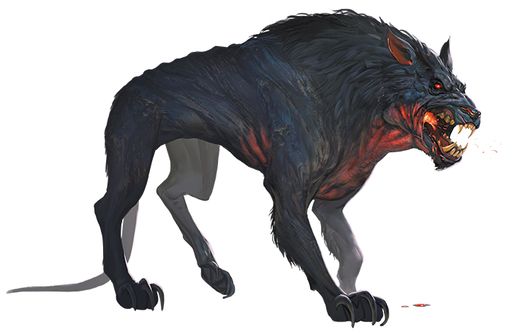
Picture: Handout: Hell Hound
Monstrous, fire-breathing fiends that take the form of powerful dogs, hell hounds are found on the battlefields of Acheron and throughout the Lower Planes. On the Material Plane, hell hounds are most commonly seen in service to devils, fire giants, and other evil creatures that use them as guard animals and companions.
Burning Hunger. Hell hounds hunt in packs, feeding on any creature that appears edible. They avoid potentially dangerous foes in favor of targeting the weakest prey with their savage bite and fiery breath, demonstrating a relentless determination as they pursue that prey to the bitter end.
When hell hounds feed, the flesh they consume stokes the infernal fires that burn within them. When a hell hound dies, that fire consumes the creature’s remains in a billowing eruption of smoke and blazing embers, leaving nothing behind but scorched tufts of black fur.
Evil to the Core. Hell hounds are smarter than mundane beasts, and their lawful nature makes them good at following orders. However, a hell hound’s evil disposition means that the creature can’t be trained to be anything other than a ruthless killer. If a hell hound isn’t allowed to indulge its malevolent hunger, it quickly abandons or turns against its master.
Traits
Keen Hearing and Smell: The hound has advantage on Wisdom (Perception) checks that rely on hearing or smell.Pack Tactics: The hound has advantage on an attack roll against a creature if at least one of the hound's allies is within 5 ft. of the creature and the ally isn't incapacitated.
Actions
Bite: Melee Weapon Attack: +5 to hit, reach 5 ft., one target. Hit: 7 (1d8 + 3) piercing damage plus 7 (2d6) fire damage.Fire Breath (Recharge 5-6): The hound exhales fire in a 15-foot cone. Each creature in that area must make a DC 12 Dexterity saving throw, taking 21 (6d6) fire damage on a failed save, or half as much damage on a successful one.

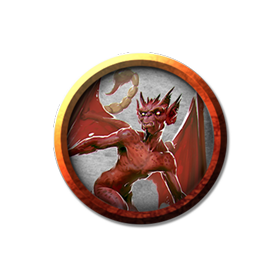
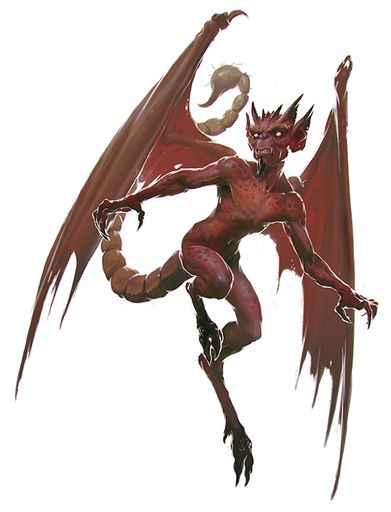
Picture: Handout: Imp
Devils
Devils personify tyranny, with a totalitarian society dedicated to the domination of mortal life. The shadow of the Nine Hells of Baator extends far across the multiverse, and Asmodeus, the dark lord of Nessus, strives to subjugate the cosmos to satisfy his thirst for power. To do so, he must continually expand his infernal armies, sending his servants to the mortal realm to corrupt the souls from which new devils are spawned.Lords of Tyranny. Devils live to conquer, enslave, and oppress. They take perverse delight in exercising authority over the weak, and any creature that defies the authority of a devil faces swift and cruel punishment. Every interaction is an opportunity for a devil to display its power, and all devils have a keen understanding of how to use and abuse their power.
Devils understand the failings that plague intelligent mortals, and they use that knowledge to lead mortals into temptation and darkness, turning creatures into slaves to their own corruption. Devils on the Material Plane use their influence to manipulate humanoid rulers, whispering evil thoughts, fomenting paranoia, and eventually driving them to tyrannical actions.
Obedience and Ambition. In accordance with their lawful alignment, devils obey even when they envy or dislike their superiors, knowing that their obedience will be rewarded. The hierarchy of the Nine Hells depends on this unswerving loyalty, without which that fiendish plane would become as anarchic as the Abyss.
At the same time, it is in the nature of devils to scheme, creating in some a desire to rule that eclipses their contentment to be ruled. This singular ambition is strongest among the archdevils whom Asmodeus appoints to rule the nine layers of the Nine Hells. These high-ranking fiends are the only devils to ever sample true power, which they crave like the sweetest ambrosia.
Dark Dealers and Soul Mongers. Devils are confined to the Lower Planes, but they can travel beyond those planes by way of portals or powerful summoning magic. They love to strike bargains with mortals seeking to gain some benefit or prize, but a mortal making such a bargain must be wary. Devils are crafty negotiators and positively ruthless at enforcing the terms of an agreement. Moreover, a contract with even the lowliest devil is enforced by Asmodeus’s will. Any mortal creature that breaks such a contract instantly forfeits its soul, which is spirited away to the Nine Hells.
To own a creature’s soul is to have absolute control over that creature, and most devils accept no other currency in exchange for the fiendish power and boons they can provide. A soul is usually forfeited when a mortal dies naturally, for devils are immortal and can wait years for a contract to play out. If a contract allows a devil to claim a mortal’s soul before death, it can instantly return to the Nine Hells with the soul in its possession. Only divine intervention can release a soul after a devil has claimed it.
The Infernal Hierarchy
The Nine Hells has a rigid hierarchy that defines every aspect of its society. Asmodeus is the supreme ruler of all devils, and the only creature in the Nine Hells with the powers of a lesser god. Worshiped as such in the Material Plane, Asmodeus inspires the evil humanoid cults that take his name. In the Nine Hells, he commands scores of pit fiend generals, which in turn command legions of subordinates. A supreme tyrant, a brilliant deceiver, and a master of subtlety, Asmodeus protects his throne by keeping his friends close and his enemies closer. He delegates most matters of rulership to the pit fiends and lesser archdevils that make up the infernal bureaucracy of the Nine Hells, even as he knows that those powerful devils conspire to usurp the Throne of Baator from which he rules. Asmodeus appoints archdevils, and he can strip any member of the infernal hierarchy of rank and status as he likes.
If it dies outside the Nine Hells, a devil disappears in a cloud of sulfurous smoke or dissolves into a pool of ichor, instantly returning to its home layer, where it reforms at full strength. Devils that die in the Nine Hells are destroyed forever—a fate that even Asmodeus fears.
Archdevils. The archdevils include all the current and deposed rulers of the Nine Hells (see the Layers and Lords of the Nine Hells table), as well as the dukes and duchesses that make up their courts, attend them as advisers, and hope to supplant them. Every archdevil is a unique being with an appearance that reflects its particular evil nature.
Greater Devils. The greater devils include the pit fiends, erinyes, horned devils, and ice devils that command lesser devils and attend the archdevils.
Lesser Devils. The lesser devils include numerous strains of fiends, including imps, chain devils, spined devils, bearded devils, barbed devils, and bone devils.
Lemures. The lowest form of devil, lemures are the twisted and tormented souls of evil and corrupted mortals. A lemure killed in the Nine Hells is only permanently destroyed if it is killed with a blessed weapon or if its shapeless corpse is splashed with holy water before it can return to life.
Promotion and Demotion. When the soul of an evil mortal sinks into the Nine Hells, it takes on the physical form of a wretched lemure. Archdevils and greater devils have the power to promote lemures to lesser devils. Archdevils can promote lesser devils to greater devils, and Asmodeus alone can promote a greater devil to archdevil status. This diabolic promotion invokes a brief, painful transformation, with the devil’s memories passing intact from one form to the next.
Low-level promotions are typically based on need, such as when a pit fiend transforms lemures into imps to gain invisible spies under its command. High-level promotions are almost always based on merit, such as when a bone devil that distinguishes itself in battle is transformed into a horned devil by the archdevil it serves. A devil is seldom promoted more than one step at a time in the hierarchy of infernal forms.
Infernal Hierarchy
1. lemureLesser devils
2. imp
3. spined devil
4. bearded devil
5. barbed devil
6. chain devil
7. bone devil
Greater devils
8. horned devil
9. erinyes
10. ice devil
11. pit fiend
Archdevils
12. duke or duchess
13. archduke or archduchess
Demotion is the customary punishment for failure or disobedience among the devils. Archdevils or greater devils can demote a lesser devil to a lemure, which loses all memory of its prior existence. An archdevil can demote a greater devil to lesser devil status, but the demoted devil retains its memories—and might seek vengeance if the severity of the demotion is excessive.
No devil can promote or demote another devil that has not sworn fealty to it, preventing rival archdevils from demoting each other’s most powerful servants. Since all devils swear fealty to Asmodeus, he can freely demote any other devil, transforming it into whatever infernal form he desires.
The Nine Hells
The Nine Hells are a single plane comprising nine separate layers (see the Layers and Lords of the Nine Hells table). The first eight layers are each ruled by archdevils that answer to the greatest archdevil of all: Asmodeus, the Archduke of Nessus, the ninth layer. To reach the deepest layer of the Nine Hells, one must descend through all eight of the layers above it, in order. The most expeditious means of doing so is the River Styx, which plunges ever deeper as it flows from one layer to the next. Only the most courageous adventurers can withstand the torment and horror of that journey.Devil True Names and Talismans
Though devils all have common names, every devil above a lemure in station also has a true name that it keeps secret. A devil can be forced to disclose its true name if charmed, and ancient scrolls and tomes are said to exist that list the true names of certain devils.A mortal who learns a devil’s true name can use powerful summoning magic to call the devil from the Nine Hells and bind it into service. Binding can also be accomplished with the help of a devil talisman. Each of these ancient relics is inscribed with the true name of a devil it controls, and was bathed in the blood of a worthy sacrifice—typically someone the creator loved—when crafted.
However it is summoned, a devil brought to the Material Plane typically resents being pressed into service. However, the devil seizes every opportunity to corrupt its summoner so that the summoner’s soul ends up in the Nine Hells. Only imps are truly content to be summoned, and they easily commit to serving a summoner as a familiar, but they still do their utmost to corrupt those who summon them.
Imp
Imps are found throughout the Lower Planes, either running errands for their infernal masters, spying on rivals, or misleading and waylaying mortals. An imp will proudly serve an evil master of any kind, but it can’t be relied on to carry out tasks with any speed or efficiency.An imp can assume animal form at will, but in its natural state it resembles a diminutive red-skinned humanoid with a barbed tail, small horns, and leathery wings. It strikes while invisible, attacking with its poison stinger.
Variant: Imp Familiar
Imps can be found in the service to mortal spellcasters, acting as advisors, spies, and familiars. An imp urges its master to acts of evil, knowing the mortal’s soul is a prize the imp might ultimately claim. Imps display an unusual loyalty to their masters, and an imp can be quite dangerous if its master is threatened. Some such imps have the following trait.Familiar. The imp can enter into a contract to serve another creature as a familiar, forming a telepathic bond with its willing master. While the two are bonded, the master can sense what the imp senses as long as they are within 1 mile of each other. While the imp is within 10 feet of its master, the master shares the imp’s Magic Resistance trait. If its master violates the terms of the contract, the imp can end its service as a familiar, ending the telepathic bond.
Layers and the Lords of the Nine Hells
| Layer | Layer Name | Archduke or Archduchess | Previous Rulers | Primary Inhabitants |
| 1 | Avernus | Zariel | Bel, Tiamat | Erinyes, imps, spined devils |
| 2 | Dis | Dispater | — | Bearded devils, erinyes, imps, spined devils |
| 3 | Minauros | Mammon | — | Bearded devils, chain devils, imps, spined devils |
| 4 | Phlegethos | Belial and Fierna | — | Barbed devils, bone devils, imps, spined devils |
| 5 | Stygia | Levistus | Geryon | Bone devils, erinyes, ice devils, imps |
| 6 | Malbolge | Glasya | Malagard, Moloch | Barbed devils, bone devils, horned devils, imps |
| 7 | Maladomini | Baalzebul | — | Barbed devils, bone devils, horned devils, imps |
| 8 | Cania | Mephistopheles | — | Horned devils, ice devils, imps, pit fiends |
| 9 | Nessus | Asmodeus | — | All devils |
Traits
Shapechanger: The imp can use its action to polymorph into a beast form that resembles a rat (speed 20 ft.), a raven (20 ft., fly 60 ft.), or a spider (20 ft., climb 20 ft.), or back into its true form. Its statistics are the same in each form, except for the speed changes noted. Any equipment it is wearing or carrying isn't transformed. It reverts to its true form if it dies.Devil's Sight: Magical darkness doesn't impede the imp's darkvision.
Magic Resistance: The imp has advantage on saving throws against spells and other magical effects.
Variant: Familiar: The imp can enter into a contract to serve another creature as a familiar, forming a Telepathic Bond with its willing master. While the two are bonded, the master can sense what the imp senses as long as they are within 1 mile of each other. While the imp is within 10 feet of its master, the master shares the imp’s Magic Resistance trait. If its master violates the terms of the contract, the imp can end its service as a familiar, ending the Telepathic Bond.
Actions
Sting (Bite in Beast Form): Melee Weapon Attack: +5 to hit, reach 5 ft ., one target. Hit: 5 (1d4 + 3) piercing damage, and the target must make on a DC 11 Constitution saving throw, taking 10 (3d6) poison damage on a failed save, or half as much damage on a successful one.Invisibility: The imp magically turns invisible until it attacks, or until its concentration ends (as if concentrating on a spell). Any equipment the imp wears or carries is invisible with it.
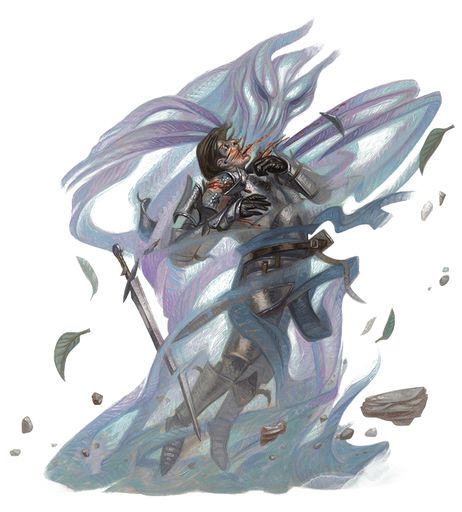
Picture: Handout: Invisible Stalker
An invisible stalker is an air elemental that has been summoned from its native plane and transformed by powerful magic. Its sole purpose is to hunt down creatures and retrieve objects for its summoner. When it is defeated or the magic that binds it expires, an invisible stalker vanishes in a gust of wind.
Directed Hunter. When an invisible stalker is created, it stays at its summoner’s side until it is given a task to perform. If an assignment doesn’t involve hunting down and slaying a specific creature or recovering an object, the magic that created the invisible stalker ends and the elemental is released. Otherwise, it completes the task, then returns to its summoner for more commands, forced to serve until the magic that binds it expires. If its summoner dies in the interim, the invisible stalker vanishes after completing its task.
An invisible stalker is an unwilling servant at best. It resents any undertaking assigned to it. A mission that requires significant time might drive the invisible stalker to pervert the intent of a command unless it is worded carefully.
Unseen Threat. Invisible stalkers are composed of air and are naturally invisible. A creature might hear and feel an invisible stalker in passing, but the elemental remains invisible even when it attacks. A spell that allows someone to see the invisible reveals only the invisible stalker’s vague outline.
Elemental Nature. An invisible stalker requires no air, food, drink, or sleep.
Traits
Invisibility: The stalker is invisible.Faultless Tracker: The stalker is given a quarry by its summoner. The stalker knows the direction and distance to its quarry as long as the two of them are on the same plane of existence. The stalker also knows the location of its summoner.
Actions
Multiattack: The stalker makes two slam attacks.Slam: Melee Weapon Attack: +6 to hit, reach 5 ft., one target. Hit: 10 (2d6 + 3) bludgeoning damage.

"Beyond the unopenable doors lay a grand hall ending before a towering stone throne, upon which sat an iron statue taller and wider than two men. In one hand it clutched an iron sword, in the other, a feather whip. We should have turned back then."
—Mordenkainen the Archmage, chronicling his party’s harrowing exploits in the dungeons below Maure Castle
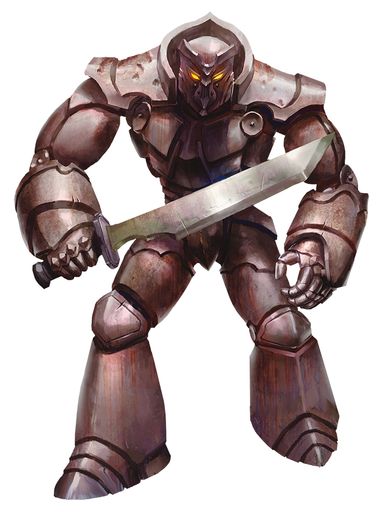
Picture: Handout: Iron Golem
Golems
Golems are made from humble materials—clay, flesh and bones, iron, or stone—but they possess astonishing power and durability. A golem has no ambitions, needs no sustenance, feels no pain, and knows no remorse. An unstoppable juggernaut, it exists to follow its creator’s orders, and it protects or attacks as that creator demands.To create a golem, one requires a manual of golems (see the Dungeon Master’s Guide). The comprehensive illustrations and instructions in a manual detail the process for creating a golem of a particular type.
Elemental Spirit in Material Form. The construction of a golem begins with the building of its body, requiring great command of the craft of sculpting, stonecutting, ironworking, or surgery. Sometimes a golem’s creator is the master of the art, but often the individual who desires a golem must enlist master artisans to do the work.
After constructing the body from clay, flesh, iron, or stone, the golem’s creator infuses it with a spirit from the Elemental Plane of Earth. This tiny spark of life has no memory, personality, or history. It is simply the impetus to move and obey. This process binds the spirit to the artificial body and subjects it to the will of the golem’s creator.
Ageless Guardians. Golems can guard sacred sites, tombs, and treasure vaults long after the deaths of their creators, carrying out their appointed tasks for all eternity while brushing off physical damage and ignoring all but the most potent spells.
A golems can be created with a special amulet or other item that allows the possessor of the item to control the golem. Golems whose creators are long dead can thus be harnessed to serve a new master.
Blind Obedience. When its creator or possessor is on hand to command it, a golem performs flawlessly. If the golem is left without instructions or is incapacitated, it continues to follow its last orders to the best of its ability. When it can’t fulfill its orders, a golem might react violently—or stand and do nothing. A golem that has been given conflicting orders sometimes alternates between them.
A golem can’t think or act for itself. Though it understands its commands perfectly, it has no grasp of language beyond that understanding, and can’t be reasoned with or tricked with words.
Constructed Nature. A golem doesn’t require air, food, drink, or sleep.
Iron Golem
The mightiest of the golems, the iron golem is a massive, towering giant wrought of heavy metal. An iron golem’s shape can be worked into any form, though most are fashioned to look like giant suits of armor. Its fist can destroy creatures with a single blow, and its clanging steps shake the earth beneath its feet. Iron golems wield enormous blades to extend their reach, and all can belch clouds of deadly poison.An iron golem’s body is smelted with rare tinctures and admixtures. Though other golems bear weaknesses inherent in their materials or the power of the elemental spirit bound within them, iron golems were designed to be nearly invulnerable. Their iron bodies imprison the spirits that drive them, and are susceptible only to weapons imbued with magic or the strength of adamantine.
Traits
Fire Absorption: Whenever the golem is subjected to fire damage, it takes no damage and instead regains a number of hit points equal to the fire damage dealt.Immutable Form: The golem is immune to any spell or effect that would alter its form.
Magic Resistance: The golem has advantage on saving throws against spells and other magical effects.
Magic Weapons: The golem's weapon attacks are magical.
Actions
Multiattack: The golem makes two melee attacks.Slam: Melee Weapon Attack: +13 to hit, reach 5 ft., one target. Hit: 20 (3d8 + 7) bludgeoning damage.
Sword: Melee Weapon Attack: +13 to hit, reach 10 ft., one target. Hit: 23 (3d10 + 7) slashing damage.
Poison Breath (Recharge 5-6): The golem exhales poisonous gas in a 15-foot cone. Each creature in that area must make a DC 19 Constitution saving throw, taking 45 (10d8) poison damage on a failed save, or half as much damage on a successful one.
Picture: Handout: Izek Strazni
Unlike his sister, Izek was born without a soul. As time wore on, he forgot his lost sister and learned to cope with his disability.
Orphaned Killer. Izek’s parents succumbed to their grief, leaving him an orphan. He became a sociopath. Other children ruthlessly mocked him because of his dead family and his missing arm, but he was a large boy and had no trouble killing them and disposing of their bodies. He was eventually caught in the act and brought to the burgomaster. Instead of punishing the boy for his crimes, Baron Vallakovich pardoned Izek and took him into his home. Izek has been loyal to the burgomaster ever since, enjoying the power of his position and the comforts of his master’s mansion. When he isn’t enforcing the burgomaster’s will, Izek drinks copious amounts of wine.
Fiendish Gift. After years of doing Baron Vallakovich’s dirty work, Izek awakened from a drunken stupor one morning to find that he had grown a new arm to replace the one he had lost.
The new appendage has barbed spines, elongated fingers, and long nails. He can create fire with the snap of his fiendish fingers and has used the flames to put the fear of the devil in every Vallakian.
Izek Strazni
Izek and his sister were born in Vallaki. One morning, their father and their uncle took them fishing on Lake Zarovich. On the way back to town, a dire wolf attacked Izek and bit off his right arm. His father carried Izek back to town while his uncle distracted the beast. His sister ran and hid in the woods and was never seen again.Unlike his sister, Izek was born without a soul. As time wore on, he forgot his lost sister and learned to cope with his disability.
Orphaned Killer. Izek’s parents succumbed to their grief, leaving him an orphan. He became a sociopath. Other children ruthlessly mocked him because of his dead family and his missing arm, but he was a large boy and had no trouble killing them and disposing of their bodies. He was eventually caught in the act and brought to the burgomaster. Instead of punishing the boy for his crimes, Baron Vallakovich pardoned Izek and took him into his home. Izek has been loyal to the burgomaster ever since, enjoying the power of his position and the comforts of his master’s mansion. When he isn’t enforcing the burgomaster’s will, Izek drinks copious amounts of wine.
Fiendish Gift. After years of doing Baron Vallakovich’s dirty work, Izek awakened from a drunken stupor one morning to find that he had grown a new arm to replace the one he had lost.
The new appendage has barbed spines, elongated fingers, and long nails. He can create fire with the snap of his fiendish fingers and has used the flames to put the fear of the devil in every Vallakian.

Picture: Handout: Kasimir Velikov
Old Friends. Kasimir’s allegiance to the Vistani is so strong that he adopted the name of the Vistana who welcomed him into his clan, a man named Velikov. Although Velikov passed away more than a century ago, Kasimir continues to live among Velikov’s descendants. Unfortunately, in his view, these modern Vistani are neither as noble nor as enlightened as their forebears. Not one to press the issue, Kasimir hopes to outlive the present leadership and see a return to the old ways.
Kasimir Velikov
Kasimir, a mutiliated and grief-stricken dusk elf, has been trapped in Barovia for centuries. His people were on the verge of being annihilated by Strahd’s armies when they surrendered. Strahd left the few survivors to the mercy of the Vistani, who bore them to the valley of Barovia, where they have lived ever since.Old Friends. Kasimir’s allegiance to the Vistani is so strong that he adopted the name of the Vistana who welcomed him into his clan, a man named Velikov. Although Velikov passed away more than a century ago, Kasimir continues to live among Velikov’s descendants. Unfortunately, in his view, these modern Vistani are neither as noble nor as enlightened as their forebears. Not one to press the issue, Kasimir hopes to outlive the present leadership and see a return to the old ways.

"The Company of the Black Moon—they used to be adventurers loyal to the realm. Now they roam the woods as a pack of werewolves. The king has promised estates, titles, and gold to anyone who can undo the curse afflicting them. I, for one, have no interest in such rewards."
—Thornstaff, elf druid
Picture: Handout: Kiril
Lycanthropes
One of the most ancient and feared of all curses, lycanthropy can transform the most civilized humanoid into a ravening beast. In its natural humanoid form, a creature cursed by lycanthropy appears as its normal self. Over time, however, many lycanthropes acquire features suggestive of their animal form. In that animal form, a lycanthrope resembles a powerful version of a normal animal. On close inspection, its eyes show a faint spark of unnatural intelligence and might glow red in the dark.Evil lycanthropes hide among normal folk, emerging in animal form at night to spread terror and bloodshed, especially under a full moon. Good lycanthropes are reclusive and uncomfortable around other civilized creatures, often living alone in wilderness areas far from villages and towns.Curse of Lycanthropy. A humanoid creature can be afflicted with the curse of lycanthropy after being wounded by a lycanthrope, or if one or both of its parents are lycanthropes. A remove curse spell can rid an afflicted lycanthrope of the curse, but a natural born lycanthrope can be freed of the curse only with a wish.
A lycanthrope can either resist its curse or embrace it. By resisting the curse, a lycanthrope retains its normal alignment and personality while in humanoid form. It lives its life as it always has, burying deep the bestial urges raging inside it. However, when the full moon rises, the curse becomes too strong to resist, transforming the individual into its beast form—or into a horrible hybrid form that combines animal and humanoid traits. When the moon wanes, the beast within can be controlled once again. Especially if the cursed creature is unaware of its condition, it might not remember the events of its transformation, though those memories often haunt a lycanthrope as bloody dreams.
Some individuals see little point in fighting the curse and accept what they are. With time and experience, they learn to master their shapechanging ability and can assume beast form or hybrid form at will. Most lycanthropes that embrace their bestial natures succumb to bloodlust, becoming evil, opportunistic creatures that prey on the weak.
Werewolf
A werewolf is a savage predator. In its humanoid form, a werewolf has heightened senses, a fiery temper, and a tendency to eat rare meat. Its wolf form is a fearsome predator, but its hybrid form is more terrifying by far—a furred and well-muscled humanoid body topped by a ravening wolf’s head. A werewolf can wield weapons in hybrid form, though it prefers to tear foes apart with its powerful claws and bite.Most werewolves flee civilized lands not long after becoming afflicted. Those that reject the curse fear what will happen if they remain among their friends and family. Those that embrace the curse fear discovery and the consequences of their murderous acts. In the wild, werewolves form packs that also include wolves and dire wolves.
Variant: Nonhuman Lycanthropes
The statistics presented in this section assume a base creature of human. However, you can also use the statistics to represent nonhuman lycanthropes, adding verisimilitude by allowing a nonhuman lycanthrope to retain one or more of its humanoid racial traits. For example, an elf werewolf might have the Fey Ancestry trait.Player Characters as Lycanthropes
A character who becomes a lycanthrope retains his or her statistics except as specified by lycanthrope type. The character gains the lycanthrope’s speeds in nonhumanoid form, damage immunities, traits, and actions that don’t involve equipment. The character is proficient with the lycanthrope’s natural attacks, such as its bite or claws, which deal damage as shown in the lycanthrope’s statistics. The character can’t speak while in animal form.A humanoid hit by an attack that carries the curse of lycanthropy must succeed on a Constitution saving throw (DC 8 + the lycanthrope’s proficiency bonus + the lycanthrope’s Constitution modifier) or be cursed. If the character embraces the curse, his or her alignment becomes the one defined for the lycanthrope. The DM is free to decide that a change in alignment places the character under DM control until the curse of lycanthropy is removed.
The following information applies to specific lycanthropes.
Werebear. The character gains a Strength of 19 if his or her score isn’t already higher, and a +1 bonus to AC while in bear or hybrid form (from natural armor). Attack and damage rolls for the natural weapons are based on Strength.
Wereboar. The character gains a Strength of 17 if his or her score isn’t already higher, and a +1 bonus to AC while in boar or hybrid form (from natural armor). Attack and damage rolls for the tusks are based on Strength. For the Charge trait, the DC is 8 + the character’s proficiency bonus + Strength modifier.
Wererat. The character gains a Dexterity of 15 if his or her score isn’t already higher. Attack and damage rolls for the bite are based on whichever is higher of the character’s Strength and Dexterity.
Weretiger. The character gains a Strength of 17 if his or her score isn’t already higher. Attack and damage rolls for the natural weapons are based on Strength. For the Pounce trait, the DC is 8 + the character’s proficiency bonus + Strength modifier.
Werewolf. The character gains a Strength of 15 if his or her score isn’t already higher, and a +1 bonus to AC while in wolf or hybrid form (from natural armor). Attack and damage rolls for the natural weapons are based on Strength.
Knights are warriors who pledge service to rulers, religious orders, and noble causes. A knight’s alignment determines the extent to which a pledge is honored. Whether undertaking a quest or patrolling a realm, a knight often travels with an entourage that includes squires and hirelings who are commoners.
Greatsword: Melee Weapon Attack: +5 to hit, reach 5 ft., one target. Hit: 10 (2d6 + 3) slashing damage.
Heavy Crossbow: Ranged Weapon Attack: +2 to hit, range 100/400 ft., one target. Hit: 5 (1d10) piercing damage.
Leadership (Recharges after a Short or Long Rest): For 1 minute, the knight can utter a special command or warning whenever a nonhostile creature that it can see within 30 ft. of it makes an attack roll or a saving throw. The creature can add a d4 to its roll provided it can hear and understand the knight. A creature can benefit from only one Leadership die at a time. This effect ends if the knight is incapacitated.
Traits
Brave: The knight has advantage on saving throws against being frightened.Actions
Multiattack: The knight makes two melee attacks.Greatsword: Melee Weapon Attack: +5 to hit, reach 5 ft., one target. Hit: 10 (2d6 + 3) slashing damage.
Heavy Crossbow: Ranged Weapon Attack: +2 to hit, range 100/400 ft., one target. Hit: 5 (1d10) piercing damage.
Leadership (Recharges after a Short or Long Rest): For 1 minute, the knight can utter a special command or warning whenever a nonhostile creature that it can see within 30 ft. of it makes an attack roll or a saving throw. The creature can add a d4 to its roll provided it can hear and understand the knight. A creature can benefit from only one Leadership die at a time. This effect ends if the knight is incapacitated.
Reactions
Parry: The knight adds 2 to its AC against one melee attack that would hit it. To do so, the knight must see the attacker and be wielding a melee weapon.
Picture: Handout: Lady Fiona Wachter
Lady Fiona Wachter (LE female human) makes no secret of her family’s long-standing loyalty to the von Zarovich line. She believes that Strahd von Zarovich is no tyrant but, at worst, a negligent landlord. She would happily serve Strahd as burgomaster of Vallaki, but she knows that Baron Vargas Vallakovich won’t give up his birthright without a fight.
Fiona conspired to wed her young daughter, Stella, to the baron’s son, Victor, as part of a plot to gain a foothold in the baron’s mansion, but Stella found Victor to be demented, and he showed no interest in Stella whatsoever. In fact, he spoke such unkind words to Stella that she went mad, and Fiona had to lock her daughter away (see area N4n).
Lady Fiona Wachter (LE female human) makes no secret of her family’s long-standing loyalty to the von Zarovich line. She believes that Strahd von Zarovich is no tyrant but, at worst, a negligent landlord. She would happily serve Strahd as burgomaster of Vallaki, but she knows that Baron Vargas Vallakovich won’t give up his birthright without a fight.
Fiona conspired to wed her young daughter, Stella, to the baron’s son, Victor, as part of a plot to gain a foothold in the baron’s mansion, but Stella found Victor to be demented, and he showed no interest in Stella whatsoever. In fact, he spoke such unkind words to Stella that she went mad, and Fiona had to lock her daughter away (see area N4n).
At the risk of sacrificing her sanity, the baron’s wife, Lydia Petrovna (LG female human), has embraced her husband’s philosophy of happiness. She laughs at the baron’s every comment, to the extent that it has become a nervous reflex, and she tries to spread good cheer by throwing daily tea-and-sandwich parties in the parlor for her “dearest friends,” many of them poor folk who tolerate the baroness only because they crave something warm to eat and drink. Lydia is a gods-fearing woman and the younger sister of the town priest, Father Lucian Petrovich. She is a descendant of Tasha Petrovna, a priest entombed in Castle Ravenloft (chapter 4, area K84, crypt 11).
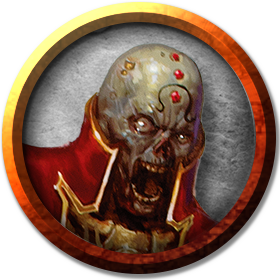
Picture: Handout: Lich
Liches are the remains of great wizards who embrace undeath as a means of preserving themselves. They further their own power at any cost, having no interest in the affairs of the living except where those affairs interfere with their own. Scheming and insane, they hunger for long-forgotten knowledge and the most terrible secrets. Because the shadow of death doesn’t hang over them, they can conceive plans that take years, decades, or centuries to come to fruition.
A lich is a gaunt and skeletal humanoid with withered flesh stretched tight across its bones. Its eyes succumbed to decay long ago, but points of light burn in its empty sockets. It is often garbed in the moldering remains of fine clothing and jewelry worn and dulled by the passage of time.
Secrets of Undeath. No wizard takes up the path to lichdom on a whim, and the process of becoming a lich is a well-guarded secret. Wizards that seek lichdom must make bargains with fiends, evil gods, or other foul entities. Many turn to Orcus, Demon Prince of Undeath, whose power has created countless liches. However, those that control the power of lichdom always demand fealty and service for their knowledge.
A lich is created by an arcane ritual that traps the wizard’s soul within a phylactery. Doing so binds the soul to the mortal world, preventing it from traveling to the Outer Planes after death. A phylactery is traditionally an amulet in the shape of a small box, but it can take the form of any item possessing an interior space into which arcane sigils of naming, binding, immortality, and dark magic are scribed in silver.
With its phylactery prepared, the future lich drinks a potion of transformation—a vile concoction of poison mixed with the blood of a sentient creature whose soul is sacrificed to the phylactery. The wizard falls dead, then rises as a lich as its soul is drawn into the phylactery, where it forever remains.
Soul Sacrifices. A lich must periodically feed souls to its phylactery to sustain the magic preserving its body and consciousness. It does this using the imprisonment spell. Instead of choosing one of the normal options of the spell, the lich uses the spell to magically trap the target’s body and soul inside its phylactery. The phylactery must be on the same plane as the lich for the spell to work. A lich’s phylactery can hold only one creature at a time, and a dispel magic cast as a 9th-level spell upon the phylactery releases any creature imprisoned within it. A creature imprisoned in the phylactery for 24 hours is consumed and destroyed utterly, whereupon nothing short of divine intervention can restore it to life.
A lich that fails or forgets to maintain its body with sacrificed souls begins to physically fall apart, and might eventually become a demilich.
Death and Restoration. When a lich’s body is broken by accident or assault, the will and mind of the lich drains from it, leaving only a lifeless corpse behind. Within days, a new body reforms next to the lich’s phylactery, coalescing out of glowing smoke that issues from the device. Because the destruction of its phylactery means the possibility of eternal death, a lich usually keeps its phylactery in a hidden, well-guarded location.
Destroying a lich’s phylactery is no easy task and often requires a special ritual, item, or weapon. Every phylactery is unique, and discovering the key to its destruction can be a quest in and of itself.
Lonely Existence. From time to time, a lich might be stirred from its single-minded pursuit of power to take an interest in the world around it, most often when some great event reminds it of the life it once led. It otherwise lives in isolation, engaging only with those creatures whose service helps secure its lair.
Few liches call themselves by their former names, instead adopting monikers such as the Black Hand or the Forgotten King.
Magic Collectors. Liches collect spells and magic items. In addition to its spell repertoire, a lich has ready access to potions, scrolls, libraries of spellbooks, one or more wands, and perhaps a staff or two. It has no qualms about putting these treasures to use whenever its lair comes under attack.
Undead Nature. A lich doesn’t require air, food, drink, or sleep.
A Lich’s Lair
A lich often haunts the abode it favored in life, such as a lonely tower, a haunted ruin, or an academy of black magic. Alternatively, some liches construct secret tombs filled with powerful guardians and traps.Everything about a lich’s lair reflects its keen mind and wicked cunning, including the magic and mundane traps that secure it. Undead, constructs, and bound demons lurk in shadowy recesses, emerging to destroy those who dare to disturb the lich’s work.
A lich encountered in its lair has a challenge rating of 22 (41,000 XP).
Lair Actions
On initiative count 20 (losing initiative ties), the lich can take a lair action to cause one of the following magical effects; the lich can’t use the same effect two rounds in a row:- The lich rolls a d8 and regains a spell slot of that level or lower. If it has no spent spell slots of that level or lower, nothing happens.
- The lich targets one creature it can see within 30 feet of it. A crackling cord of negative energy tethers the lich to the target. Whenever the lich takes damage, the target must make a DC 18 Constitution saving throw. On a failed save, the lich takes half the damage (rounded down), and the target takes the remaining damage. This tether lasts until initiative count 20 on the next round or until the lich or the target is no longer in the lich’s lair.
- The lich calls forth the spirits of creatures that died in its lair. These apparitions materialize and attack one creature that the lich can see within 60 feet of it. The target must succeed on a DC 18 Constitution saving throw, taking 52 (15d6) necrotic damage on a failed save, or half as much damage on a success. The apparitions then disappear.
Traits
Legendary Resistance (3/Day): If the lich fails a saving throw, it can choose to succeed instead.Rejuvenation: If it has a phylactery, a destroyed lich gains a new body in 1d10 days, regaining all its hit points and becoming active again. The new body appears within 5 feet of the phylactery.
Spellcasting: The lich is an 18th-level spellcaster. Its spellcasting ability is Intelligence (spell save DC 20, +12 to hit with spell attacks). The lich has the following wizard spells prepared:
• Cantrips (at will): mage hand, prestidigitation, ray of frost
• 1st level (4 slots): detect magic, magic missile, shield, thunderwave
• 2nd level (3 slots): detect thoughts, invisibility, Melf's acid arrow, mirror image
• 3rd level (3 slots): animate dead, counterspell, dispel magic, fireball
• 4th level (3 slots): blight, dimension door
• 5th level (3 slots): cloudkill, scrying
• 6th level (1 slot): disintegrate, globe of invulnerability
• 7th level (1 slot): finger of death, plane shift
• 8th level (1 slot): dominate monster, power word stun
• 9th level (1 slot): power word kill
Turn Resistance: The lich has advantage on saving throws against any effect that turns undead.
Actions
Paralyzing Touch: Melee Spell Attack: +12 to hit, reach 5 ft., one creature. Hit: 10 (3d6) cold damage. The target must succeed on a DC 18 Constitution saving throw or be paralyzed for 1 minute. The target can repeat the saving throw at the end of each of its turns, ending the effect on itself on a success.Ray of Frost: Ranged Spell Attack: +12 to hit, range 60 ft., one creature. Hit: 18 (4d8) cold damage and the target's speed is reduced by 10 feet until the start of the evoker's next turn.
Melf's Acid Arrow: Ranged Spell Attack: +12 to hit, range 90 ft., one creature. Hit: 10 (4d4) acid damage, and the target takes 2d4 acid damage at the end of its turn. On a miss, the arrow splashes the target for half as much of the initial damage and no damage at the end of its next turn.
Legendary Actions
Can take 3 Legendary Actions, choosing from the options below. Only one legendary action can be used at a time, and only at the end of another creature's turn. Spent legendary actions are regained at the start of each turn.Cantrip: The lich casts a cantrip.
Paralyzing Touch (Costs 2 Actions): The lich uses its Paralyzing Touch.
Frightening Gaze (Costs 2 Actions): The lich fixes its gaze on one creature it can see within 10 feet of it. The target must succeed on a DC 18 Wisdom saving throw against this magic or become frightened for 1 minute. The frightened target can repeat the saving throw at the end of each of its turns, ending the effect on itself on a success. If a target's saving throw is successful or the effect ends for it, the target is immune to the lich's gaze for the next 24 hours.
Disrupt Life (Costs 3 Actions): Each non-undead creature within 20 feet of the lich must make a DC 18 Constitution saving throw against this magic, taking 21 (6d6) necrotic damage on a failed save, or half as much damage on a successful one.

Picture: Handout: Lief Lipsiege
Lief Lipsiege is an accountant. He is chained yo a heavy wooden desk in Castle Ravenloft (see are K30) and has no interest in the characters or their concerns. Under no circumstances does he voluntarily leave his room. Lief pulls a rope to summon guards the instant he feels threatened.
Lief Lipsiege is an accountant. He is chained yo a heavy wooden desk in Castle Ravenloft (see are K30) and has no interest in the characters or their concerns. Under no circumstances does he voluntarily leave his room. Lief pulls a rope to summon guards the instant he feels threatened.

(no bio)

"I am The Ancient, I am The Land. My beginnings are lost in the darkness of the past. I was the warrior, I was good and just. I thundered across the land like the wrath of a just god, but the war years and the killing years wore down my soul as the wind wears down stone into sand."
—Count Strahd von Zarovich
Vampires
Awakened to an endless night, vampires hunger for the life they have lost and sate that hunger by drinking the blood of the living. Vampires abhor sunlight, for its touch burns them. They never cast shadows or reflections, and any vampire wishing to move unnoticed among the living keeps to the darkness and far from reflective surfaces.Dark Desires. Whether or not a vampire retains any memories from its former life, its emotional attachments wither as once-pure feelings become twisted by undeath. Love turns into hungry obsession, while friendship becomes bitter jealousy. In place of emotion, vampires pursue physical symbols of what they crave, so that a vampire seeking love might fixate on a young beauty. A child might become an object of fascination for a vampire obsessed with youth and potential. Others surround themselves with art, books, or sinister items such as torture devices or trophies from creatures they have killed.
Born from Death. Most of a vampire’s victims become vampire spawn—ravenous creatures with a vampire’s hunger for blood, but under the control of the vampire that created them. If a true vampire allows a spawn to draw blood from its own body, the spawn transforms into a true vampire no longer under its master’s control. Few vampires are willing to relinquish their control in this manner. Vampire spawn become free-willed when their creator dies.
Chained to the Grave. Every vampire remains bound to its coffin, crypt, or grave site, where it must rest by day. If a vampire didn’t receive a formal burial, it must lie beneath a foot of earth at the place of its transition to undeath. A vampire can move its place of burial by transporting its coffin or a significant amount of grave dirt to another location. Some vampires set up multiple resting places this way.
Undead Nature. Neither a vampire nor a vampire spawn requires air.
Traits
Regeneration: The vampire regains 10 hit points at the start of its turn if it has at least 1 hit point and isn't in sunlight or running water. If the vampire takes radiant damage or damage from holy water, this trait doesn't function at the start of the vampire's next turn.Spider Climb: The vampire can climb difficult surfaces, including upside down on ceilings, without needing to make an ability check.
Vampire Weaknesses: The vampire has the following flaws:
• Forbiddance. The vampire can't enter a residence without an invitation from one of the occupants.
• Harmed by Running Water. The vampire takes 20 acid damage when it ends its turn in running water.
• Stake to the Heart. The vampire is destroyed if a piercing weapon made of wood is driven into its heart while it is incapacitated in its resting place.
• Sunlight Hypersensitivity. The vampire takes 20 radiant damage when it starts its turn in sunlight. While in sunlight, it has disadvantage on attack rolls and ability checks.
Actions
Multiattack: The vampire makes two attacks, only one of which can be a bite attack.Claws: Melee Weapon Attack: +6 to hit, reach 5 ft., one creature. Hit: 8 (2d4 + 3) slashing damage. Instead of dealing damage, the vampire can grapple the target, escape DC 13.
Bite: Melee Weapon Attack: +6 to hit, reach 5 ft., one willing creature, or a creature that is grappled by the vampire, incapacitated, or restrained. Hit: 6 (1d6 + 3) piercing damage plus 7 (2d6) necrotic damage. The target's hit point maximum is reduced by an amount equal to the necrotic damage taken, and the vampire regains hit points equal to that amount. The reduction lasts until the target finishes a long rest. The target dies if this effect reduces its hit point maximum to 0.

Picture: Handout: Luvash
Vistani are silversmiths, coppersmiths, haberdashers, cooks, weavers, musicians, entertainers, storytellers, toolmakers, and horse traders. They also earn money by telling fortunes and selling information. They spend whatever they earn to support a lavish lifestyle, display their wealth openly as a sign of prosperity, and share their good fortune with family and friends.
Each family or clan of Vistani is its own little gerontocracy, with the oldest member ruling the roost. This elder carries the bulk of the responsibility for enforcing traditions, settling disputes, setting the course for the group’s travels, and preserving the Vistani way of life. Vistani elders make all the important decisions, but whether by choice or because of their age, tend to speak in cryptic, flowing riddles.
Vistani families and clans are closely knit. They resolve disagreements through contests that end with reconciliatory singing, dancing, and storytelling. Although they can seem lazy and irresponsible to outsiders, the Vistani are serious people, quick to act when their lives or traditions are threatened. They are merciless when they believe they must be. Vistani who knowingly bring harm or misfortune to others of their kind are banished—the worst punishment a Vistana can imagine, even worse than death.
Vistani
The Vistani (singular: Vistana) are wanderers who live outside civilization, traveling about in horse-drawn, barrel-topped wagons called vardos, which they build themselves. Compared to Barovians, they are flamboyant. Vistani dress in bright clothes, laugh often, and drink heartily. As much as they feel at home in Strahd’s dreary land, they know they can leave it whenever they please and aren’t damned to spend eternity there.Vistani are silversmiths, coppersmiths, haberdashers, cooks, weavers, musicians, entertainers, storytellers, toolmakers, and horse traders. They also earn money by telling fortunes and selling information. They spend whatever they earn to support a lavish lifestyle, display their wealth openly as a sign of prosperity, and share their good fortune with family and friends.
Each family or clan of Vistani is its own little gerontocracy, with the oldest member ruling the roost. This elder carries the bulk of the responsibility for enforcing traditions, settling disputes, setting the course for the group’s travels, and preserving the Vistani way of life. Vistani elders make all the important decisions, but whether by choice or because of their age, tend to speak in cryptic, flowing riddles.
Vistani families and clans are closely knit. They resolve disagreements through contests that end with reconciliatory singing, dancing, and storytelling. Although they can seem lazy and irresponsible to outsiders, the Vistani are serious people, quick to act when their lives or traditions are threatened. They are merciless when they believe they must be. Vistani who knowingly bring harm or misfortune to others of their kind are banished—the worst punishment a Vistana can imagine, even worse than death.
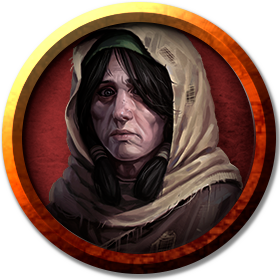
Picture: Handout: Mad Mary
Mad Mary sits in the center of the floor in an upstairs bedroom of her home, clutching a malformed doll. She is lost in her sorrow and despondency. She barely recognizes the presence of anyone in the room. She says nothing in the presence of anger, but she will talk, albeit haltingly, to someone who talks with her gently.
Mary hid her beloved daughter, Gertruda, in this house for the girl’s entire life. Gertruda, now a teenager, broke out of the house a week ago and has not been seen since. Her mother fears the worst—and is justified in doing so. See area K42 in chapter 4 for more information on Gertruda’s fate.
Mad Mary sits in the center of the floor in an upstairs bedroom of her home, clutching a malformed doll. She is lost in her sorrow and despondency. She barely recognizes the presence of anyone in the room. She says nothing in the presence of anger, but she will talk, albeit haltingly, to someone who talks with her gently.
Mary hid her beloved daughter, Gertruda, in this house for the girl’s entire life. Gertruda, now a teenager, broke out of the house a week ago and has not been seen since. Her mother fears the worst—and is justified in doing so. See area K42 in chapter 4 for more information on Gertruda’s fate.
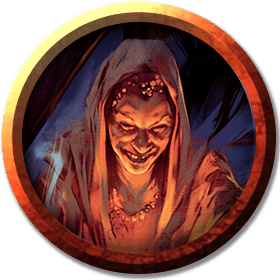
Madam Eva
The fortune-teller Madam Eva lives among the Vistani but isn’t truly one of them. She appears to be in her seventies, but she is, in fact, much older.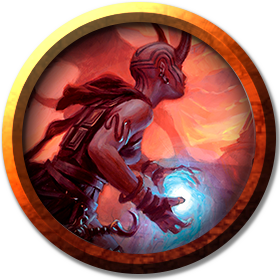
Mages spend their lives in the study and practice of magic. Good-aligned mages offer counsel to nobles and others in power, while evil mages dwell in isolated sites to perform unspeakable experiments without interference.
• Cantrips (at will): fire bolt, light, mage hand, prestidigitation
• 1st level (4 slots): detect magic, mage armor, magic missile, shield
• 2nd level (3 slots): misty step, suggestion
• 3rd level (3 slots): counterspell, fireball, fly
• 4th level (3 slots): greater invisibility, ice storm
• 5th level (1 slot): cone of cold
Dagger (Ranged): Ranged Weapon Attack: +5 to hit, range 20/60 ft., one target. Hit: 4 (1d4 + 2) piercing damage.
Fire Bolt: Ranged Spell Attack: +6 to hit, range 120 ft., one target. Hit: 10 (2d10) fire damage. A flammable object hit by this spell ignites if it isn't being worn or carried.
Variant: Familiars
Any spellcaster that can cast the find familiar spell (such as an archmage or mage) is likely to have a familiar. The familiar can be one of the creatures described in the spell (see the Player’s Handbook) or some other Tiny monster, such as a crawling claw, imp, pseudodragon, or quasit.Traits
Spellcasting: The mage is a 9th-level spellcaster. Its spellcasting ability is Intelligence (spell save DC 14, +6 to hit with spell attacks). The mage has the following wizard spells prepared:• Cantrips (at will): fire bolt, light, mage hand, prestidigitation
• 1st level (4 slots): detect magic, mage armor, magic missile, shield
• 2nd level (3 slots): misty step, suggestion
• 3rd level (3 slots): counterspell, fireball, fly
• 4th level (3 slots): greater invisibility, ice storm
• 5th level (1 slot): cone of cold
Actions
Dagger (Melee): Melee Weapon Attack: +5 to hit, reach 5 ft., one target. Hit: 4 (1d4 + 2) piercing damage.Dagger (Ranged): Ranged Weapon Attack: +5 to hit, range 20/60 ft., one target. Hit: 4 (1d4 + 2) piercing damage.
Fire Bolt: Ranged Spell Attack: +6 to hit, range 120 ft., one target. Hit: 10 (2d10) fire damage. A flammable object hit by this spell ignites if it isn't being worn or carried.
Devils
Devils personify tyranny, with a totalitarian society dedicated to the domination of mortal life. The shadow of the Nine Hells of Baator extends far across the multiverse, and Asmodeus, the dark lord of Nessus, strives to subjugate the cosmos to satisfy his thirst for power. To do so, he must continually expand his infernal armies, sending his servants to the mortal realm to corrupt the souls from which new devils are spawned.Lords of Tyranny. Devils live to conquer, enslave, and oppress. They take perverse delight in exercising authority over the weak, and any creature that defies the authority of a devil faces swift and cruel punishment. Every interaction is an opportunity for a devil to display its power, and all devils have a keen understanding of how to use and abuse their power.
Devils understand the failings that plague intelligent mortals, and they use that knowledge to lead mortals into temptation and darkness, turning creatures into slaves to their own corruption. Devils on the Material Plane use their influence to manipulate humanoid rulers, whispering evil thoughts, fomenting paranoia, and eventually driving them to tyrannical actions.
Obedience and Ambition. In accordance with their lawful alignment, devils obey even when they envy or dislike their superiors, knowing that their obedience will be rewarded. The hierarchy of the Nine Hells depends on this unswerving loyalty, without which that fiendish plane would become as anarchic as the Abyss.
At the same time, it is in the nature of devils to scheme, creating in some a desire to rule that eclipses their contentment to be ruled. This singular ambition is strongest among the archdevils whom Asmodeus appoints to rule the nine layers of the Nine Hells. These high-ranking fiends are the only devils to ever sample true power, which they crave like the sweetest ambrosia.
Dark Dealers and Soul Mongers. Devils are confined to the Lower Planes, but they can travel beyond those planes by way of portals or powerful summoning magic. They love to strike bargains with mortals seeking to gain some benefit or prize, but a mortal making such a bargain must be wary. Devils are crafty negotiators and positively ruthless at enforcing the terms of an agreement. Moreover, a contract with even the lowliest devil is enforced by Asmodeus’s will. Any mortal creature that breaks such a contract instantly forfeits its soul, which is spirited away to the Nine Hells.
To own a creature’s soul is to have absolute control over that creature, and most devils accept no other currency in exchange for the fiendish power and boons they can provide. A soul is usually forfeited when a mortal dies naturally, for devils are immortal and can wait years for a contract to play out. If a contract allows a devil to claim a mortal’s soul before death, it can instantly return to the Nine Hells with the soul in its possession. Only divine intervention can release a soul after a devil has claimed it.
The Infernal Hierarchy
The Nine Hells has a rigid hierarchy that defines every aspect of its society. Asmodeus is the supreme ruler of all devils, and the only creature in the Nine Hells with the powers of a lesser god. Worshiped as such in the Material Plane, Asmodeus inspires the evil humanoid cults that take his name. In the Nine Hells, he commands scores of pit fiend generals, which in turn command legions of subordinates.A supreme tyrant, a brilliant deceiver, and a master of subtlety, Asmodeus protects his throne by keeping his friends close and his enemies closer. He delegates most matters of rulership to the pit fiends and lesser archdevils that make up the infernal bureaucracy of the Nine Hells, even as he knows that those powerful devils conspire to usurp the Throne of Baator from which he rules. Asmodeus appoints archdevils, and he can strip any member of the infernal hierarchy of rank and status as he likes.If it dies outside the Nine Hells, a devil disappears in a cloud of sulfurous smoke or dissolves into a pool of ichor, instantly returning to its home layer, where it reforms at full strength. Devils that die in the Nine Hells are destroyed forever—a fate that even Asmodeus fears.
Archdevils. The archdevils include all the current and deposed rulers of the Nine Hells (see the Layers and Lords of the Nine Hells table), as well as the dukes and duchesses that make up their courts, attend them as advisers, and hope to supplant them. Every archdevil is a unique being with an appearance that reflects its particular evil nature.
Greater Devils. The greater devils include the pit fiends, erinyes, horned devils, and ice devils that command lesser devils and attend the archdevils.
Lesser Devils. The lesser devils include numerous strains of fiends, including imps, chain devils, spined devils, bearded devils, barbed devils, and bone devils.
Lemures. The lowest form of devil, lemures are the twisted and tormented souls of evil and corrupted mortals. A lemure killed in the Nine Hells is only permanently destroyed if it is killed with a blessed weapon or if its shapeless corpse is splashed with holy water before it can return to life.
Promotion and Demotion. When the soul of an evil mortal sinks into the Nine Hells, it takes on the physical form of a wretched lemure. Archdevils and greater devils have the power to promote lemures to lesser devils. Archdevils can promote lesser devils to greater devils, and Asmodeus alone can promote a greater devil to archdevil status. This diabolic promotion invokes a brief, painful transformation, with the devil’s memories passing intact from one form to the next.
Low-level promotions are typically based on need, such as when a pit fiend transforms lemures into imps to gain invisible spies under its command. High-level promotions are almost always based on merit, such as when a bone devil that distinguishes itself in battle is transformed into a horned devil by the archdevil it serves. A devil is seldom promoted more than one step at a time in the hierarchy of infernal forms.
Infernal Hierarchy
1. lemureLesser devils
2. imp
3. spined devil
4. bearded devil
5. barbed devil
6. chain devil
7. bone devil
Greater devils
8. horned devil
9. erinyes
10. ice devil
11. pit fiend
Archdevils
12. duke or duchess
13. archduke or archduchess
Demotion is the customary punishment for failure or disobedience among the devils. Archdevils or greater devils can demote a lesser devil to a lemure, which loses all memory of its prior existence. An archdevil can demote a greater devil to lesser devil status, but the demoted devil retains its memories—and might seek vengeance if the severity of the demotion is excessive.
No devil can promote or demote another devil that has not sworn fealty to it, preventing rival archdevils from demoting each other’s most powerful servants. Since all devils swear fealty to Asmodeus, he can freely demote any other devil, transforming it into whatever infernal form he desires.
The Nine Hells
The Nine Hells are a single plane comprising nine separate layers (see the Layers and Lords of the Nine Hells table). The first eight layers are each ruled by archdevils that answer to the greatest archdevil of all: Asmodeus, the Archduke of Nessus, the ninth layer. To reach the deepest layer of the Nine Hells, one must descend through all eight of the layers above it, in order. The most expeditious means of doing so is the River Styx, which plunges ever deeper as it flows from one layer to the next. Only the most courageous adventurers can withstand the torment and horror of that journey.Devil True Names and Talismans
Though devils all have common names, every devil above a lemure in station also has a true name that it keeps secret. A devil can be forced to disclose its true name if charmed, and ancient scrolls and tomes are said to exist that list the true names of certain devils.A mortal who learns a devil’s true name can use powerful summoning magic to call the devil from the Nine Hells and bind it into service. Binding can also be accomplished with the help of a devil talisman. Each of these ancient relics is inscribed with the true name of a devil it controls, and was bathed in the blood of a worthy sacrifice—typically someone the creator loved—when crafted.
However it is summoned, a devil brought to the Material Plane typically resents being pressed into service. However, the devil seizes every opportunity to corrupt its summoner so that the summoner’s soul ends up in the Nine Hells. Only imps are truly content to be summoned, and they easily commit to serving a summoner as a familiar, but they still do their utmost to corrupt those who summon them.
Imp
Imps are found throughout the Lower Planes, either running errands for their infernal masters, spying on rivals, or misleading and waylaying mortals. An imp will proudly serve an evil master of any kind, but it can’t be relied on to carry out tasks with any speed or efficiency.An imp can assume animal form at will, but in its natural state it resembles a diminutive red-skinned humanoid with a barbed tail, small horns, and leathery wings. It strikes while invisible, attacking with its poison stinger.
Variant: Imp Familiar
Imps can be found in the service to mortal spellcasters, acting as advisors, spies, and familiars. An imp urges its master to acts of evil, knowing the mortal’s soul is a prize the imp might ultimately claim. Imps display an unusual loyalty to their masters, and an imp can be quite dangerous if its master is threatened. Some such imps have the following trait.Familiar. The imp can enter into a contract to serve another creature as a familiar, forming a telepathic bond with its willing master. While the two are bonded, the master can sense what the imp senses as long as they are within 1 mile of each other. While the imp is within 10 feet of its master, the master shares the imp’s Magic Resistance trait. If its master violates the terms of the contract, the imp can end its service as a familiar, ending the telepathic bond.
Layers and the Lords of the Nine Hells
| Layer | Layer Name | Archduke or Archduchess | Previous Rulers | Primary Inhabitants |
| 1 | Avernus | Zariel | Bel, Tiamat | Erinyes, imps, spined devils |
| 2 | Dis | Dispater | — | Bearded devils, erinyes, imps, spined devils |
| 3 | Minauros | Mammon | — | Bearded devils, chain devils, imps, spined devils |
| 4 | Phlegethos | Belial and Fierna | — | Barbed devils, bone devils, imps, spined devils |
| 5 | Stygia | Levistus | Geryon | Bone devils, erinyes, ice devils, imps |
| 6 | Malbolge | Glasya | Malagard, Moloch | Barbed devils, bone devils, horned devils, imps |
| 7 | Maladomini | Baalzebul | — | Barbed devils, bone devils, horned devils, imps |
| 8 | Cania | Mephistopheles | — | Horned devils, ice devils, imps, pit fiends |
| 9 | Nessus | Asmodeus | — | All devils |
Traits
Shapechanger: The imp can use its action to polymorph into a beast form that resembles a rat (speed 20 ft.), a raven (20 ft., fly 60 ft.), or a spider (20 ft., climb 20 ft.), or back into its true form. Its statistics are the same in each form, except for the speed changes noted. Any equipment it is wearing or carrying isn't transformed. It reverts to its true form if it dies.Devil's Sight: Magical darkness doesn't impede the imp's darkvision.
Magic Resistance: The imp has advantage on saving throws against spells and other magical effects.
Variant: Familiar: The imp can enter into a contract to serve another creature as a familiar, forming a Telepathic Bond with its willing master. While the two are bonded, the master can sense what the imp senses as long as they are within 1 mile of each other. While the imp is within 10 feet of its master, the master shares the imp’s Magic Resistance trait. If its master violates the terms of the contract, the imp can end its service as a familiar, ending the Telepathic Bond.
Actions
Sting (Bite in Beast Form): Melee Weapon Attack: +5 to hit, reach 5 ft ., one target. Hit: 5 (1d4 + 3) piercing damage, and the target must make on a DC 11 Constitution saving throw, taking 10 (3d6) poison damage on a failed save, or half as much damage on a successful one.Invisibility: The imp magically turns invisible until it attacks, or until its concentration ends (as if concentrating on a spell). Any equipment the imp wears or carries is invisible with it.
Mongrelfolk
Mongrelfolk are humanoids that have undergone, or whose ancestors underwent, horrific magical transformations, to the extent that they retain only a fraction of their original being. Their humanoid bodies incorporate the features of various beasts. For example, one mongrelfolk might have the basic body shape of a dwarf with a head that combines the features of a cat and a lizard, one arm that ends in a crab’s pincer, and one leg that ends in a cloven hoof. Another might have the skin and horns of a cow, the eyes of a spider, frog’s legs, and a scaly lizard’s tail. Each mongrelfolk’s mad combination of humanoid and animal forms results in its having a slow, awkward gait.Sound Mimicry. Mongrelfolk have misshapen mouths and vocal cords. They speak fragmented Common mixed with various animal cries and nonsense. They can effectively imitate sounds made by beasts and humanoids that they’ve heard. Mongrelfolk aren’t sophisticated enough to use these sounds as a covert form of communication, but they can use the sounds to lure enemies into a trap or otherwise distract them.
Outcasts. Mongrelfolk are seldom welcome in other humanoid societies, where they are abused, enslaved, or shunned. They typically live on the fringes of civilization in ruins, deserted buildings, or other places that other humanoid races once lived in or built. They tend to be timid and skittish outside their homes and fiercely territorial within their lairs.
Camouflage Experts. Mongrelfolk often hide their deformities under cloaks and cowls. In this way, they can sometimes pass as stout humans or thin dwarves. They are fond of camouflage, attaching leaves and twigs to their cloaks, making brown paint to cover their skin, and weaving grass nets under which they can hide. They use such camouflage while hunting in the wild or while standing guard outside their lairs. Until it is seen, a camouflaged mongrelfolk has advantage on Stealth checks made to hide.
Horrific Offspring. It’s possible to restore a mongrelfolk to its original form using a greater restoration spell, but the same can’t be said for a mongrelfolk’s offspring. Only mongrelfolk that are made by magic can be restored to their original forms. Mongrelfolk that are born are true mongrelfolk and not the subjects of a spell or an effect that can be undone.
Mongrelfolk can breed with other humanoids, but nearly all children born to such parents are mongrelfolk. (About one child in every hundred is born looking like its non-mongrelfolk parent.)
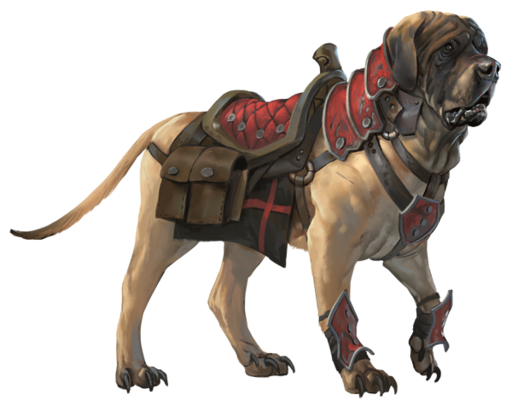
Picture: Handout: Mastiff
Mastiffs are impressive hounds prized by humanoids for their loyalty and keen senses. Mastiffs can be trained as guard dogs, hunting dogs, and war dogs. Halflings and other Small humanoids ride them as mounts.
Traits
Keen Hearing and Smell: The mastiff has advantage on Wisdom (Perception) checks that rely on hearing or smell.Actions
Bite: Melee Weapon Attack: +3 to hit, reach 5 ft., one target. Hit: 4 (1d6 + 1) piercing damage. If the target is a creature, it must succeed on a DC 11 Strength saving throw or be knocked prone.
Picture: Handout: Milivoj
Milivoj is rarely seen without a shovel, which he wields like a club. He rejects the burgomaster’s proclamation that “All will be well!” and is frustrated that he can’t protect his younger siblings. He wants to be free of Barovia’s curse but sees no hope of escape.
Milivoj is rarely seen without a shovel, which he wields like a club. He rejects the burgomaster’s proclamation that “All will be well!” and is frustrated that he can’t protect his younger siblings. He wants to be free of Barovia’s curse but sees no hope of escape.
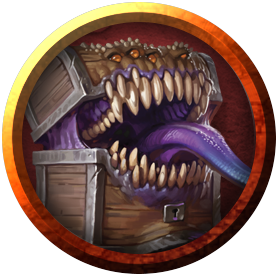
“Sometimes a chest is just a chest, but don’t bet on it.”
—X the Mystic’s 3rd rule of dungeon survival
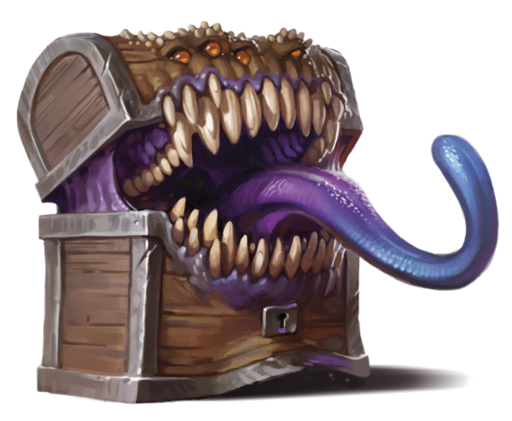
Picture: Handout: Mimic
Mimics are shapeshifting predators able to take on the form of inanimate objects to lure creatures to their doom. In dungeons, these cunning creatures most often take the form of doors and chests, having learned that such forms attract a steady stream of prey.
Imitative Predators. Mimics can alter their outward texture to resemble wood, stone, and other basic materials, and they have evolved to assume the appearance of objects that other creatures are likely to come into contact with. A mimic in its altered form is nearly unrecognizable until potential prey blunders into its reach, whereupon the monster sprouts pseudopods and attacks.
When it changes shape, a mimic excretes an adhesive that helps it seize prey and weapons that touch it. The adhesive is absorbed when the mimic assumes its amorphous form and on parts the mimic uses to move itself.
Cunning Hunters. Mimics live and hunt alone, though they occasionally share their feeding grounds with other creatures. Although most mimics have only predatory intelligence, a rare few evolve greater cunning and the ability to carry on simple conversations in Common or Undercommon. Such mimics might allow safe passage through their domains or provide useful information in exchange for food.
Traits
Shapechanger: The mimic can use its action to polymorph into an object or back into its true, amorphous form. Its statistics are the same in each form. Any equipment it is wearing or carrying isn 't transformed. It reverts to its true form if it dies.Adhesive (Object Form Only): The mimic adheres to anything that touches it. A Huge or smaller creature adhered to the mimic is also grappled by it (escape DC 13). Ability checks made to escape this grapple have disadvantage.
False Appearance (Object Form Only): While the mimic remains motionless, it is indistinguishable from an ordinary object.
Grappler: The mimic has advantage on attack rolls against any creature grappled by it.
Actions
Pseudopod: Melee Weapon Attack: +5 to hit, reach 5 ft., one target. Hit: 7 (1d8 + 3) bludgeoning damage. If the mimic is in object form, the target is subjected to its Adhesive trait.Bite: Melee Weapon Attack: +5 to hit, reach 5 ft., one target. Hit: 7 (1d8 + 3) piercing damage plus 4 (1d8) acid damage.
Mongrelfolk
Mongrelfolk are humanoids that have undergone, or whose ancestors underwent, horrific magical transformations, to the extent that they retain only a fraction of their original being. Their humanoid bodies incorporate the features of various beasts. For example, one mongrelfolk might have the basic body shape of a dwarf with a head that combines the features of a cat and a lizard, one arm that ends in a crab’s pincer, and one leg that ends in a cloven hoof. Another might have the skin and horns of a cow, the eyes of a spider, frog’s legs, and a scaly lizard’s tail. Each mongrelfolk’s mad combination of humanoid and animal forms results in its having a slow, awkward gait.Sound Mimicry. Mongrelfolk have misshapen mouths and vocal cords. They speak fragmented Common mixed with various animal cries and nonsense. They can effectively imitate sounds made by beasts and humanoids that they’ve heard. Mongrelfolk aren’t sophisticated enough to use these sounds as a covert form of communication, but they can use the sounds to lure enemies into a trap or otherwise distract them.
Outcasts. Mongrelfolk are seldom welcome in other humanoid societies, where they are abused, enslaved, or shunned. They typically live on the fringes of civilization in ruins, deserted buildings, or other places that other humanoid races once lived in or built. They tend to be timid and skittish outside their homes and fiercely territorial within their lairs.
Camouflage Experts. Mongrelfolk often hide their deformities under cloaks and cowls. In this way, they can sometimes pass as stout humans or thin dwarves. They are fond of camouflage, attaching leaves and twigs to their cloaks, making brown paint to cover their skin, and weaving grass nets under which they can hide. They use such camouflage while hunting in the wild or while standing guard outside their lairs. Until it is seen, a camouflaged mongrelfolk has advantage on Stealth checks made to hide.
Horrific Offspring. It’s possible to restore a mongrelfolk to its original form using a greater restoration spell, but the same can’t be said for a mongrelfolk’s offspring. Only mongrelfolk that are made by magic can be restored to their original forms. Mongrelfolk that are born are true mongrelfolk and not the subjects of a spell or an effect that can be undone.
Mongrelfolk can breed with other humanoids, but nearly all children born to such parents are mongrelfolk. (About one child in every hundred is born looking like its non-mongrelfolk parent.)
Mongrelfolk
Mongrelfolk are humanoids that have undergone, or whose ancestors underwent, horrific magical transformations, to the extent that they retain only a fraction of their original being. Their humanoid bodies incorporate the features of various beasts. For example, one mongrelfolk might have the basic body shape of a dwarf with a head that combines the features of a cat and a lizard, one arm that ends in a crab’s pincer, and one leg that ends in a cloven hoof. Another might have the skin and horns of a cow, the eyes of a spider, frog’s legs, and a scaly lizard’s tail. Each mongrelfolk’s mad combination of humanoid and animal forms results in its having a slow, awkward gait.Sound Mimicry. Mongrelfolk have misshapen mouths and vocal cords. They speak fragmented Common mixed with various animal cries and nonsense. They can effectively imitate sounds made by beasts and humanoids that they’ve heard. Mongrelfolk aren’t sophisticated enough to use these sounds as a covert form of communication, but they can use the sounds to lure enemies into a trap or otherwise distract them.
Outcasts. Mongrelfolk are seldom welcome in other humanoid societies, where they are abused, enslaved, or shunned. They typically live on the fringes of civilization in ruins, deserted buildings, or other places that other humanoid races once lived in or built. They tend to be timid and skittish outside their homes and fiercely territorial within their lairs.
Camouflage Experts. Mongrelfolk often hide their deformities under cloaks and cowls. In this way, they can sometimes pass as stout humans or thin dwarves. They are fond of camouflage, attaching leaves and twigs to their cloaks, making brown paint to cover their skin, and weaving grass nets under which they can hide. They use such camouflage while hunting in the wild or while standing guard outside their lairs. Until it is seen, a camouflaged mongrelfolk has advantage on Stealth checks made to hide.
Horrific Offspring. It’s possible to restore a mongrelfolk to its original form using a greater restoration spell, but the same can’t be said for a mongrelfolk’s offspring. Only mongrelfolk that are made by magic can be restored to their original forms. Mongrelfolk that are born are true mongrelfolk and not the subjects of a spell or an effect that can be undone.
Mongrelfolk can breed with other humanoids, but nearly all children born to such parents are mongrelfolk. (About one child in every hundred is born looking like its non-mongrelfolk parent.)
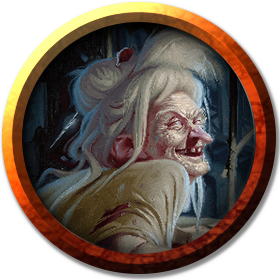
Picture: Handout: Morgantha and Her Pastry Cart
Faces of Evil. Ancient beings with origins in the Feywild, hags are cankers on the mortal world. Their withered faces are framed by long, frayed hair, horrid moles and warts dot their blotchy skin, and their long, skinny fingers are tipped by claws that can slice open flesh with a touch. Their simple clothes are always tattered and filthy.
All hags possess magical powers, and some have an affinity for spellcasting. They can alter their forms or curse their foes, and their arrogance inspires them to view their magic as a challenge to the magic of the gods, whom they blaspheme at every opportunity.
Hags name themselves in darkly whimsical ways, claiming monikers such as Black Morwen, Peggy Pigknuckle, Grandmother Titchwillow, Nanna Shug, Rotten Ethel, or Auntie Wormtooth.
Monstrous Motherhood. Hags propagate by snatching and devouring human infants. After stealing a baby from its cradle or its mother’s womb, the hag consumes the poor child. A week later, the hag gives birth to a daughter who looks human until her thirteenth birthday, whereupon the child transforms into the spitting image of her hag mother.
Hags sometimes raise the daughters they spawn, creating covens. A hag might also return the child to its grieving parents, only to watch from the shadows as the child grows up to become a horror.
Dark Bargains. Arrogant to a fault, hags believe themselves to be the most cunning of creatures, and they treat all others as inferior. Even so, a hag is open to dealing with mortals as long as those mortals show the proper respect and deference. Over their long lives, hags accumulate much knowledge of local lore, dark creatures, and magic, which they are pleased to sell.
Hags enjoy watching mortals bring about their own downfall, and a bargain with a hag is always dangerous. The terms of such bargains typically involve demands to compromise principles or give up something dear—especially if the thing lost diminishes or negates the knowledge gained through the bargain.
A Foul Nature. Hags love the macabre and festoon their garb with dead things and accentuate their appearance with bones, bits of flesh, and filth. They nurture blemishes and pick at wounds to produce weeping, suppurating flesh. Attractive creatures evoke disgust in a hag, which might “help” such creatures by disfiguring or transforming them.
This embrace of the disturbing and unpleasant extends to all aspects of a hag’s life. A hag might fly in a magical giant’s skull, landing it on a tree shaped to resemble an enormous headless body. Another might travel with a menagerie of monsters and slaves kept in cages, and disguised by illusions to lure unwary creatures close. Hags sharpen their teeth on millstones and spin cloth from the intestines of their victims, reacting with glee to the horror their actions invoke.
Dark Sorority. Hags maintain contact with each other and share knowledge. Through such contacts, it is likely that any given hag knows of every other hag in existence. Hags don’t like each other, but they abide by an ageless code of conduct. Hags announce their presence before crossing into another hag’s territory, bring gifts when entering another hag’s dwelling, and break no oaths given to other hags—as long as the oath isn’t given with the fingers crossed.
Some humanoids make the mistake of thinking that the hags’ rules of conduct apply to all creatures. When confronted by such an individual, a hag might find it amusing to string the fool along for a while before teaching it a permanent lesson.
Dark Lairs. Hags dwell in dark and twisted woods, bleak moors, storm-lashed seacoasts, and gloomy swamps. In time, the landscape around a hag’s lair reflects the creature’s noxiousness, such that the land itself can attack and kill trespassers. Trees twisted by darkness attack passersby, while vines snake through the undergrowth to snare and drag off creatures one at a time. Foul stinking fogs turn the air to poison, and conceal pools of quicksand and sinkholes that consume unwary wanderers.
Night hags were once creatures of the Feywild, but their foulness saw them exiled to Hades long ago, where they degenerated into fiends. The night hags have long since spread across the Lower Planes.
Soulmongers. While a humanoid sleeps, a night hag can straddle the person ethereally and intrude upon its dreams. Any creature with truesight can see the hag’s spectral form straddling its prey. The ethereal hag fills her victim’s head with doubts and fears, in the hope of tricking it into performing evil acts in the waking world. The hag continues her nightly visitations until the victim finally expires in its sleep. If the hag has driven her victim to commit evil deeds, she traps its corrupted soul in her soul bag (see Night Hag Items) for transport to Hades.
Covens. A night hag that is part of a coven (see Hag Covens) has a challenge rating of 7 (2,900 XP).
Heartstone. This lustrous black gem allows a night hag to become ethereal while it is in her possession. The touch of a heartstone also cures any disease. Crafting a heartstone takes 30 days.
Soul Bag. When an evil humanoid dies as a result of a night hag’s Nightmare Haunting, the hag catches the soul in this black sack made of stitched flesh. A soul bag can hold only one evil soul at a time, and only the night hag who crafted the bag can catch a soul with it. Crafting a soul bag takes 7 days and a humanoid sacrifice (whose flesh is used to make the bag).
A coven consists of three hags so that any arguments between two hags can be settled by the third. If more than three hags ever come together, as might happen if two covens come into conflict, the result is usually chaos.
Shared Spellcasting. While all three members of a hag coven are within 30 feet of one another, they can each cast the following spells from the wizard’s spell list but must share the spell slots among themselves:
• 1st level (4 slots): identify, ray of sickness
• 2nd level (3 slots): hold person, locate object
• 3rd level (3 slots): bestow curse, counterspell, lightning bolt
• 4th level (3 slots): phantasmal killer, polymorph
• 5th level (2 slots): contact other plane, scrying
• 6th level (1 slot): eyebite
For casting these spells, each hag is a 12th-level spellcaster that uses Intelligence as her spellcasting ability. The spell save DC is 12 + the hag’s Intelligence modifier, and the spell attack bonus is 4 + the hag’s Intelligence modifier.
Hag Eye. A hag coven can craft a magic item called a hag eye, which is made from a real eye coated in varnish and often fitted to a pendant or other wearable item. The hag eye is usually entrusted to a minion for safekeeping and transport. A hag in the coven can take an action to see what the hag eye sees if the hag eye is on the same plane of existence. A hag eye has AC 10, 1 hit point, and darkvision with a radius of 60 feet. If it is destroyed, each coven member takes 3d10 psychic damage and is blinded for 24 hours.
A hag coven can have only one hag eye at a time, and creating a new one requires all three members of the coven to perform a ritual. The ritual takes 1 hour, and the hags can’t perform it while blinded. During the ritual, if the hags take any action other than performing the ritual, they must start over.
• At will: detect magic, magic missile
• 2/day each: plane shift (self only), ray of enfeeblement, sleep
Magic Resistance: The hag has advantage on saving throws against spells and other magical effects.
Shared Spellcasting (Coven Only): While all three members of a hag coven are within 30 feet of one another, they can each cast the following spells from the wizard's spell list but must share the spell slots among themselves:
• 1st level (4 slots): identify, ray of sickness
• 2nd level (3 slots): hold person, locate object
• 3rd level (3 slots): bestow curse, counterspell, lightning bolt
• 4th level (3 slots): phantasmal killer, polymorph
• 5th level (2 slots): contact other plane, scrying
• 6th level (1 slot): eye bite
For casting these spells, each hag is a 12th-level spellcaster that uses Intelligence as her spellcasting ability. The night hag's spell save DC is 15, and the spell attack bonus is +7 for these spells.
Ray of Enfeeblement: Ranged Spell Attack: +6 to hit, range 60 ft., on creature. Hit: 0 (1d0) necrotic damage. The target deals half damage with weapon attacks that use Strength for the duration. At the end of each of the target's turns, it can make a DC 14 Constitution saving throw, ending the effect early on a success.
Change Shape: The hag magically polymorphs into a Small or Medium female humanoid, or back into her true form. Her statistics are the same in each form. Any equipment she is wearing or carrying isn't transformed. She reverts to her true form if she dies.
Etherealness: The hag magically enters the Ethereal Plane from the Material Plane, or vice versa. To do so, the hag must have a heartstone in her possession.
Nightmare Haunting (1/Day): While on the Ethereal Plane, the hag magically touches a sleeping humanoid on the Material Plane. A protection from evil and good spell cast on the target prevents this contact, as does a magic circle. As long as the contact persists, the target has dreadful visions. If these visions last for at least 1 hour, the target gains no benefit from its rest, and its hit point maximum is reduced by 5 (1d10). If this effect reduces the target's hit point maximum to 0, the target dies, and if the target was evil, its soul is trapped in the hag's soul bag. The reduction to the target's hit point maximum lasts until removed by the greater restoration spell or similar magic.
Hags
Hags represent all that is evil and cruel. Though they resemble withered crones, there is nothing mortal about these monstrous creatures, whose forms reflect only the wickedness in their hearts.Faces of Evil. Ancient beings with origins in the Feywild, hags are cankers on the mortal world. Their withered faces are framed by long, frayed hair, horrid moles and warts dot their blotchy skin, and their long, skinny fingers are tipped by claws that can slice open flesh with a touch. Their simple clothes are always tattered and filthy.
All hags possess magical powers, and some have an affinity for spellcasting. They can alter their forms or curse their foes, and their arrogance inspires them to view their magic as a challenge to the magic of the gods, whom they blaspheme at every opportunity.
Hags name themselves in darkly whimsical ways, claiming monikers such as Black Morwen, Peggy Pigknuckle, Grandmother Titchwillow, Nanna Shug, Rotten Ethel, or Auntie Wormtooth.
Monstrous Motherhood. Hags propagate by snatching and devouring human infants. After stealing a baby from its cradle or its mother’s womb, the hag consumes the poor child. A week later, the hag gives birth to a daughter who looks human until her thirteenth birthday, whereupon the child transforms into the spitting image of her hag mother.
Hags sometimes raise the daughters they spawn, creating covens. A hag might also return the child to its grieving parents, only to watch from the shadows as the child grows up to become a horror.
Dark Bargains. Arrogant to a fault, hags believe themselves to be the most cunning of creatures, and they treat all others as inferior. Even so, a hag is open to dealing with mortals as long as those mortals show the proper respect and deference. Over their long lives, hags accumulate much knowledge of local lore, dark creatures, and magic, which they are pleased to sell.
Hags enjoy watching mortals bring about their own downfall, and a bargain with a hag is always dangerous. The terms of such bargains typically involve demands to compromise principles or give up something dear—especially if the thing lost diminishes or negates the knowledge gained through the bargain.
A Foul Nature. Hags love the macabre and festoon their garb with dead things and accentuate their appearance with bones, bits of flesh, and filth. They nurture blemishes and pick at wounds to produce weeping, suppurating flesh. Attractive creatures evoke disgust in a hag, which might “help” such creatures by disfiguring or transforming them.
This embrace of the disturbing and unpleasant extends to all aspects of a hag’s life. A hag might fly in a magical giant’s skull, landing it on a tree shaped to resemble an enormous headless body. Another might travel with a menagerie of monsters and slaves kept in cages, and disguised by illusions to lure unwary creatures close. Hags sharpen their teeth on millstones and spin cloth from the intestines of their victims, reacting with glee to the horror their actions invoke.
Dark Sorority. Hags maintain contact with each other and share knowledge. Through such contacts, it is likely that any given hag knows of every other hag in existence. Hags don’t like each other, but they abide by an ageless code of conduct. Hags announce their presence before crossing into another hag’s territory, bring gifts when entering another hag’s dwelling, and break no oaths given to other hags—as long as the oath isn’t given with the fingers crossed.
Some humanoids make the mistake of thinking that the hags’ rules of conduct apply to all creatures. When confronted by such an individual, a hag might find it amusing to string the fool along for a while before teaching it a permanent lesson.
Dark Lairs. Hags dwell in dark and twisted woods, bleak moors, storm-lashed seacoasts, and gloomy swamps. In time, the landscape around a hag’s lair reflects the creature’s noxiousness, such that the land itself can attack and kill trespassers. Trees twisted by darkness attack passersby, while vines snake through the undergrowth to snare and drag off creatures one at a time. Foul stinking fogs turn the air to poison, and conceal pools of quicksand and sinkholes that consume unwary wanderers.
Night Hag
Sly and subversive, night hags want to see the virtuous turn to villainy: love turned into obsession, kindness turned to hate, devotion to disregard, and generosity to selfishness. Night hags take perverse joy in corrupting mortals.Night hags were once creatures of the Feywild, but their foulness saw them exiled to Hades long ago, where they degenerated into fiends. The night hags have long since spread across the Lower Planes.
Soulmongers. While a humanoid sleeps, a night hag can straddle the person ethereally and intrude upon its dreams. Any creature with truesight can see the hag’s spectral form straddling its prey. The ethereal hag fills her victim’s head with doubts and fears, in the hope of tricking it into performing evil acts in the waking world. The hag continues her nightly visitations until the victim finally expires in its sleep. If the hag has driven her victim to commit evil deeds, she traps its corrupted soul in her soul bag (see Night Hag Items) for transport to Hades.
Covens. A night hag that is part of a coven (see Hag Covens) has a challenge rating of 7 (2,900 XP).
Night Hag Items
A night hag carries two very rare magic items that she must craft for herself. If either object is lost, the night hag will go to great lengths to retrieve it, as creating a new tool takes time and effort.Heartstone. This lustrous black gem allows a night hag to become ethereal while it is in her possession. The touch of a heartstone also cures any disease. Crafting a heartstone takes 30 days.
Soul Bag. When an evil humanoid dies as a result of a night hag’s Nightmare Haunting, the hag catches the soul in this black sack made of stitched flesh. A soul bag can hold only one evil soul at a time, and only the night hag who crafted the bag can catch a soul with it. Crafting a soul bag takes 7 days and a humanoid sacrifice (whose flesh is used to make the bag).
Hag Covens
When hags must work together, they form covens, in spite of their selfish natures. A coven is made up of hags of any type, all of whom are equals within the group. However, each of the hags continues to desire more personal power.A coven consists of three hags so that any arguments between two hags can be settled by the third. If more than three hags ever come together, as might happen if two covens come into conflict, the result is usually chaos.
Shared Spellcasting. While all three members of a hag coven are within 30 feet of one another, they can each cast the following spells from the wizard’s spell list but must share the spell slots among themselves:
• 1st level (4 slots): identify, ray of sickness
• 2nd level (3 slots): hold person, locate object
• 3rd level (3 slots): bestow curse, counterspell, lightning bolt
• 4th level (3 slots): phantasmal killer, polymorph
• 5th level (2 slots): contact other plane, scrying
• 6th level (1 slot): eyebite
For casting these spells, each hag is a 12th-level spellcaster that uses Intelligence as her spellcasting ability. The spell save DC is 12 + the hag’s Intelligence modifier, and the spell attack bonus is 4 + the hag’s Intelligence modifier.
Hag Eye. A hag coven can craft a magic item called a hag eye, which is made from a real eye coated in varnish and often fitted to a pendant or other wearable item. The hag eye is usually entrusted to a minion for safekeeping and transport. A hag in the coven can take an action to see what the hag eye sees if the hag eye is on the same plane of existence. A hag eye has AC 10, 1 hit point, and darkvision with a radius of 60 feet. If it is destroyed, each coven member takes 3d10 psychic damage and is blinded for 24 hours.
A hag coven can have only one hag eye at a time, and creating a new one requires all three members of the coven to perform a ritual. The ritual takes 1 hour, and the hags can’t perform it while blinded. During the ritual, if the hags take any action other than performing the ritual, they must start over.
Traits
Innate Spellcasting: The hag's innate spellcasting ability is Charisma (spell save DC 14, +6 to hit with spell attacks). She can innately cast the following spells, requiring no material components:• At will: detect magic, magic missile
• 2/day each: plane shift (self only), ray of enfeeblement, sleep
Magic Resistance: The hag has advantage on saving throws against spells and other magical effects.
Shared Spellcasting (Coven Only): While all three members of a hag coven are within 30 feet of one another, they can each cast the following spells from the wizard's spell list but must share the spell slots among themselves:
• 1st level (4 slots): identify, ray of sickness
• 2nd level (3 slots): hold person, locate object
• 3rd level (3 slots): bestow curse, counterspell, lightning bolt
• 4th level (3 slots): phantasmal killer, polymorph
• 5th level (2 slots): contact other plane, scrying
• 6th level (1 slot): eye bite
For casting these spells, each hag is a 12th-level spellcaster that uses Intelligence as her spellcasting ability. The night hag's spell save DC is 15, and the spell attack bonus is +7 for these spells.
Actions
Claws (Hag Form Only): Melee Weapon Attack: +7 to hit, reach 5 ft., one target. Hit: 13 (2d8 + 4) slashing damage.Ray of Enfeeblement: Ranged Spell Attack: +6 to hit, range 60 ft., on creature. Hit: 0 (1d0) necrotic damage. The target deals half damage with weapon attacks that use Strength for the duration. At the end of each of the target's turns, it can make a DC 14 Constitution saving throw, ending the effect early on a success.
Change Shape: The hag magically polymorphs into a Small or Medium female humanoid, or back into her true form. Her statistics are the same in each form. Any equipment she is wearing or carrying isn't transformed. She reverts to her true form if she dies.
Etherealness: The hag magically enters the Ethereal Plane from the Material Plane, or vice versa. To do so, the hag must have a heartstone in her possession.
Nightmare Haunting (1/Day): While on the Ethereal Plane, the hag magically touches a sleeping humanoid on the Material Plane. A protection from evil and good spell cast on the target prevents this contact, as does a magic circle. As long as the contact persists, the target has dreadful visions. If these visions last for at least 1 hour, the target gains no benefit from its rest, and its hit point maximum is reduced by 5 (1d10). If this effect reduces the target's hit point maximum to 0, the target dies, and if the target was evil, its soul is trapped in the hag's soul bag. The reduction to the target's hit point maximum lasts until removed by the greater restoration spell or similar magic.
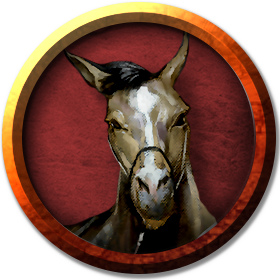
Traits
Beast of Burden: The mule is considered to be a Large animal for the purpose of determining its carrying capacity.Sure-Footed: The mule has advantage on Strength and Dexterity saving throws made against effects that would knock it prone.
Actions
Hooves: Melee Weapon Attack: +2 to hit, reach 5 ft., one target. Hit: 4 (1d4 + 2) bludgeoning damage.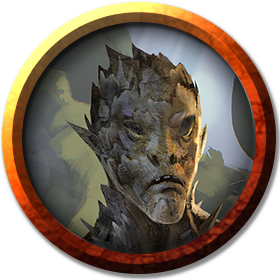
Behold the legacy of Gulthias the vampire: plants with a taste for blood.
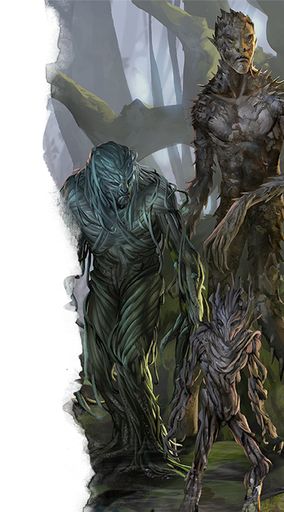
Blights
Awakened plants gifted with the powers of intelligence and mobility, blights plague lands contaminated by darkness. Drinking that darkness from the soil, a blight carries out the will of ancient evil and attempts to spread that evil wherever it can.Roots of the Gulthias Tree. Legends tell of a vampire named Gulthias who worked terrible magic and raised up an abominable tower called Nightfang Spire. Gulthias was undone when a hero plunged a wooden stake through his heart, but as the vampire was destroyed, his blood infused the stake with a dreadful power. In time, tendrils of new growth sprouted from the wood, growing into a sapling infused with the vampire’s evil essence. It is said that a mad druid discovered the sapling, transplanting it to an underground grotto where it could grow. From this Gulthias tree came the seeds from which the first blights were sown.
Dark Conquest. Wherever a tree or plant is contaminated by a fragment of an evil mind or power, a Gulthias tree can rise to infest and corrupt the surrounding forest. Its evil spreads through root and soil to other plants, which perish or transform into blights. As those blights spread, they poison and uproot healthy plants, replacing them with brambles, toxic weeds, and others of their kind. In time, an infestation of blights can turn any land or forest into a place of corruption.
In forests infested with blights, trees and plants grow with supernatural speed. Vines and undergrowth rapidly spread through buildings and overrun trails and roads. After blights have killed or driven off their inhabitants, whole villages can disappear in the space of days.
Controlled by Evil. Blights are independent creatures, but most act under a Gulthias tree’s control, often displaying the habits and traits of the life force or spirit that spawned them. By attacking their progenitor’s old foes or seeking out treasures valuable to it, they carry on the legacy of long-lost evil.
Needle Blight
In the shadows of a forest, needle blights might be taken at a distance for shuffling, hunched humanoids. Up close, these creatures reveal themselves as horrid plants whose conifer-like needles grow across their bodies in quivering clumps. A needle blight lashes out with these needles or launches them as an aerial assault that can punch through armor and flesh.When needle blights detect a threat, they loose a pollen that the wind carries to other needle blights throughout the forest. Alerted to their foes’ location, needle blights converge from all sides to drench their roots in blood.
Actions
Claws: Melee Weapon Attack: +3 to hit, reach 5 ft., one target. Hit: 6 (2d4 + 1) piercing damage.Needles: Ranged Weapon Attack: +3 to hit, range 30/60 ft., one target. Hit: 8 (2d6 + 1) piercing damage.
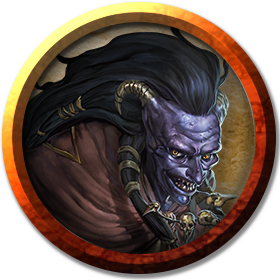
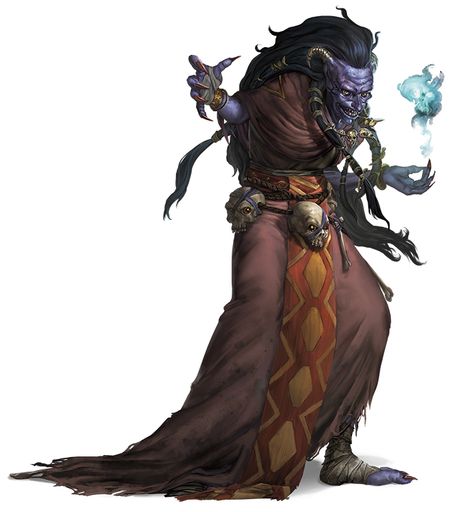
Picture: Handout: Night Hag
Hags
Hags represent all that is evil and cruel. Though they resemble withered crones, there is nothing mortal about these monstrous creatures, whose forms reflect only the wickedness in their hearts.Faces of Evil. Ancient beings with origins in the Feywild, hags are cankers on the mortal world. Their withered faces are framed by long, frayed hair, horrid moles and warts dot their blotchy skin, and their long, skinny fingers are tipped by claws that can slice open flesh with a touch. Their simple clothes are always tattered and filthy.
All hags possess magical powers, and some have an affinity for spellcasting. They can alter their forms or curse their foes, and their arrogance inspires them to view their magic as a challenge to the magic of the gods, whom they blaspheme at every opportunity.
Hags name themselves in darkly whimsical ways, claiming monikers such as Black Morwen, Peggy Pigknuckle, Grandmother Titchwillow, Nanna Shug, Rotten Ethel, or Auntie Wormtooth.
Monstrous Motherhood. Hags propagate by snatching and devouring human infants. After stealing a baby from its cradle or its mother’s womb, the hag consumes the poor child. A week later, the hag gives birth to a daughter who looks human until her thirteenth birthday, whereupon the child transforms into the spitting image of her hag mother.
Hags sometimes raise the daughters they spawn, creating covens. A hag might also return the child to its grieving parents, only to watch from the shadows as the child grows up to become a horror.
Dark Bargains. Arrogant to a fault, hags believe themselves to be the most cunning of creatures, and they treat all others as inferior. Even so, a hag is open to dealing with mortals as long as those mortals show the proper respect and deference. Over their long lives, hags accumulate much knowledge of local lore, dark creatures, and magic, which they are pleased to sell.
Hags enjoy watching mortals bring about their own downfall, and a bargain with a hag is always dangerous. The terms of such bargains typically involve demands to compromise principles or give up something dear—especially if the thing lost diminishes or negates the knowledge gained through the bargain.
A Foul Nature. Hags love the macabre and festoon their garb with dead things and accentuate their appearance with bones, bits of flesh, and filth. They nurture blemishes and pick at wounds to produce weeping, suppurating flesh. Attractive creatures evoke disgust in a hag, which might “help” such creatures by disfiguring or transforming them.
This embrace of the disturbing and unpleasant extends to all aspects of a hag’s life. A hag might fly in a magical giant’s skull, landing it on a tree shaped to resemble an enormous headless body. Another might travel with a menagerie of monsters and slaves kept in cages, and disguised by illusions to lure unwary creatures close. Hags sharpen their teeth on millstones and spin cloth from the intestines of their victims, reacting with glee to the horror their actions invoke.
Dark Sorority. Hags maintain contact with each other and share knowledge. Through such contacts, it is likely that any given hag knows of every other hag in existence. Hags don’t like each other, but they abide by an ageless code of conduct. Hags announce their presence before crossing into another hag’s territory, bring gifts when entering another hag’s dwelling, and break no oaths given to other hags—as long as the oath isn’t given with the fingers crossed.
Some humanoids make the mistake of thinking that the hags’ rules of conduct apply to all creatures. When confronted by such an individual, a hag might find it amusing to string the fool along for a while before teaching it a permanent lesson.
Dark Lairs. Hags dwell in dark and twisted woods, bleak moors, storm-lashed seacoasts, and gloomy swamps. In time, the landscape around a hag’s lair reflects the creature’s noxiousness, such that the land itself can attack and kill trespassers. Trees twisted by darkness attack passersby, while vines snake through the undergrowth to snare and drag off creatures one at a time. Foul stinking fogs turn the air to poison, and conceal pools of quicksand and sinkholes that consume unwary wanderers.
Night Hag
Sly and subversive, night hags want to see the virtuous turn to villainy: love turned into obsession, kindness turned to hate, devotion to disregard, and generosity to selfishness. Night hags take perverse joy in corrupting mortals.Night hags were once creatures of the Feywild, but their foulness saw them exiled to Hades long ago, where they degenerated into fiends. The night hags have long since spread across the Lower Planes.
Soulmongers. While a humanoid sleeps, a night hag can straddle the person ethereally and intrude upon its dreams. Any creature with truesight can see the hag’s spectral form straddling its prey. The ethereal hag fills her victim’s head with doubts and fears, in the hope of tricking it into performing evil acts in the waking world. The hag continues her nightly visitations until the victim finally expires in its sleep. If the hag has driven her victim to commit evil deeds, she traps its corrupted soul in her soul bag (see Night Hag Items) for transport to Hades.
Covens. A night hag that is part of a coven (see Hag Covens) has a challenge rating of 7 (2,900 XP).
Night Hag Items
A night hag carries two very rare magic items that she must craft for herself. If either object is lost, the night hag will go to great lengths to retrieve it, as creating a new tool takes time and effort.Heartstone. This lustrous black gem allows a night hag to become ethereal while it is in her possession. The touch of a heartstone also cures any disease. Crafting a heartstone takes 30 days.
Soul Bag. When an evil humanoid dies as a result of a night hag’s Nightmare Haunting, the hag catches the soul in this black sack made of stitched flesh. A soul bag can hold only one evil soul at a time, and only the night hag who crafted the bag can catch a soul with it. Crafting a soul bag takes 7 days and a humanoid sacrifice (whose flesh is used to make the bag).
Hag Covens
When hags must work together, they form covens, in spite of their selfish natures. A coven is made up of hags of any type, all of whom are equals within the group. However, each of the hags continues to desire more personal power.A coven consists of three hags so that any arguments between two hags can be settled by the third. If more than three hags ever come together, as might happen if two covens come into conflict, the result is usually chaos.
Shared Spellcasting. While all three members of a hag coven are within 30 feet of one another, they can each cast the following spells from the wizard’s spell list but must share the spell slots among themselves:
• 1st level (4 slots): identify, ray of sickness
• 2nd level (3 slots): hold person, locate object
• 3rd level (3 slots): bestow curse, counterspell, lightning bolt
• 4th level (3 slots): phantasmal killer, polymorph
• 5th level (2 slots): contact other plane, scrying
• 6th level (1 slot): eyebite
For casting these spells, each hag is a 12th-level spellcaster that uses Intelligence as her spellcasting ability. The spell save DC is 12 + the hag’s Intelligence modifier, and the spell attack bonus is 4 + the hag’s Intelligence modifier.
Hag Eye. A hag coven can craft a magic item called a hag eye, which is made from a real eye coated in varnish and often fitted to a pendant or other wearable item. The hag eye is usually entrusted to a minion for safekeeping and transport. A hag in the coven can take an action to see what the hag eye sees if the hag eye is on the same plane of existence. A hag eye has AC 10, 1 hit point, and darkvision with a radius of 60 feet. If it is destroyed, each coven member takes 3d10 psychic damage and is blinded for 24 hours.
A hag coven can have only one hag eye at a time, and creating a new one requires all three members of the coven to perform a ritual. The ritual takes 1 hour, and the hags can’t perform it while blinded. During the ritual, if the hags take any action other than performing the ritual, they must start over.
Traits
Innate Spellcasting: The hag's innate spellcasting ability is Charisma (spell save DC 14, +6 to hit with spell attacks). She can innately cast the following spells, requiring no material components:• At will: detect magic, magic missile
• 2/day each: plane shift (self only), ray of enfeeblement, sleep
Magic Resistance: The hag has advantage on saving throws against spells and other magical effects.
Shared Spellcasting (Coven Only): While all three members of a hag coven are within 30 feet of one another, they can each cast the following spells from the wizard's spell list but must share the spell slots among themselves:
• 1st level (4 slots): identify, ray of sickness
• 2nd level (3 slots): hold person, locate object
• 3rd level (3 slots): bestow curse, counterspell, lightning bolt
• 4th level (3 slots): phantasmal killer, polymorph
• 5th level (2 slots): contact other plane, scrying
• 6th level (1 slot): eye bite
For casting these spells, each hag is a 12th-level spellcaster that uses Intelligence as her spellcasting ability. The night hag's spell save DC is 15, and the spell attack bonus is +7 for these spells.
Actions
Claws (Hag Form Only): Melee Weapon Attack: +7 to hit, reach 5 ft., one target. Hit: 13 (2d8 + 4) slashing damage.Ray of Enfeeblement: Ranged Spell Attack: +6 to hit, range 60 ft., on creature. Hit: 0 (1d0) necrotic damage. The target deals half damage with weapon attacks that use Strength for the duration. At the end of each of the target's turns, it can make a DC 14 Constitution saving throw, ending the effect early on a success.
Change Shape: The hag magically polymorphs into a Small or Medium female humanoid, or back into her true form. Her statistics are the same in each form. Any equipment she is wearing or carrying isn't transformed. She reverts to her true form if she dies.
Etherealness: The hag magically enters the Ethereal Plane from the Material Plane, or vice versa. To do so, the hag must have a heartstone in her possession.
Nightmare Haunting (1/Day): While on the Ethereal Plane, the hag magically touches a sleeping humanoid on the Material Plane. A protection from evil and good spell cast on the target prevents this contact, as does a magic circle. As long as the contact persists, the target has dreadful visions. If these visions last for at least 1 hour, the target gains no benefit from its rest, and its hit point maximum is reduced by 5 (1d10). If this effect reduces the target's hit point maximum to 0, the target dies, and if the target was evil, its soul is trapped in the hag's soul bag. The reduction to the target's hit point maximum lasts until removed by the greater restoration spell or similar magic.

(no bio)

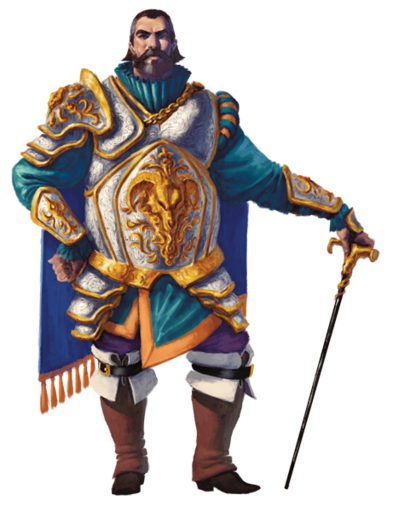
Nobles wield great authority and influence as members of the upper class, possessing wealth and connections that can make them as powerful as monarchs and generals. A noble often travels in the company of guards, as well as servants who are commoners.
The noble’s statistics can also be used to represent courtiers who aren’t of noble birth.
Actions
Rapier: Melee Weapon Attack: +3 to hit, reach 5 ft., one target. Hit: 5 (1d8 + 1) piercing damage.Reactions
Parry: The noble adds 2 to its AC against one melee attack that would hit it. To do so, the noble must see the attacker and be wielding a melee weapon.
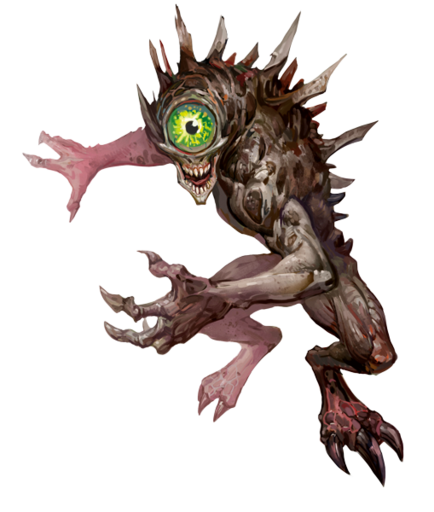
Picture: Handout: Nothic
A baleful eye peers out from the darkness, its gleam hinting at a weird intelligence and unnerving malevolence. Most times, a nothic is content to watch, weighing and assessing the creatures it encounters. When driven to violence, it uses its horrific gaze to rot the flesh from its enemies’ bones.
Cursed Arcanists. Rather than gaining the godlike supremacy they crave, some wizards who devote their lives to unearthing arcane secrets are reduced to creeping, tormented monsters by a dark curse left behind by Vecna, a powerful lich who, in some worlds, has transcended his undead existence to become a god of secrets. Nothics retain no awareness of their former selves, skulking amid the shadows and haunting places rich in magical knowledge, drawn by memories and impulses they can’t quite understand.
Dark Oracles. Nothics possess a strange magical insight that allows them to extract knowledge from other creatures. This grants them unique understanding of secret and forbidden lore, which they share for a price. A nothic covets magic items, greedily accepting such gifts from creatures that seek out its knowledge.
Lurkers in Magical Places. Nothics are notorious for infiltrating arcane academies and other places rich in magical learning. They are driven by the vague knowledge that there exists a method to reverse their condition. This isn’t a clear sense of purpose, but rather an obsessive tug at the end of the mind. Some nothics are clever enough to realize that this is merely part of the strange lesson for their folly, a false hope to drive them to seek out more arcane secrets.
Traits
Keen Sight: The nothic has advantage on Wisdom (Perception) checks that rely on sight.Actions
Multiattack: The nothic makes two claw attacks.Claw: Melee Weapon Attack: +4 to hit, reach 5 ft., one target. Hit: 6 (1d6 + 3) slashing damage.
Rotting Gaze: The nothic targets one creature it can see within 30 feet of it. The target must succeed on a DC 12 Constitution saving throw against this magic or take 10 (3d6) necrotic damage.
Weird Insight: The nothic targets one creature it can see within 30 feet of it. The target must contest its Charisma, Deception, check against the nothic’s Wisdom, Insight, check. If the nothic wins, it magically learns one fact or secret about the target. The target automatically wins if it is immune to being charmed.

Picture: Handout: Otto Belview
Sound Mimicry. Mongrelfolk have misshapen mouths and vocal cords. They speak fragmented Common mixed with various animal cries and nonsense. They can effectively imitate sounds made by beasts and humanoids that they’ve heard. Mongrelfolk aren’t sophisticated enough to use these sounds as a covert form of communication, but they can use the sounds to lure enemies into a trap or otherwise distract them.
Outcasts. Mongrelfolk are seldom welcome in other humanoid societies, where they are abused, enslaved, or shunned. They typically live on the fringes of civilization in ruins, deserted buildings, or other places that other humanoid races once lived in or built. They tend to be timid and skittish outside their homes and fiercely territorial within their lairs.
Camouflage Experts. Mongrelfolk often hide their deformities under cloaks and cowls. In this way, they can sometimes pass as stout humans or thin dwarves. They are fond of camouflage, attaching leaves and twigs to their cloaks, making brown paint to cover their skin, and weaving grass nets under which they can hide. They use such camouflage while hunting in the wild or while standing guard outside their lairs. Until it is seen, a camouflaged mongrelfolk has advantage on Stealth checks made to hide.
Horrific Offspring. It’s possible to restore a mongrelfolk to its original form using a greater restoration spell, but the same can’t be said for a mongrelfolk’s offspring. Only mongrelfolk that are made by magic can be restored to their original forms. Mongrelfolk that are born are true mongrelfolk and not the subjects of a spell or an effect that can be undone.
Mongrelfolk can breed with other humanoids, but nearly all children born to such parents are mongrelfolk. (About one child in every hundred is born looking like its non-mongrelfolk parent.)
Mongrelfolk
Mongrelfolk are humanoids that have undergone, or whose ancestors underwent, horrific magical transformations, to the extent that they retain only a fraction of their original being. Their humanoid bodies incorporate the features of various beasts. For example, one mongrelfolk might have the basic body shape of a dwarf with a head that combines the features of a cat and a lizard, one arm that ends in a crab’s pincer, and one leg that ends in a cloven hoof. Another might have the skin and horns of a cow, the eyes of a spider, frog’s legs, and a scaly lizard’s tail. Each mongrelfolk’s mad combination of humanoid and animal forms results in its having a slow, awkward gait.Sound Mimicry. Mongrelfolk have misshapen mouths and vocal cords. They speak fragmented Common mixed with various animal cries and nonsense. They can effectively imitate sounds made by beasts and humanoids that they’ve heard. Mongrelfolk aren’t sophisticated enough to use these sounds as a covert form of communication, but they can use the sounds to lure enemies into a trap or otherwise distract them.
Outcasts. Mongrelfolk are seldom welcome in other humanoid societies, where they are abused, enslaved, or shunned. They typically live on the fringes of civilization in ruins, deserted buildings, or other places that other humanoid races once lived in or built. They tend to be timid and skittish outside their homes and fiercely territorial within their lairs.
Camouflage Experts. Mongrelfolk often hide their deformities under cloaks and cowls. In this way, they can sometimes pass as stout humans or thin dwarves. They are fond of camouflage, attaching leaves and twigs to their cloaks, making brown paint to cover their skin, and weaving grass nets under which they can hide. They use such camouflage while hunting in the wild or while standing guard outside their lairs. Until it is seen, a camouflaged mongrelfolk has advantage on Stealth checks made to hide.
Horrific Offspring. It’s possible to restore a mongrelfolk to its original form using a greater restoration spell, but the same can’t be said for a mongrelfolk’s offspring. Only mongrelfolk that are made by magic can be restored to their original forms. Mongrelfolk that are born are true mongrelfolk and not the subjects of a spell or an effect that can be undone.
Mongrelfolk can breed with other humanoids, but nearly all children born to such parents are mongrelfolk. (About one child in every hundred is born looking like its non-mongrelfolk parent.)

If the characters give Bildrath (see area E1) a hard time, he calls Parriwimple (LG male human), his nephew and stock-boy, to help him out. Parriwimple’s real name is Parpol Cantemir, but no one in the village calls him that. His muscles rippling beneath his leather tunic should give ample notice of his strength. At the same time, Parriwimple is simple-minded. He is devoted to his uncle and will not follow the characters as long as Bildrath has something to say about it.


Picture: Handout: Phantom Warrior
Task Driven. Although one is often mistaken for a ghost, a phantom warrior isn’t bound by a yearning to complete some unresolved goal. It can choose to end its undead existence at any time. Its spirit lingers willingly, either out of loyalty to its former master or because it believes it must perform a task to satisfy its honor or sense of duty. For example, a guard who dies defending a wall might return as a phantom warrior and continue guarding the wall, then disappear forever once a new guard assumes its post or the wall is destroyed. The period between the time it died and the time it rises as a phantom warrior is usually 24 hours.
Faded Memories. A phantom warrior retains the alignment and personality it had before it died, and it remembers how it died. Memories of its life from shortly before it died are hazy, and older memories are forgotten. A phantom warrior can usually remember the last 1d10 + 10 days of its life; everything that happened before that is an impenetrable fog.
Forceful Presence. Although they are incorporeal, phantom warriors can harness the energy around them to deflect incoming attacks and strike with great force. An invisible sheath of energy surrounds a phantom warrior’s ghostly armor, shields, and weapons, which become as hard as steel yet don’t impede the warrior’s ability to move through walls and other solid objects.
Undead Nature. A phantom warrior doesn’t require air, food, drink, or sleep.
Phantom Warrior
A phantom warrior is the spectral remnant of a willful soldier or knight who perished on the battlefield or died performing its sworn duty. It appears like a translucent version of its living self.Task Driven. Although one is often mistaken for a ghost, a phantom warrior isn’t bound by a yearning to complete some unresolved goal. It can choose to end its undead existence at any time. Its spirit lingers willingly, either out of loyalty to its former master or because it believes it must perform a task to satisfy its honor or sense of duty. For example, a guard who dies defending a wall might return as a phantom warrior and continue guarding the wall, then disappear forever once a new guard assumes its post or the wall is destroyed. The period between the time it died and the time it rises as a phantom warrior is usually 24 hours.
Faded Memories. A phantom warrior retains the alignment and personality it had before it died, and it remembers how it died. Memories of its life from shortly before it died are hazy, and older memories are forgotten. A phantom warrior can usually remember the last 1d10 + 10 days of its life; everything that happened before that is an impenetrable fog.
Forceful Presence. Although they are incorporeal, phantom warriors can harness the energy around them to deflect incoming attacks and strike with great force. An invisible sheath of energy surrounds a phantom warrior’s ghostly armor, shields, and weapons, which become as hard as steel yet don’t impede the warrior’s ability to move through walls and other solid objects.
Undead Nature. A phantom warrior doesn’t require air, food, drink, or sleep.

Picture: Handout: Phantom Warrior
Task Driven. Although one is often mistaken for a ghost, a phantom warrior isn’t bound by a yearning to complete some unresolved goal. It can choose to end its undead existence at any time. Its spirit lingers willingly, either out of loyalty to its former master or because it believes it must perform a task to satisfy its honor or sense of duty. For example, a guard who dies defending a wall might return as a phantom warrior and continue guarding the wall, then disappear forever once a new guard assumes its post or the wall is destroyed. The period between the time it died and the time it rises as a phantom warrior is usually 24 hours.
Faded Memories. A phantom warrior retains the alignment and personality it had before it died, and it remembers how it died. Memories of its life from shortly before it died are hazy, and older memories are forgotten. A phantom warrior can usually remember the last 1d10 + 10 days of its life; everything that happened before that is an impenetrable fog.
Forceful Presence. Although they are incorporeal, phantom warriors can harness the energy around them to deflect incoming attacks and strike with great force. An invisible sheath of energy surrounds a phantom warrior’s ghostly armor, shields, and weapons, which become as hard as steel yet don’t impede the warrior’s ability to move through walls and other solid objects.
Undead Nature. A phantom warrior doesn’t require air, food, drink, or sleep.
Phantom Warrior
A phantom warrior is the spectral remnant of a willful soldier or knight who perished on the battlefield or died performing its sworn duty. It appears like a translucent version of its living self.Task Driven. Although one is often mistaken for a ghost, a phantom warrior isn’t bound by a yearning to complete some unresolved goal. It can choose to end its undead existence at any time. Its spirit lingers willingly, either out of loyalty to its former master or because it believes it must perform a task to satisfy its honor or sense of duty. For example, a guard who dies defending a wall might return as a phantom warrior and continue guarding the wall, then disappear forever once a new guard assumes its post or the wall is destroyed. The period between the time it died and the time it rises as a phantom warrior is usually 24 hours.
Faded Memories. A phantom warrior retains the alignment and personality it had before it died, and it remembers how it died. Memories of its life from shortly before it died are hazy, and older memories are forgotten. A phantom warrior can usually remember the last 1d10 + 10 days of its life; everything that happened before that is an impenetrable fog.
Forceful Presence. Although they are incorporeal, phantom warriors can harness the energy around them to deflect incoming attacks and strike with great force. An invisible sheath of energy surrounds a phantom warrior’s ghostly armor, shields, and weapons, which become as hard as steel yet don’t impede the warrior’s ability to move through walls and other solid objects.
Undead Nature. A phantom warrior doesn’t require air, food, drink, or sleep.

The pet monkey of Gadof Blinksy.

Picture: Handout: Pidlwick II

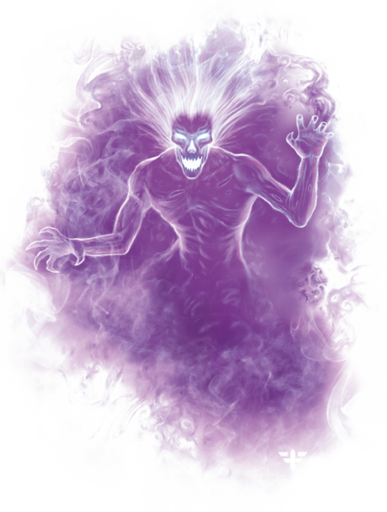
Picture: Handout: Specter
A specter is the angry, unfettered spirit of a humanoid that has been prevented from passing to the afterlife. Specters no longer possess connections to who or what they were, yet are condemned to walk the world forever. Some are spawned when dark magic or the touch of a wraith rips a soul from a living body.
Beyond Redemption. When a ghost’s unfinished business is completed, it can rest at last. No such rest or redemption awaits a specter. It is doomed to the Material Plane, its only end the oblivion that comes with the destruction of its soul. Until then, it bears out its lonely life in forlorn places, carrying on forgotten through the ages of the world.
Undying Hatred. Living creatures remind the specter that life is beyond its grasp. The mere sight of the living overwhelms a specter with sorrow and wrath, which can be abated only by destroying said life. A specter kills quickly and mercilessly, for only by depriving others of life can it gain the slightest satisfaction. However, no matter how many lives it extinguishes, a specter always succumbs to its hatred and sorrow.
Dwellers in Darkness. Sunlight represents a source of life that no specter can ever hope to douse, and it pains them. When night falls, they leave their final resting places in search of living creatures to slay, knowing that few weapons can harm them in return. At the first light of dawn, they retreat back into the darkness, where they remain until night falls again.
Undead Nature. A specter doesn’t require air, food, drink, or sleep.
Poltergeist
A poltergeist is a different kind of specter — the confused, invisible spirit of an individual with no sense of how he or she died. A poltergeist expresses its rage by hurling creatures and objects using the power of its shattered psyche.Traits
Incorporeal Movement: The specter can move through other creatures and objects as if they were difficult terrain. It takes 5 (1d10) force damage if it ends its turn inside an object.Sunlight Sensitivity: While in sunlight, the specter has disadvantage on attack rolls, as well as on Wisdom (Perception) checks that rely on sight.
Invisibility: The poltergeist is invisible.
Actions
Forceful Slam: Melee Weapon Attack: +4 to hit, reach 5 ft., one creature. Hit: 10 (3d6) force damage.Telekinetic Thrust (Creature): The poltergeist targets a creature within 30 feet of it. A creature must be Medium or smaller to be affected by this magic. The poltergeist makes a Charisma check contested by the target’s Strength check. If the poltergeist wins the contest, the poltergeist hurls the target up to 30 feet in any direction, including upward. If the target then comes into contact with a hard surface or heavy object, the target takes 1d6 damage per 10 feet moved.
Telekinetic Thrust (Object): Ranged Spell Attack: +4 to hit. Hit: 5 (2d4) bludgeoning damage. The poltergeist targets a unattended object within 30 feet of it, weighing up to 150 pounds. If the target is an object that isn’t being worn or carried, the poltergeist hurls it up to 30 feet in any direction. The poltergeist can use the object as a ranged weapon, attacking one creature along the object’s path.

Priests bring the teachings of their gods to the common folk. They are the spiritual leaders of temples and shrines and often hold positions of influence in their communities. Evil priests might work openly under a tyrant, or they might be the leaders of religious sects hidden in the shadows of good society, overseeing depraved rites.
A priest typically has one or more acolytes to help with religious ceremonies and other sacred duties.
Spellcasting: The priest is a 5th-level spellcaster. Its spellcasting ability is Wisdom (spell save DC 13, +5 to hit with spell attacks). The priest has the following cleric spells prepared:
• Cantrips (at will): light, sacred flame, thaumaturgy
• 1st level (4 slots): cure wounds, guiding bolt, sanctuary
• 2nd level (3 slots): lesser restoration, spiritual weapon
• 3rd level (2 slots): dispel magic, spirit guardians
A priest typically has one or more acolytes to help with religious ceremonies and other sacred duties.
Traits
Divine Eminence: As a bonus action, the priest can expend a spell slot to cause its melee weapon attacks to magically deal an extra 10 (3d6) radiant damage to a target on a hit. This benefit lasts until the end of the turn. If the priest expends a spell slot of 2nd level or higher, the extra damage increases by 1d6 for each level above 1st.Spellcasting: The priest is a 5th-level spellcaster. Its spellcasting ability is Wisdom (spell save DC 13, +5 to hit with spell attacks). The priest has the following cleric spells prepared:
• Cantrips (at will): light, sacred flame, thaumaturgy
• 1st level (4 slots): cure wounds, guiding bolt, sanctuary
• 2nd level (3 slots): lesser restoration, spiritual weapon
• 3rd level (2 slots): dispel magic, spirit guardians
Actions
Mace: Melee Weapon Attack: +2 to hit, reach 5 ft., one target. Hit: 3 (1d6) bludgeoning damage.
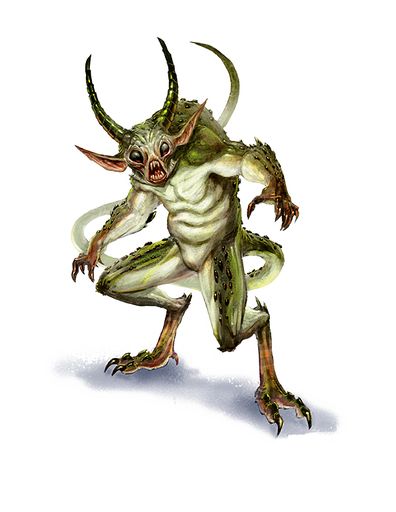
Picture: Handout: Quasit
Demons
Spawned in the Infinite Layers of the Abyss, demons are the embodiment of chaos and evil—engines of destruction barely contained in monstrous form. Possessing no compassion, empathy, or mercy, they exist only to destroy.Spawn of Chaos. The Abyss creates demons as extensions of itself, spontaneously forming fiends out of filth and carnage. Some are unique monstrosities, while others represent uniform strains virtually identical to each other. Other demons (such as manes) are created from mortal souls shunned or cursed by the gods, or which are otherwise trapped in the Abyss.
Capricious Elevation. Demons respect power and power alone. A greater demon commands shrieking mobs of lesser demons because it can destroy any lesser demon that dares to refuse its commands. A demon’s status grows with the blood it spills; the more enemies that fall before it, the greater it becomes.A demon might spawn as a manes, then become a dretch, and eventually transform to a vrock after untold time spent fighting and surviving in the Abyss. Such elevations are rare, however, for most demons are destroyed before they attain significant power. The greatest of those that do survive make up the ranks of the demon lords that threaten to tear the Abyss apart with their endless warring.
By expending considerable magical power, demon lords can raise lesser demons into greater forms, though such promotions never stem from a demon’s deeds or accomplishments. Rather, a demon lord might warp a manes into a quasit when it needs an invisible spy, or turn an army of dretches into hezrous when marching against a rival lord. Demon lords only rarely elevate demons to the highest ranks, fearful of inadvertently creating rivals to their own power.
Abyssal Invasions. Wherever they wander across the Abyss, demons search for portals to the other planes. They crave the chance to slip free of their native realm and spread their dark influence across the multiverse, undoing the works of the gods, tearing down civilizations, and reducing the cosmos to despair and ruin.
Some of the darkest legends of the mortal realm are built around the destruction wrought by demons set loose in the world. As such, even nations embroiled in bitter conflict will set their differences aside to help contain an outbreak of demons, or to seal off abyssal breaches before these fiends can break free.
Signs of Corruption. Demons carry the stain of abyssal corruption with them, and their mere presence changes the world for the worse. Plants wither and die in areas where abyssal breaches and demons appear. Animals shun the sites where a demon has made a kill. The site of a demonic infestation might be fouled by a stench that never abates, by areas of bitter cold or burning heat, or by permanent shadows that mark the places where these fiends lingered.
Eternal Evil. Outside the Abyss, death is a minor nuisance that no demon fears. Mundane weapons can’t stop these fiends, and many demons are resistant to the energy of the most potent spells. When a lucky hero manages to drop a demon in combat, the fiend dissolves into foul ichor. It then instantly reforms in the Abyss, its mind and essence intact even as its hatred is inflamed. The only way to truly destroy a demon is to seek it in the Abyss and kill it there.
Protected Essence. A powerful demon can take steps to safeguard its life essence, using secret methods and abyssal metals to create an amulet into which part of that essence is ceded. If the demon’s abyssal form is ever destroyed, the amulet allows the fiend to reform at a time and place of its choosing.
Obtaining a demonic amulet is a dangerous enterprise, and simply seeking such a device risks drawing the attention of the demon that created it. A creature possessing a demonic amulet can exact favors from the demon whose life essence the amulet holds—or inflict great pain if the fiend resists. If an amulet is destroyed, the demon that created it is trapped in the Abyss for a year and a day.
Demonic Cults. Despite the dark risks involved in dealing with fiends, the mortal realm is filled with creatures that covet demonic power. Demon lords manipulate these mortal servants into performing ever greater acts of depravity, furthering the demon lord’s ambitions in exchange for magic and other boons. However, a demon regards any mortals in its service as tools to use and then discard at its whim, consigning their mortal souls to the Abyss.
Demon Summoning. Few acts are as dangerous as summoning a demon, and even mages who bargain freely with devils fear the fiends of the Abyss. Though demons yearn to sow chaos on the Material Plane, they show no gratitude when brought there, raging against their prisons and demanding release.
Those who would risk summoning a demon might do so to wrest information from it, press it into service, or send it on a mission that only a creature of absolute evil can complete. Preparation is key, and experienced summoners know the specific spells and magic items that can force a demon to bend to another’s will. If a single mistake is made, a demon that breaks free shows no mercy as it makes its summoner the first victim of its wrath.
Bound Demons. The Book of Vile Darkness, the Black Scrolls of Ahm, and the Demonomicon of Iggwilv are the foremost authorities on demonic matters. These ancient tomes describe techniques that can trap the essence of a demon on the Material Plane, placing it within a weapon, idol, or piece of jewelry and preventing the fiend’s return to the Abyss.
An object that binds a demon must be specially prepared with unholy incantations and innocent blood. It radiates a palpable evil, chilling and fouling the air around it. A creature that handles such an object experiences unsettling dreams and wicked impulses, but is able to control the demon whose essence is trapped within the object. Destroying the object frees the demon, which immediately seeks revenge against its binder.
Demonic Possession. No matter how secure its bindings, a powerful demon often finds a way to escape an object that holds it. When a demonic essence emerges from its container, it can possess a mortal host. Sometimes a fiend employs stealth to hide a successful possession. Other times, it unleashes the full brunt of its fiendish drives through its new form.
As long as the demon remains in possession of its host, the soul of that host is in danger of being dragged to the Abyss with the demon if it is exorcised from the flesh, or if the host dies. If a demon possesses a creature and the object binding the demon is destroyed, the possession lasts until powerful magic is used to drive the demonic spirit out of its host.
Demon True Names
Though demons all have common names, every demon lord and every demon of type 1 through 6 has a true name that it keeps secret. A demon can be forced to disclose its true name if charmed, and ancient scrolls and tomes are said to exist that list the true names of the most powerful demons.A mortal who learns a demon’s true name can use powerful summoning magic to call the demon from the Abyss and exercise some measure of control over it. However, most demons brought to the Material Plane in this manner do everything in their power to wreak havoc or sow discord and strife.
Demon Lords
The chaotic power of the Abyss rewards demons of particular ruthlessness and ingenuity with a dark blessing, transforming them into unique fiends whose power can rival the gods. These demon lords rule through cunning or brute force, hoping to one day claim the prize of absolute control over all the Abyss.Reward for Outsiders. Although most demon lords rise up from the vast and uncountable mobs of demons rampaging across the Abyss, the plane also rewards outsiders that conquer any of its infinite layers. The elven goddess Lolth became a demon lord after Corellon Larethian cast her into the Abyss for betraying elvenkind. Sages claim that the Dark Prince Graz’zt originated on some other plane before stealing his abyssal title from another long-forgotten demon lord.
Power and Control. The greatest sign of a demon lord’s power is its ability to reshape an abyssal realm. A layer of the Abyss controlled by a demon lord becomes a twisted reflection of that fiend’s vile personality, and demon lords seldom leave their realms for fear of allowing another creature to reshape and seize it.
As with other demons, a demon lord that dies on another plane has its essence return to the Abyss, where it reforms into a new body. Likewise, a demon lord that dies in the Abyss is permanently destroyed. Most demon lords keep a portion of their essence safely stored away to prevent such a fate.
Baphomet
The demon lord Baphomet, also known as the Horned King and the Prince of Beasts, rules over minotaurs and other savage creatures. If he had his way, civilization would crumble and all races would embrace their base animal savagery.The Prince of Beasts appears as a huge, black-furred minotaur with iron horns, red eyes, and a blood-soaked mouth. His iron crown is topped with the rotting heads of his enemies, while his dark armor is set with spikes and skull-like serrations. He carries a huge glaive named Heartcleaver, but often hurls it into the fray so as to face his enemies with horns and hooves.
Demogorgon
The Sibilant Beast and the self-styled Prince of Demons, Demogorgon yearns for nothing less than undoing the order of the multiverse. An insane assemblage of features and drives, the Prince of Demons inspires fear and hatred among other demons and demon lords.Demogorgon towers three times the height of a human, his body as sinuous as a snake’s and as powerful as a great ape’s. Suckered tentacles take the place of his arms. His saurian lower torso ends in webbed and clawed feet, and a forked tail whose whip-like tips are armed with cruel blades. The Prince of Demons has two baleful baboon heads, both of them mad. It is only the conflict between the two halves of his dual nature that keeps the demon lord’s ambitions in check.
Graz’zt
The demon lord Graz’zt appears as a darkly handsome figure nearly nine feet tall. Those who refer to the Dark Prince as the most humanoid of the demon lords vastly underestimate the capacity for evil in his scheming heart.Graz’zt is a striking physical specimen, whose demonic nature shows in his ebon skin, pointed ears, yellow fangs, crown of horns, and six-fingered hands. He delights in finery, pageantry, and sating his decadent desires with subjects and consorts alike, among whom incubi and succubi are often his favorites.
Juiblex
The demon lord of slimes and oozes, Juiblex is a stew of noxious fluids that lurks in the abyssal depths. The wretched Faceless Lord cares nothing for cultists or mortal servants, and its sole desire is to turn all creatures into formless copies of its horrid self.In its resting state, Juiblex spreads out in a noxious mass, bubbling and filling the air with a profound stench. On the rare occasions when creatures confront the demon lord, Juiblex draws itself up into a shuddering cone of slime striated with veins of black and green. Baleful red eyes swim within its gelatinous body, while dripping pseudopods of ooze lash out hungrily at any creature they can reach.
Lolth
The Demon Queen of Spiders is the evil matron of the drow. Her every thought is touched by malice, and the depth of her viciousness can surprise even her most faithful priestesses. She directs her faithful while she weaves plots across the worlds of the Material Plane, looking forward to the time when her drow followers bring those worlds under her control.Lolth appears as a lithe, imperious drow matriarch when she manifests to her followers in the mortal realm, which she does with unusual frequency. When battle breaks out—or if she has a reason to remind her followers to fear her—Lolth’s lower body transforms into that of a huge demonic spider, whose spike-tipped legs and mandibles tear foes apart.
Orcus
Known as the Demon Prince of Undeath and the Blood Lord, the demon lord Orcus is worshiped by the undead and by living creatures that channel the power of undeath. A brooding and nihilistic entity, Orcus yearns to make the multiverse a place of death and darkness, forever unchanging except by his will.The Demon Prince of Undeath is a foul and corpulent creature, with a humanoid torso, powerful goat legs, and the desiccated head of a ram. His sore-ridden body stinks of disease, but his decaying head and glowing red eyes are as a creature already dead. Great black bat wings sprout from his back, stirring reeking air as he moves.
Orcus wields a malevolent artifact known as the Wand of Orcus, a mace-like rod of obsidian topped by a humanoid skull. He surrounds himself with undead, and living creatures not under his control are anathema to him.
Yeenoghu
Known as the Gnoll Lord and the Beast of Butchery, the demon lord Yeenoghu hungers for slaughter and senseless destruction. Gnolls are his mortal instruments, and he drives them to ever-greater atrocities in his name. Delighting in sorrow and hopelessness, the Gnoll Lord yearns to turn the world into a wasteland in which the last surviving gnolls tear each other apart for the right to feast upon the dead.Yeenoghu appears as a huge, scarred gnoll with a spiky crest of black spines, and eyes that burn with emerald flame. His armor is a patchwork of shields and breastplates claimed from fallen foes, and decorated by those foes’ flayed skins. Yeenoghu can summon a triple flail he calls the Butcher, which he wields to deadly effect or wills to fly independently into battle as he tears foes apart with teeth and claws.
Other Demon Lords
No one knows the full number of demon lords that rage in the Abyss. Given the infinite depths of that plane, powerful demons constantly rise to become demon lords, then fall almost as quickly. Among the demon lords whose power has endured long enough for demonologists to name them are Fraz-Urb’luu, the Prince of Deception; Kostchtchie, the Prince of Wrath; Pazuzu, Prince of the Lower Aerial Kingdoms; and Zuggtmoy, Lady of Fungi.Quasit
Quasits infest the Lower Planes. Physically weak, they keep to the shadows to plot mischief and wickedness. More powerful demons use quasits as spies and messengers when they aren’t devouring them or pulling them apart to pass the time.A quasit can assume animal forms, but in its true form it looks like a 2-foot-tall green humanoid with a barbed tail and horns. The quasit has clawed fingers and toes, and these claws can deliver an irritating poison. It prefers to be invisible when it attacks.
Variant: Quasit Familiar
Mortal spellcasters interested in extraplanar familiars find quasits easy to summon and eager to serve. The quasit plays the part of the obsequious servant. It serves its master well, but it goads the mortal to greater and greater acts of chaos and evil. Such quasits have the following trait.Familiar: The quasit can serve another creature as a familiar, forming a telepathic bond with its willing master. While the two are bonded, the master can sense what the quasit senses as long as they are within 1 mile of each other. While the quasit is within 10 feet of its master, the master shares the quasit’s Magic Resistance trait. At any time and for any reason, the quasit can end its service as a familiar, ending the telepathic bond.
Demon Types
Demonologists organize the chaotic distribution of demons into broad categories of power known as types. Most demons fit into one of six major types, with the weakest categorized as Type 1 and the strongest as Type 6. Demons outside the six main types are categorized as minor demons and demon lords.Demons by Type
| Type | Examples |
| 1 | barlgura, shadow demon, vrock |
| 2 | chasme, hezrou |
| 3 | glabrezu, yochlol |
| 4 | nalfeshnee |
| 5 | marilith |
| 6 | balor, goristro |
Traits
Shapechanger: The quasit can use its action to polymorph into a beast form that resembles a bat (speed 10 ft. fly 40 ft.), a centipede (40 ft., climb 40 ft.), or a toad (40 ft., swim 40 ft.), or back into its true form . Its statistics are the same in each form, except for the speed changes noted. Any equipment it is wearing or carrying isn't transformed . It reverts to its true form if it dies.Magic Resistance: The quasit has advantage on saving throws against spells and other magical effects.
Variant: Familiar: The quasit can serve another creature as a familiar, forming a telepathic bond with its willing master. While the two are bonded, the master can sense what the quasit senses as long as they are within 1 mile of each other. While the quasit is within 10 feet of its master, the master shares the quasit's Magic Resistance trait. At any time and for any reason, the quasit can end its service as a familiar, ending the telepathic bond.
Actions
Claw (Bite in Beast Form): Melee Weapon Attack: +4 to hit, reach 5 ft ., one target. Hit: 5 (1d4 + 3) piercing damage, and the target must succeed on a DC 10 Constitution saving throw or take 5 (2d4) poison damage and become poisoned for 1 minute. The target can repeat the saving throw at the end of each of its turns, ending the effect on itself on a success.Scare (1/day): One creature of the quasit's choice within 20 ft. of it must succeed on a DC 10 Wisdom saving throw or be frightened for 1 minute. The target can repeat the saving throw at the end of each of its turns, with disadvantage if the quasit is within line of sight, ending the effect on itself on a success.
Invisibility: The quasit magically turns invisible until it attacks or uses Scare, or until its concentration ends (as if concentrating on a spell). Any equipment the quasit wears or carries is invisible with it.


Traits
Mimicry: The raven can mimic simple sounds it has heard, such as a person whispering, a baby crying, or an animal chittering. A creature that hears the sounds can tell they are imitations with a successful DC 10 Wisdom (Insight) check.Actions
Beak: Melee Weapon Attack: +4 to hit, reach 5 ft., one target. Hit: 1 (1d1) piercing damage.
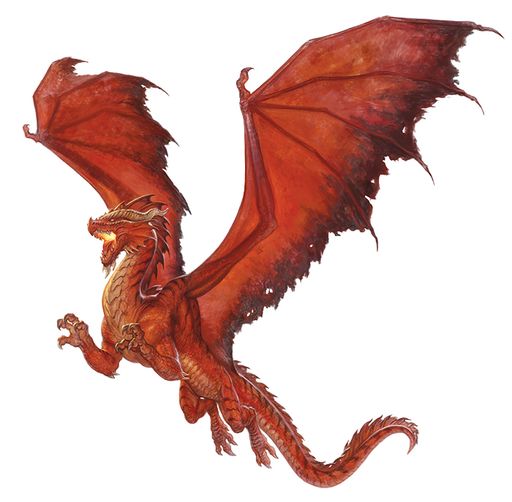
Picture: Handout: Red Dragon
Dragons
True dragons are winged reptiles of ancient lineage and fearsome power. They are known and feared for their predatory cunning and greed, with the oldest dragons accounted as some of the most powerful creatures in the world. Dragons are also magical creatures whose innate power fuels their dreaded breath weapons and other preternatural abilities.Many creatures, including wyverns and dragon turtles, have draconic blood. However, true dragons fall into the two broad categories of chromatic and metallic dragons. The black, blue, green, red, and white dragons are selfish, evil, and feared by all. The brass, bronze, copper, gold, and silver dragons are noble, good, and highly respected by the wise.
Though their goals and ideals vary tremendously, all true dragons covet wealth, hoarding mounds of coins and gathering gems, jewels, and magic items. Dragons with large hoards are loath to leave them for long, venturing out of their lairs only to patrol or feed.
True dragons pass through four distinct stages of life, from lowly wyrmlings to ancient dragons, which can live for over a thousand years. In that time, their might can become unrivaled and their hoards can grow beyond price.
Dragon Age Categories
| Category | Size | Age Range |
| Wyrmling | Medium | 5 years or less |
| Young | Large | 6-100 years |
| Adult | Huge | 101-800 years |
| Ancient | Gargantuan | 801 years or more |
Chromatic Dragons
The black, blue, green, red, and white dragons represent the evil side of dragonkind. Aggressive, gluttonous, and vain, chromatic dragons are dark sages and powerful tyrants feared by all creatures—including each other.Driven by Greed. Chromatic dragons lust after treasure, and this greed colors their every scheme and plot. They believe that the world’s wealth belongs to them by right, and a chromatic dragon seizes that wealth without regard for the humanoids and other creatures that have “stolen” it. With its piles of coins, gleaming gems, and magic items, a dragon’s hoard is the stuff of legend. However, chromatic dragons have no interest in commerce, amassing wealth for no other reason than to have it.
Creatures of Ego. Chromatic dragons are united by their sense of superiority, believing themselves the most powerful and worthy of all mortal creatures. When they interact with other creatures, it is only to further their own interests. They believe in their innate right to rule, and this belief is the cornerstone of every chromatic dragon’s personality and worldview. Trying to humble a chromatic dragon is like trying to convince the wind to stop blowing. To these creatures, humanoids are animals, fit to serve as prey or beasts of burden, and wholly unworthy of respect.
Dangerous Lairs. A dragon’s lair serves as the seat of its power and a vault for its treasure. With its innate toughness and tolerance for severe environmental effects, a dragon selects or builds a lair not for shelter but for defense, favoring multiple entrances and exits, and security for its hoard.
Most chromatic dragon lairs are hidden in dangerous and remote locations to prevent all but the most audacious mortals from reaching them. A black dragon might lair in the heart of a vast swamp, while a red dragon might claim the caldera of an active volcano. In addition to the natural defenses of their lairs, powerful chromatic dragons use magical guardians, traps, and subservient creatures to protect their treasures.
Queen of Evil Dragons. Tiamat the Dragon Queen is the chief deity of evil dragonkind. She dwells on Avernus, the first layer of the Nine Hells. As a lesser god, Tiamat has the power to grant spells to her worshipers, though she is loath to share her power. She epitomizes the avarice of evil dragons, believing that the multiverse and all its treasures will one day be hers and hers alone.
Tiamat is a gigantic dragon whose five heads reflect the forms of the chromatic dragons that worship her—black, blue, green, red, and white. She is a terror on the battlefield, capable of annihilating whole armies with her five breath weapons, her formidable spellcasting, and her fearsome claws.
Tiamat’s most hated enemy is Bahamut the Platinum Dragon, with whom she shares control of the faith of dragonkind. She also holds a special enmity for Asmodeus, who long ago stripped her of the rule of Avernus and who continues to curb the Dragon Queen’s power.
Red Dragon
The most covetous of the true dragons, red dragons tirelessly seek to increase their treasure hoards. They are exceptionally vain, even for dragons, and their conceit is reflected in their proud bearing and their disdain for other creatures.The odor of sulfur and pumice surrounds a red dragon, whose swept-back horns and spinal frill define its silhouette. Its beaked snout vents smoke at all times, and its eyes dance with flame when it is angry. Its wings are the longest of any chromatic dragon, and have a blue-black tint along the trailing edge that resembles metal burned blue by fire.
The scales of a red dragon wyrmling are a bright glossy scarlet, turning a dull, deeper red and becoming as thick and strong as metal as the dragon ages. Its pupils also fade as it ages, and the oldest red dragons have eyes that resemble molten lava orbs.
Mountain Masters. Red dragons prefer mountainous terrain, badlands, and any other locale where they can perch high and survey their domain. Their preference for mountains brings them into conflict with the hill-dwelling copper dragons from time to time.
Arrogant Tyrants. Red dragons fly into destructive rages and act on impulse when angered. They are so ferocious and vengeful that they are regarded as the archetypical evil dragon by many cultures.
No other dragon comes close to the arrogance of the red dragon. These creatures see themselves as kings and emperors, and view the rest of dragonkind as inferior. Believing that they are chosen by Tiamat to rule in her name, red dragons consider the world and every creature in it as theirs to command.
Status and Slaves. Red dragons are fiercely territorial and isolationist. However, they yearn to know about events in the wider world, and they make use of lesser creatures as informants, messengers, and spies. They are most interested in news about other red dragons, with which they compete constantly for status.
When it requires servants, a red dragon demands fealty from chaotic evil humanoids. If allegiance isn’t forthcoming, it slaughters a tribe’s leaders and claims lordship over the survivors. Creatures serving a red dragon live in constant terror of being roasted and eaten for displeasing it. They spend most of their time fawning over the creature in an attempt to stay alive.
Obsessive Collectors. Red dragons value wealth above all else, and their treasure hoards are legendary. They covet anything of monetary value, and can often judge the worth of a bauble to within a copper piece at a glance. A red dragon has a special affection for treasure claimed from powerful enemies it has slain, exhibiting that treasure to prove its superiority.
A red dragon knows the value and provenance of every item in its hoard, along with each item’s exact location. It might notice the absence of a single coin, igniting its rage as it tracks down and slays the thief without mercy. If the thief can’t be found, the dragon goes on a rampage, laying waste to towns and villages in an attempt to sate its wrath.
A Red Dragon’s Lair
Red dragons lair in high mountains or hills, dwelling in caverns under snow-capped peaks, or within the deep halls of abandoned mines and dwarven strongholds. Caves with volcanic or geothermal activity are the most highly prized red dragon lairs, creating hazards that hinder intruders and letting searing heat and volcanic gases wash over a dragon as it sleeps.With its hoard well protected deep within the lair, a red dragon spends as much of its time outside the mountain as in it. For a red dragon, the great heights of the world are the throne from which it can look out to survey all it controls—and the wider world it seeks to control.
Throughout the lair complex, servants erect monuments to the dragon’s power, telling the grim story of its life, the enemies it has slain, and the nations it has conquered.
Lair Actions
On initiative count 20 (losing initiative ties), the dragon takes a lair action to cause one of the following effects; the dragon can’t use the same effect two rounds in a row:- Magma erupts from a point on the ground the dragon can see within 120 feet of it, creating a 20-foot-high, 5-foot-radius geyser. Each creature in the geyser’s area must make a DC 15 Dexterity saving throw, taking 21 (6d6) fire damage on a failed save, or half as much damage on a successful one.
- A tremor shakes the lair in a 60-foot radius around the dragon. Each creature other than the dragon on the ground in that area must succeed on a DC 15 Dexterity saving throw or be knocked prone.
- Volcanic gases form a cloud in a 20-foot-radius sphere centered on a point the dragon can see within 120 feet of it. The sphere spreads around corners, and its area is lightly obscured. It lasts until initiative count 20 on the next round. Each creature that starts its turn in the cloud must succeed on a DC 13 Constitution saving throw or be poisoned until the end of its turn. While poisoned in this way, a creature is incapacitated.
Regional Effects
The region containing a legendary red dragon’s lair is warped by the dragon’s magic, which creates one or more of the following effects:- Small earthquakes are common within 6 miles of the dragon’s lair.
- Water sources within 1 mile of the lair are supernaturally warm and tainted by sulfur.
- Rocky fissures within 1 mile of the dragon’s lair form portals to the Elemental Plane of Fire, allowing creatures of elemental fire into the world to dwell nearby.
If the dragon dies, these effects fade over the course of 1d10 days.
Actions
Bite: Melee Weapon Attack: +6 to hit, reach 5 ft., one target. Hit: 9 (1d10 + 4) piercing damage plus 3 (1d6) fire damage.Fire Breath (Recharge 5-6): The dragon exhales fire in a 15-foot cone. Each creature in that area must make a DC l3 Dexterity saving throw, taking 24 (7d6) fire damage on a failed save, or half as much damage on a successful one.

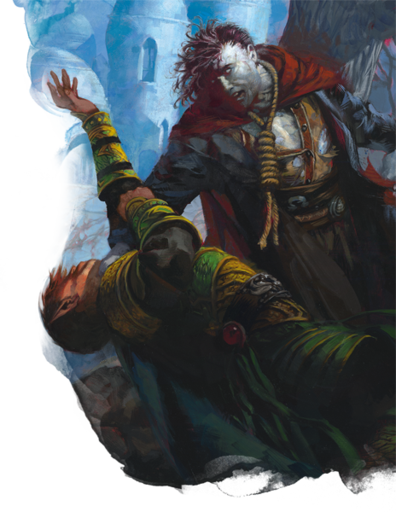
Picture: Handout: Revenant
A revenant forms from the soul of a mortal who met a cruel and undeserving fate. It claws its way back into the world to seek revenge against the one who wronged it. The revenant reclaims its mortal body and superficially resembles a zombie. However, instead of lifeless eyes, a revenant’s eyes burn with resolve and flare in the presence of its adversary. If the revenant’s original body was destroyed or is otherwise unavailable, the spirit of the revenant enters another humanoid corpse. Regardless of the body the revenant uses as a vessel, its adversary always recognizes the revenant for what it truly is.
Hunger for Revenge. A revenant has only one year to exact revenge. When its adversary dies, or if the revenant fails to kill its adversary before its time runs out, it crumbles to dust and its soul fades into the afterlife. If its foe is too powerful for the revenant to destroy on its own, it seeks worthy allies to help it fulfill its quest.
Divine Justice. No magic can hide a creature pursued by a revenant, which always knows the direction and distance between it and the target of its vengeance. In cases where the revenant seeks revenge against more than one adversary, it pursues them one at a time, starting with the creature that dealt it the killing blow. If the revenant’s body is destroyed, its soul flies forth to seek out a new corpse in which to resume its hunt.
Undead Nature. A revenant doesn’t require air, food, drink, or sleep.
Variant: Revenants with Spells and Weapons
Revenants that were spellcasters before they died might retain some or all of their spellcasting capabilities. Similarly, revenants that wore armor and wielded weapons in life might continue to do so.Traits
Regeneration: The revenant regains 10 hit points at the start of its turn. If the revenant takes fire or radiant damage, this trait doesn’t function at the start of the revenant’s next turn. The revenant’s body is destroyed only if it starts its turn with 0 hit points and doesn’t regenerate.Rejuvenation: When the revenant’s body is destroyed, its soul lingers. After 24 hours, the soul inhabits and animates another corpse on the same plane of existence and regains all its hit points. While the soul is bodiless, a wish spell can be used to force the soul to go to the afterlife and not return.
Turn Immunity: The revenant is immune to effects that turn undead.
Vengeful Tracker: The revenant knows the distance to and direction of any creature against which it seeks revenge, even if the creature and the revenant are on different planes of existence. If the creature being tracked by the revenant dies, the revenant knows.
Actions
Multiattack: The revenant makes two fist attacks.Fist: Melee Weapon Attack: +7 to hit, reach 5 ft., one target. Hit: 11 (2d6 + 4) bludgeoning damage. If the target is a creature against which the revenant has sworn vengeance, the target takes an extra 14, 4d6, bludgeoning damage. Instead of dealing damage, the revenant can grapple the target, escape DC 14, provided the target is Large or smaller.
Vengeful Glare: The revenant targets one creature it can see within 30 feet of it and against which it has sworn vengeance. The target must make a DC 15 Wisdom saving throw. On a failure, the target is paralyzed until the revenant deals damage to it, or until the end of the revenant’s next turn. When the paralysis ends, the target is frightened of the revenant for 1 minute. The frightened target can repeat the saving throw at the end of each of its turns, with disadvantage if it can see the revenant, ending the frightened condition on itself on a success.

Picture: Handout: Revenant
A revenant forms from the soul of a mortal who met a cruel and undeserving fate. It claws its way back into the world to seek revenge against the one who wronged it. The revenant reclaims its mortal body and superficially resembles a zombie. However, instead of lifeless eyes, a revenant’s eyes burn with resolve and flare in the presence of its adversary. If the revenant’s original body was destroyed or is otherwise unavailable, the spirit of the revenant enters another humanoid corpse. Regardless of the body the revenant uses as a vessel, its adversary always recognizes the revenant for what it truly is.
Hunger for Revenge. A revenant has only one year to exact revenge. When its adversary dies, or if the revenant fails to kill its adversary before its time runs out, it crumbles to dust and its soul fades into the afterlife. If its foe is too powerful for the revenant to destroy on its own, it seeks worthy allies to help it fulfill its quest.
Divine Justice. No magic can hide a creature pursued by a revenant, which always knows the direction and distance between it and the target of its vengeance. In cases where the revenant seeks revenge against more than one adversary, it pursues them one at a time, starting with the creature that dealt it the killing blow. If the revenant’s body is destroyed, its soul flies forth to seek out a new corpse in which to resume its hunt.
Undead Nature. A revenant doesn’t require air, food, drink, or sleep.
Variant: Revenants with Spells and Weapons
Revenants that were spellcasters before they died might retain some or all of their spellcasting capabilities. Similarly, revenants that wore armor and wielded weapons in life might continue to do so.
Picture: Handout: Rictavio
Rictavio
Several months ago, a colorfully dressed half-elf bard came to Barovia in a carnival wagon, with a pet monkey on his shoulder. He took over an abandoned tower on Lake Baratok before rolling into the town of Vallaki several months later. Claiming to be a carnival ringmaster in search of new actors, he began regaling locals with tales of distant lands.
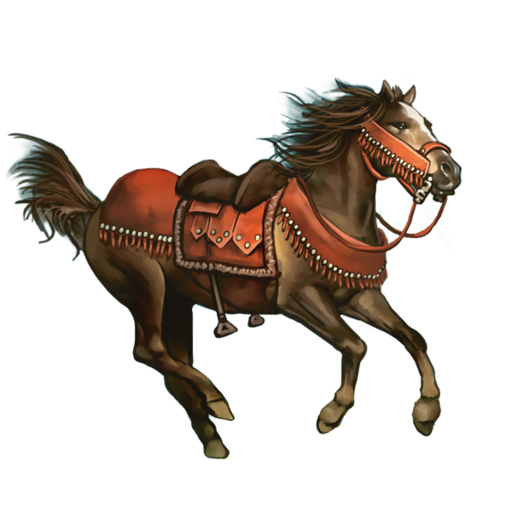
Actions
Hooves: Melee Weapon Attack: +5 to hit, reach 5 ft., one target. Hit: 8 (2d4 + 3) bludgeoning damage.
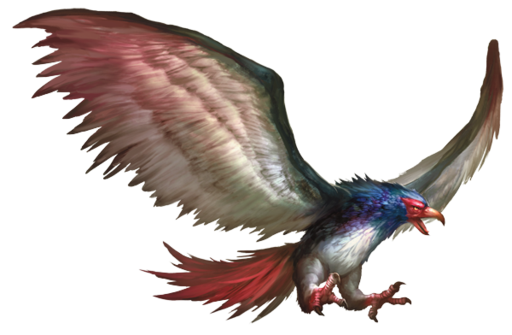
Picture: Handout: Roc
At first sight, a roc’s silhouette looks much like any other bird of prey. As it descends, however, its unearthly size becomes terrifyingly clear. In flight, a roc’s wingspan spreads two hundred feet or more. At rest, perched upon the mountain peaks that are its home, this monstrous bird rivals the oldest dragons in size.
Sky Titans. In the ancient days when giants battled dragons for control of the world, Annam, the father of the giant gods, created the rocs so that his worshipers might challenge the dragons’ dominance of the air. When the war ended, the rocs were freed from giant domination and spread throughout the world.
Though cloud giants and storm giants sometimes tame these great birds, rocs treat even giants as potential prey. They fly great distances in search of food, soaring high above the clouds to reach their favored hunting grounds. A roc seldom hunts swift or small creatures, and it ignores towns and forests where prey can easily take cover. When it locates a large and slow-moving target such as a giant, a whale, or an elephant, a roc dives down to snatch its prey in its massive talons.
Remote and Alone. Rocs are solitary creatures that can live for centuries. They lair in nests made from trees, tents, broken ships, and the remains of caravans they carry off, placing these massive tangles in mountain clefts out of the reach of lesser creatures.
Sometimes a roc’s nest contains treasures from the caravans or ships they raid, but these creatures are heedless of such baubles. More rarely, a nest holds eggs that are taller than a human, produced by the rocs’ infrequent mating.
Traits
Keen Sight: The roc has advantage on Wisdom (Perception) checks that rely on sight.Actions
Multiattack: The roc makes two attacks: one with its beak and one with its talons.Beak: Melee Weapon Attack: +13 to hit, reach 10 ft., one target. Hit: 27 (4d8 + 9) piercing damage.
Talons: Melee Weapon Attack: +13 to hit, reach 5 ft., one target. Hit: 23 (4d6 + 9) slashing damage, and the target is grappled, escape DC 19. Until this grapple ends, the target is restrained, and the roc can't use its talons on another target.


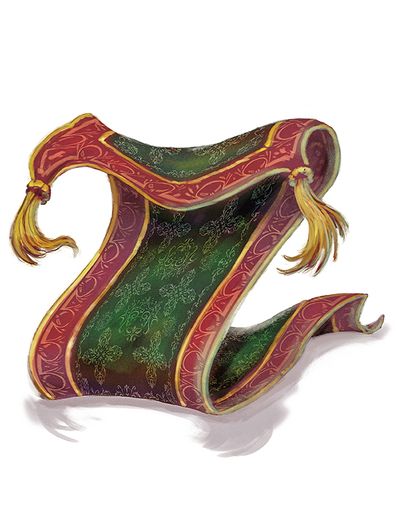
Animated Objects
Animated objects are crafted with potent magic to follow the commands of their creators. When not commanded, they follow the last order they received to the best of their ability, and can act independently to fulfill simple instructions. Some animated objects (including many of those created in the Feywild) might converse fluently or adopt a persona, but most are simple automatons.Constructed Nature. An animated object doesn’t require air, food, drink, or sleep.
The magic that animates an object is dispelled when the construct drops to 0 hit points. An animated object reduced to 0 hit points becomes inanimate and is too damaged to be of much use or value to anyone.
Rug of Smothering
Would-be thieves and careless heroes arrive at the doorsteps of an enemy’s abode, eyes and ears alert for traps, only to end their quest prematurely as the rugs beneath their feet animate and smother them to death.A rug of smothering can be made in many different forms, from a finely woven carpet fit for a queen to a coarse mat in a peasant’s hovel. Creatures with the ability to sense magic detect the rug’s false magical aura.
In some cases, a rug of smothering is disguised as a carpet of flying or another beneficial magic item. However, a character who stands or sits on the rug, or who attempts to utter a word of command, is quickly trapped as the rug of smothering rolls itself tightly around its victim.
Traits
Antimagic Susceptibility: The rug is incapacitated while in the area of an antimagic field. If targeted by dispel magic, the rug must succeed on a Constitution saving throw against the caster's spell save DC or fall unconscious for 1 minute.Damage Transfer: While it is grappling a creature, the rug takes only half the damage dealt to it, and the creature grappled by the rug takes the other half.
False Appearance: While the rug remains motionless, it is indistinguishable from a normal rug.
Actions
Smother: Melee Weapon Attack: +5 to hit, reach 5 ft., Medium or smaller creature. Hit: 0 (1d0) bludgeoning damage, and the creature is grappled escape DC 13. Until this grapple ends, the target is restrained, blinded, and at risk of suffocating, and the rug can't smother another target. In addition, at the start of each of the target's turns, the target takes 10 or 2d6 + 3 bludgeoning dmg.
Sangzor is a giant goat known for its supernatural resilience and evil disposition (see Special Events: Chapter 9).

Savid is a wounded dusk elf in Argynvostholt. He has 4 hit points remaining and is grateful for any healing the characters can provide.
Savid lives with the other dusk elves of Barovia in the Vistani camp outside Vallaki (chapter 5, area N9). He was searching the woods for a missing Vistani girl named Arabelle when a wandering mob of needle blights accosted him. He was forced to take refuge in the mansion.
Savid lives with the other dusk elves of Barovia in the Vistani camp outside Vallaki (chapter 5, area N9). He was searching the woods for a missing Vistani girl named Arabelle when a wandering mob of needle blights accosted him. He was forced to take refuge in the mansion.

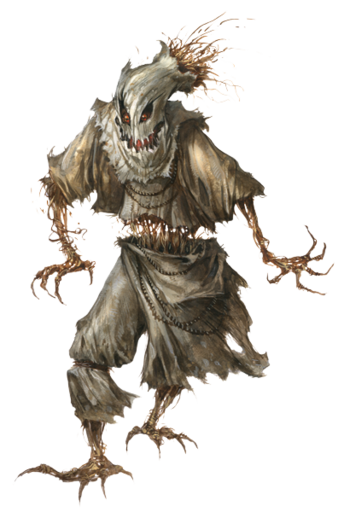
Picture: Handout: Scarecrow
At harvest time, when death revisits the twilit world and summer’s blossoms bow their withered heads, eerie scarecrows loom in silent vigil over empty fields. With immortal patience, these stoic sentinels hold their posts through wind, storm, and flood, bound to their master’s command, eager to terrify prey with its sackcloth visage and rend victims with its razor-sharp claws.
Spirit-Powered Constructs. A scarecrow is animated by the bound spirit of a slain evil creature, granting it purpose and mobility. It is this uncanny presence from beyond death that allows a scarecrow to inspire fear in those it gazes upon. Hags and witches often bind scarecrows with the spirits of demons, but any evil spirit will do. Although aspects of the spirit’s personality might surface, a scarecrow’s spirit doesn’t recall the memories it had as a creature, and its will is focused solely on serving its creator. If its creator dies, the spirit inhabiting a scarecrow either continues to follow its last commands, seeks revenge for its creator’s death, or destroys itself.
Construct Nature. A scarecrow doesn’t require air, food, drink, or sleep.
Traits
False Appearance: While the scarecrow remains motionless, it is indistinguishable from an ordinary, inanimate scarecrow.Actions
Multiattack: The scarecrow makes two claw attacks.Claw: Melee Weapon Attack: +3 to hit, reach 5 ft., one target. Hit: 6 (2d4 + 1) slashing damage. If the target is a creature, it must succeed on a DC 11 Wisdom saving throw or be frightened until the end of the scarecrow’s next turn.
Terrifying Glare: The scarecrow targets one creature it can see within 30 feet of it. If the target can see the scarecrow, the target must succeed on a DC 11 Wisdom saving throw or be magically frightened until the end of the scarecrow’s next turn. The frightened target is paralyzed.

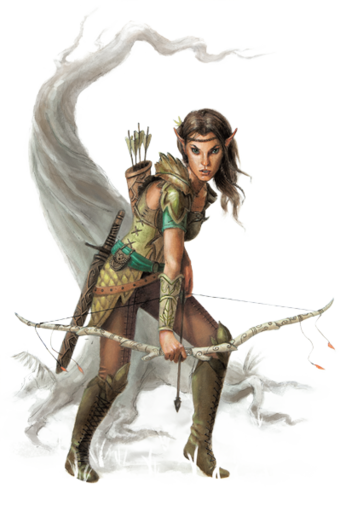
Scouts are skilled hunters and trackers who offer their services for a fee. Most hunt wild game, but a few work as bounty hunters, serve as guides, or provide military reconnaissance.
Traits
Keen Hearing and Sight: The scout has advantage on Wisdom (Perception) checks that rely on hearing or sight.Actions
Multiattack: The scout makes two melee attacks or two ranged attacks.Shortsword: Melee Weapon Attack: +4 to hit, reach 5 ft., one target. Hit: 5 (1d6 + 2) piercing damage.
Longbow: Ranged Weapon Attack: +4 to hit, ranged 150/600 ft., one target. Hit: 6 (1d8 + 2) piercing damage.

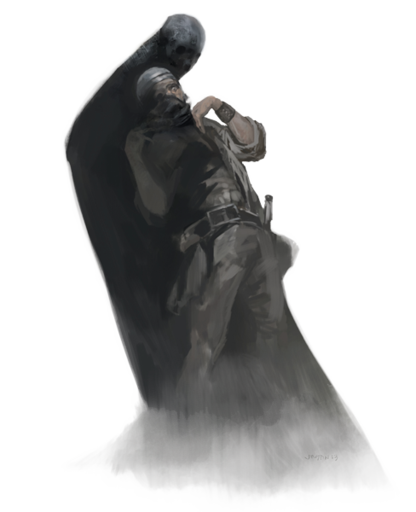
Picture: Handout: Shadow
Shadows are undead that resemble dark exaggerations of humanoid shadows.
Dark Disposition. From the darkness, the shadow reaches out to feed on living creatures’ vitality. They can consume any living creature, but they are especially drawn to creatures untainted by evil. A creature that lives a life of goodness and piety consigns its basest impulses and strongest temptations to the darkness where the shadows hunger. As a shadow drains its victim’s strength and physical form, the victim’s shadow darkens and begins to move of its own volition. In death, the creature’s shadow breaks free, becoming a new undead shadow hungry for more life to consume.
If a creature from which a shadow has been created somehow returns to life, its undead shadow senses the return. The shadow might seek its “parent” to vex or slay. Whether the shadow pursues its living counterpart, the creature that birthed the shadow no longer casts one until the monster is destroyed.
Undead Nature. A shadow doesn’t require air, food, drink, or sleep.
Traits
Amorphous: The shadow can move through a space as narrow as 1 inch wide without squeezing.Shadow Stealth: While in dim light or darkness, the shadow can take the Hide action as a bonus action. Its stealth bonus is also improved to +6.
Sunlight Weakness: While in sunlight, the shadow has disadvantage on attack rolls, ability checks, and saving throws.
Actions
Strength Drain: Melee Weapon Attack: +4 to hit, reach 5 ft., one creature. Hit: 9 (2d6 + 2) necrotic damage, and the target's Strength score is reduced by 1d4. The target dies if this reduces its Strength to 0. Otherwise, the reduction lasts until the target finishes a short or long rest.If a non-evil humanoid dies from this attack, a new shadow rises from the corpse 1d4 hours later.

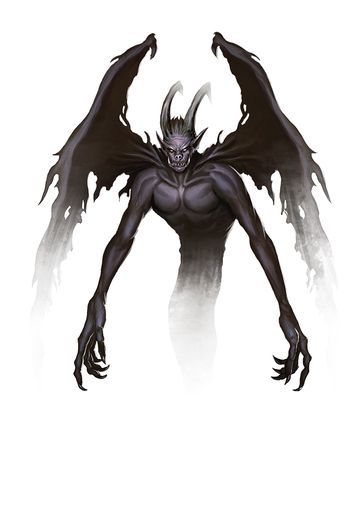
Picture: Handout: Shadow Demon
Demons
Spawned in the Infinite Layers of the Abyss, demons are the embodiment of chaos and evil—engines of destruction barely contained in monstrous form. Possessing no compassion, empathy, or mercy, they exist only to destroy.Spawn of Chaos. The Abyss creates demons as extensions of itself, spontaneously forming fiends out of filth and carnage. Some are unique monstrosities, while others represent uniform strains virtually identical to each other. Other demons (such as manes) are created from mortal souls shunned or cursed by the gods, or which are otherwise trapped in the Abyss.
Capricious Elevation. Demons respect power and power alone. A greater demon commands shrieking mobs of lesser demons because it can destroy any lesser demon that dares to refuse its commands. A demon’s status grows with the blood it spills; the more enemies that fall before it, the greater it becomes.A demon might spawn as a manes, then become a dretch, and eventually transform to a vrock after untold time spent fighting and surviving in the Abyss. Such elevations are rare, however, for most demons are destroyed before they attain significant power. The greatest of those that do survive make up the ranks of the demon lords that threaten to tear the Abyss apart with their endless warring.
By expending considerable magical power, demon lords can raise lesser demons into greater forms, though such promotions never stem from a demon’s deeds or accomplishments. Rather, a demon lord might warp a manes into a quasit when it needs an invisible spy, or turn an army of dretches into hezrous when marching against a rival lord. Demon lords only rarely elevate demons to the highest ranks, fearful of inadvertently creating rivals to their own power.
Abyssal Invasions. Wherever they wander across the Abyss, demons search for portals to the other planes. They crave the chance to slip free of their native realm and spread their dark influence across the multiverse, undoing the works of the gods, tearing down civilizations, and reducing the cosmos to despair and ruin.
Some of the darkest legends of the mortal realm are built around the destruction wrought by demons set loose in the world. As such, even nations embroiled in bitter conflict will set their differences aside to help contain an outbreak of demons, or to seal off abyssal breaches before these fiends can break free.
Signs of Corruption. Demons carry the stain of abyssal corruption with them, and their mere presence changes the world for the worse. Plants wither and die in areas where abyssal breaches and demons appear. Animals shun the sites where a demon has made a kill. The site of a demonic infestation might be fouled by a stench that never abates, by areas of bitter cold or burning heat, or by permanent shadows that mark the places where these fiends lingered.
Eternal Evil. Outside the Abyss, death is a minor nuisance that no demon fears. Mundane weapons can’t stop these fiends, and many demons are resistant to the energy of the most potent spells. When a lucky hero manages to drop a demon in combat, the fiend dissolves into foul ichor. It then instantly reforms in the Abyss, its mind and essence intact even as its hatred is inflamed. The only way to truly destroy a demon is to seek it in the Abyss and kill it there.
Protected Essence. A powerful demon can take steps to safeguard its life essence, using secret methods and abyssal metals to create an amulet into which part of that essence is ceded. If the demon’s abyssal form is ever destroyed, the amulet allows the fiend to reform at a time and place of its choosing.
Obtaining a demonic amulet is a dangerous enterprise, and simply seeking such a device risks drawing the attention of the demon that created it. A creature possessing a demonic amulet can exact favors from the demon whose life essence the amulet holds—or inflict great pain if the fiend resists. If an amulet is destroyed, the demon that created it is trapped in the Abyss for a year and a day.
Demonic Cults. Despite the dark risks involved in dealing with fiends, the mortal realm is filled with creatures that covet demonic power. Demon lords manipulate these mortal servants into performing ever greater acts of depravity, furthering the demon lord’s ambitions in exchange for magic and other boons. However, a demon regards any mortals in its service as tools to use and then discard at its whim, consigning their mortal souls to the Abyss.
Demon Summoning. Few acts are as dangerous as summoning a demon, and even mages who bargain freely with devils fear the fiends of the Abyss. Though demons yearn to sow chaos on the Material Plane, they show no gratitude when brought there, raging against their prisons and demanding release.
Those who would risk summoning a demon might do so to wrest information from it, press it into service, or send it on a mission that only a creature of absolute evil can complete. Preparation is key, and experienced summoners know the specific spells and magic items that can force a demon to bend to another’s will. If a single mistake is made, a demon that breaks free shows no mercy as it makes its summoner the first victim of its wrath.
Bound Demons. The Book of Vile Darkness, the Black Scrolls of Ahm, and the Demonomicon of Iggwilv are the foremost authorities on demonic matters. These ancient tomes describe techniques that can trap the essence of a demon on the Material Plane, placing it within a weapon, idol, or piece of jewelry and preventing the fiend’s return to the Abyss.
An object that binds a demon must be specially prepared with unholy incantations and innocent blood. It radiates a palpable evil, chilling and fouling the air around it. A creature that handles such an object experiences unsettling dreams and wicked impulses, but is able to control the demon whose essence is trapped within the object. Destroying the object frees the demon, which immediately seeks revenge against its binder.
Demonic Possession. No matter how secure its bindings, a powerful demon often finds a way to escape an object that holds it. When a demonic essence emerges from its container, it can possess a mortal host. Sometimes a fiend employs stealth to hide a successful possession. Other times, it unleashes the full brunt of its fiendish drives through its new form.
As long as the demon remains in possession of its host, the soul of that host is in danger of being dragged to the Abyss with the demon if it is exorcised from the flesh, or if the host dies. If a demon possesses a creature and the object binding the demon is destroyed, the possession lasts until powerful magic is used to drive the demonic spirit out of its host.
Demon True Names
Though demons all have common names, every demon lord and every demon of type 1 through 6 has a true name that it keeps secret. A demon can be forced to disclose its true name if charmed, and ancient scrolls and tomes are said to exist that list the true names of the most powerful demons.A mortal who learns a demon’s true name can use powerful summoning magic to call the demon from the Abyss and exercise some measure of control over it. However, most demons brought to the Material Plane in this manner do everything in their power to wreak havoc or sow discord and strife.
Demon Lords
The chaotic power of the Abyss rewards demons of particular ruthlessness and ingenuity with a dark blessing, transforming them into unique fiends whose power can rival the gods. These demon lords rule through cunning or brute force, hoping to one day claim the prize of absolute control over all the Abyss.Reward for Outsiders. Although most demon lords rise up from the vast and uncountable mobs of demons rampaging across the Abyss, the plane also rewards outsiders that conquer any of its infinite layers. The elven goddess Lolth became a demon lord after Corellon Larethian cast her into the Abyss for betraying elvenkind. Sages claim that the Dark Prince Graz’zt originated on some other plane before stealing his abyssal title from another long-forgotten demon lord.
Power and Control. The greatest sign of a demon lord’s power is its ability to reshape an abyssal realm. A layer of the Abyss controlled by a demon lord becomes a twisted reflection of that fiend’s vile personality, and demon lords seldom leave their realms for fear of allowing another creature to reshape and seize it.
As with other demons, a demon lord that dies on another plane has its essence return to the Abyss, where it reforms into a new body. Likewise, a demon lord that dies in the Abyss is permanently destroyed. Most demon lords keep a portion of their essence safely stored away to prevent such a fate.
Baphomet
The demon lord Baphomet, also known as the Horned King and the Prince of Beasts, rules over minotaurs and other savage creatures. If he had his way, civilization would crumble and all races would embrace their base animal savagery.The Prince of Beasts appears as a huge, black-furred minotaur with iron horns, red eyes, and a blood-soaked mouth. His iron crown is topped with the rotting heads of his enemies, while his dark armor is set with spikes and skull-like serrations. He carries a huge glaive named Heartcleaver, but often hurls it into the fray so as to face his enemies with horns and hooves.
Demogorgon
The Sibilant Beast and the self-styled Prince of Demons, Demogorgon yearns for nothing less than undoing the order of the multiverse. An insane assemblage of features and drives, the Prince of Demons inspires fear and hatred among other demons and demon lords.Demogorgon towers three times the height of a human, his body as sinuous as a snake’s and as powerful as a great ape’s. Suckered tentacles take the place of his arms. His saurian lower torso ends in webbed and clawed feet, and a forked tail whose whip-like tips are armed with cruel blades. The Prince of Demons has two baleful baboon heads, both of them mad. It is only the conflict between the two halves of his dual nature that keeps the demon lord’s ambitions in check.
Graz’zt
The demon lord Graz’zt appears as a darkly handsome figure nearly nine feet tall. Those who refer to the Dark Prince as the most humanoid of the demon lords vastly underestimate the capacity for evil in his scheming heart.Graz’zt is a striking physical specimen, whose demonic nature shows in his ebon skin, pointed ears, yellow fangs, crown of horns, and six-fingered hands. He delights in finery, pageantry, and sating his decadent desires with subjects and consorts alike, among whom incubi and succubi are often his favorites.
Juiblex
The demon lord of slimes and oozes, Juiblex is a stew of noxious fluids that lurks in the abyssal depths. The wretched Faceless Lord cares nothing for cultists or mortal servants, and its sole desire is to turn all creatures into formless copies of its horrid self.In its resting state, Juiblex spreads out in a noxious mass, bubbling and filling the air with a profound stench. On the rare occasions when creatures confront the demon lord, Juiblex draws itself up into a shuddering cone of slime striated with veins of black and green. Baleful red eyes swim within its gelatinous body, while dripping pseudopods of ooze lash out hungrily at any creature they can reach.
Lolth
The Demon Queen of Spiders is the evil matron of the drow. Her every thought is touched by malice, and the depth of her viciousness can surprise even her most faithful priestesses. She directs her faithful while she weaves plots across the worlds of the Material Plane, looking forward to the time when her drow followers bring those worlds under her control.Lolth appears as a lithe, imperious drow matriarch when she manifests to her followers in the mortal realm, which she does with unusual frequency. When battle breaks out—or if she has a reason to remind her followers to fear her—Lolth’s lower body transforms into that of a huge demonic spider, whose spike-tipped legs and mandibles tear foes apart.
Orcus
Known as the Demon Prince of Undeath and the Blood Lord, the demon lord Orcus is worshiped by the undead and by living creatures that channel the power of undeath. A brooding and nihilistic entity, Orcus yearns to make the multiverse a place of death and darkness, forever unchanging except by his will.The Demon Prince of Undeath is a foul and corpulent creature, with a humanoid torso, powerful goat legs, and the desiccated head of a ram. His sore-ridden body stinks of disease, but his decaying head and glowing red eyes are as a creature already dead. Great black bat wings sprout from his back, stirring reeking air as he moves.
Orcus wields a malevolent artifact known as the Wand of Orcus, a mace-like rod of obsidian topped by a humanoid skull. He surrounds himself with undead, and living creatures not under his control are anathema to him.
Yeenoghu
Known as the Gnoll Lord and the Beast of Butchery, the demon lord Yeenoghu hungers for slaughter and senseless destruction. Gnolls are his mortal instruments, and he drives them to ever-greater atrocities in his name. Delighting in sorrow and hopelessness, the Gnoll Lord yearns to turn the world into a wasteland in which the last surviving gnolls tear each other apart for the right to feast upon the dead.Yeenoghu appears as a huge, scarred gnoll with a spiky crest of black spines, and eyes that burn with emerald flame. His armor is a patchwork of shields and breastplates claimed from fallen foes, and decorated by those foes’ flayed skins. Yeenoghu can summon a triple flail he calls the Butcher, which he wields to deadly effect or wills to fly independently into battle as he tears foes apart with teeth and claws.
Other Demon Lords
No one knows the full number of demon lords that rage in the Abyss. Given the infinite depths of that plane, powerful demons constantly rise to become demon lords, then fall almost as quickly. Among the demon lords whose power has endured long enough for demonologists to name them are Fraz-Urb’luu, the Prince of Deception; Kostchtchie, the Prince of Wrath; Pazuzu, Prince of the Lower Aerial Kingdoms; and Zuggtmoy, Lady of Fungi.Shadow Demon
When a demon’s body is destroyed but the fiend is prevented from reforming in the Abyss, its essence sometimes takes on a vague physical form. These shadow demons exist outside the normal abyssal hierarchy, since their creation results most often from mortal magic, not from transformation or promotion.Shadow demons all but disappear in the darkness, and they can creep about without making a sound. A shadow demon uses its insubstantial claws to feast on its victim’s fears, to taste its memories, and drink in its doubts. Bright light harries this fiend and shows its distinct shape, resolving it from a blur of darkness to a winged humanoid creature whose lower body trails off into nothing, and whose claws rend a victim’s mind.
Shadowy Nature. A shadow demon doesn’t require air, food, drink, or sleep.
Demon Types
Demonologists organize the chaotic distribution of demons into broad categories of power known as types. Most demons fit into one of six major types, with the weakest categorized as Type 1 and the strongest as Type 6. Demons outside the six main types are categorized as minor demons and demon lords.Demons by Type
| Type | Examples |
| 1 | barlgura, shadow demon, vrock |
| 2 | chasme, hezrou |
| 3 | glabrezu, yochlol |
| 4 | nalfeshnee |
| 5 | marilith |
| 6 | balor, goristro |
Traits
Incorporeal Movement: The demon can move through other creatures and objects as if they were difficult terrain. It takes 5 (1d10) force damage if it ends its turn inside an object.Light Sensitivity: While in bright light, the demon has disadvantage on attack rolls, as well as on Wisdom (Perception) checks that rely on sight.
Shadow Stealth: While in dim light or darkness, the demon can take the Hide action as a bonus action.
Actions
Claws: Melee Weapon Attack: +5 to hit, reach 5 ft., one creature. Hit: 10 (2d6 + 3) psychic damage or, if the demon had advantage on the attack roll, 17 (4d6 + 3) psychic damage.
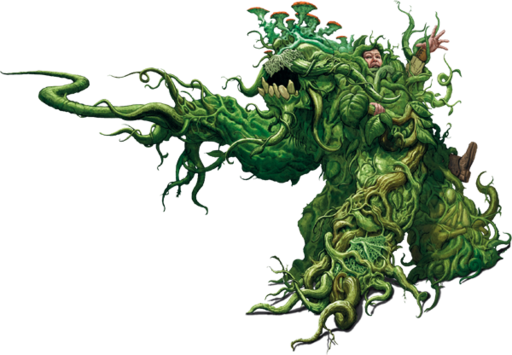
Picture: Handout: Shambling Mound
A shambling mound, sometimes called a shambler, trudges ponderously through bleak swamps, dismal marshes, and rain forests, consuming any organic matter in its path. This rotting heap of animated vegetation looms up half again as tall as a human, tapering into a faceless “head” at its top.
All-Consuming Devourers. A shambling mound feeds on any organic material, tirelessly consuming plants as it moves and devouring animals that can’t escape it. Only the shambling mounds’ rarity and plodding speed prevent them from overwhelming entire ecosystems. Even so, their presence leeches natural environments of plant and animal life, and an unsettling quiet pervades the swamps and woods haunted by these ever-hungry horrors.
Unseen Hunters. Composed of decaying leaves, vines, roots, and other natural swamp and forest compost, shamblers can blend into their environs. Because they move slowly, they rarely attempt to pursue and catch creatures. Rather, they remain in place, sustaining themselves by absorbing nutrients from their surroundings as they wait for prey to come to them. When a creature passes near or alights upon a shambling mound, the monster comes to life, seizing and absorbing the unwary prey.
Spawned by Lightning. A shambling mound results from a phenomenon in which lightning or fey magic invigorates an otherwise ordinary swamp plant. As the plant is reborn into its second life, it chokes the life from plants and animals around it, mulching their corpses in a heap around its roots. Those roots eventually give up their reliance on the soil, directing the shambling mound to seek out new sources of food.
The Weed that Walks. The instinct that drives a shambling mound is its central root-stem, buried somewhere inside its ponderous form. The rest of a shambler consists of the rotting heap that it simultaneously accumulates and feeds on, which protects the root-stem and animates to smash and smother the life from any creature.
The dense mass of a shambling mound’s body shrugs off the effects of cold and fire. Lightning reinvigorates the root-stem, strengthening the shambling mound and bolstering its consumptive drive. Despite its monstrous form, the shambling mound is a living plant that requires air and nourishment. Although it doesn’t sleep the way an animal does, it can lie dormant for days on end before rising to hunt for food.
A Resurgent Menace. If a shambling mound faces defeat before an overwhelming foe, the root-stem can feign death, collapsing the remains of its mound. If not subsequently killed, the root-stem beds down in the shambler’s remains to slowly regrow its full body, then once again sets out to consume all it can. In this way, shambling mound infestations long thought destroyed can recur time and again.
Traits
Lightning Absorption: Whenever the shambling mound is subjected to lightning damage, it takes no damage and regains a number of hit points equal to the lightning damage dealt.Actions
Multiattack: The shambling mound makes two slam attacks. If both attacks hit a Medium or smaller target, the target is grappled, escape DC 14, and the shambling mound uses its Engulf on it.Slam: Melee Weapon Attack: +7 to hit, reach 5 ft., one target. Hit: 13 (2d8 + 4) bludgeoning damage.
Engulf: The shambling mound engulfs a Medium or smaller creature grappled by it. The engulfed target is blinded, restrained, and unable to breathe, and it must succeed on a DC 14 Constitution saving throw at the start of each of the mound's turns or take 13 (2d8 + 4) bludgeoning damage. If the mound moves, the engulfed target moves with it. The mound can have only one creature engulfed at a time.

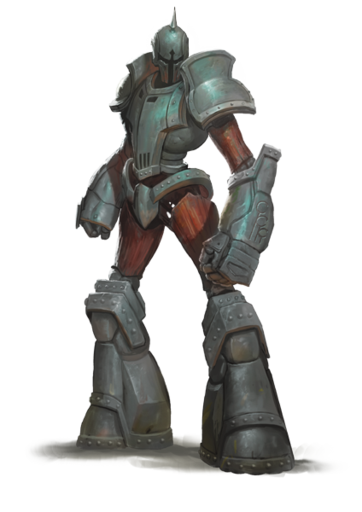
Picture: Handout: Shield Guardian
Wizards and other spellcasters create shield guardians for protection. A shield guardian treads beside its master, absorbing damage to keep its master alive as long as possible.
Master’s Amulet. Every shield guardian has an amulet magically linked to it. A shield guardian can have only one corresponding amulet, and if that amulet is destroyed, the shield guardian is incapacitated until a replacement amulet is created. A shield guardian’s amulet is subject to direct attack if it isn’t being worn or carried. It has AC 10, 10 hit points, and immunity to poison and psychic damage. Crafting an amulet requires 1 week and costs 1,000 gp in components.
A shield guardian’s solitary focus is to protect the amulet’s wearer. The amulet’s wearer can command the guardian to attack its enemies or to guard the wielder against attack. If an attack threatens to injure the wearer, the construct can magically absorb the blow into its own body, even at a distance.
A spellcaster can store a single spell within a shield guardian, which can then cast the spell on command or under specific conditions. Many a wizard has been rendered helpless by enemies, only to surprise those foes when its shield guardian unleashes potent magical power.
Magnificent Treasure. Because a shield guardian’s ownership can be transferred by giving its matching amulet to another creature, some wizards collect exorbitant sums from princes, nobles, and crime lords to create shield guardians for them. At the same time, a shield guardian makes a mighty prize for anyone who slays its master and claims its amulet.
Construct Nature. A shield guardian doesn’t require air, food, drink, or sleep.
Traits
Bound: The shield guardian is magically bound to an amulet. As long as the guardian and its amulet are on the same plane of existence, the amulet's wearer can telepathically call the guardian to travel to it, and the guardian knows the distance and direction to the amulet. If the guardian is within 60 feet of the amulet's wearer, half of any damage the wearer takes (rounded up) is transferred to the guardian.Regeneration: The shield guardian regains 10 hit points at the start of its turn if it has at least 1 hit. point.
Spell Storing: A spellcaster who wears the shield guardian's amulet can cause the guardian to store one spell of 4th level or lower. To do so, the wearer must cast the spell on the guardian. The spell has no effect but is stored within the guardian. When commanded to do so by the wearer or when a situation arises that was predefined by the spellcaster, the guardian casts the stored spell with any parameters set by the original caster, requiring no components. When the spell is cast or a new spell is stored, any previously stored spell is lost.
Actions
Multiattack: The guardian makes two fist attacks.Fist: Melee Weapon Attack: +7 to hit, reach 5 ft., one target. Hit: 11 (2d6 + 4) bludgeoning damage.
Reactions
Shield: When a creature makes an attack against the wearer of the guardian's amulet, the guardian grants a +2 bonus to the wearer's AC if the guardian is within 5 feet of the wearer.
Picture: Handout: Sir Godfrey Gwilyn
A revenant forms from the soul of a mortal who met a cruel and undeserving fate. It claws its way back into the world to seek revenge against the one who wronged it. The revenant reclaims its mortal body and superficially resembles a zombie. However, instead of lifeless eyes, a revenant’s eyes burn with resolve and flare in the presence of its adversary. If the revenant’s original body was destroyed or is otherwise unavailable, the spirit of the revenant enters another humanoid corpse. Regardless of the body the revenant uses as a vessel, its adversary always recognizes the revenant for what it truly is.
Hunger for Revenge. A revenant has only one year to exact revenge. When its adversary dies, or if the revenant fails to kill its adversary before its time runs out, it crumbles to dust and its soul fades into the afterlife. If its foe is too powerful for the revenant to destroy on its own, it seeks worthy allies to help it fulfill its quest.
Divine Justice. No magic can hide a creature pursued by a revenant, which always knows the direction and distance between it and the target of its vengeance. In cases where the revenant seeks revenge against more than one adversary, it pursues them one at a time, starting with the creature that dealt it the killing blow. If the revenant’s body is destroyed, its soul flies forth to seek out a new corpse in which to resume its hunt.
Undead Nature. A revenant doesn’t require air, food, drink, or sleep.
Variant: Revenants with Spells and Weapons
Revenants that were spellcasters before they died might retain some or all of their spellcasting capabilities. Similarly, revenants that wore armor and wielded weapons in life might continue to do so.
Phantom Warrior
A phantom warrior is the spectral remnant of a willful soldier or knight who perished on the battlefield or died performing its sworn duty. It appears like a translucent version of its living self.Task Driven. Although one is often mistaken for a ghost, a phantom warrior isn’t bound by a yearning to complete some unresolved goal. It can choose to end its undead existence at any time. Its spirit lingers willingly, either out of loyalty to its former master or because it believes it must perform a task to satisfy its honor or sense of duty. For example, a guard who dies defending a wall might return as a phantom warrior and continue guarding the wall, then disappear forever once a new guard assumes its post or the wall is destroyed. The period between the time it died and the time it rises as a phantom warrior is usually 24 hours.
Faded Memories. A phantom warrior retains the alignment and personality it had before it died, and it remembers how it died. Memories of its life from shortly before it died are hazy, and older memories are forgotten. A phantom warrior can usually remember the last 1d10 + 10 days of its life; everything that happened before that is an impenetrable fog.
Forceful Presence. Although they are incorporeal, phantom warriors can harness the energy around them to deflect incoming attacks and strike with great force. An invisible sheath of energy surrounds a phantom warrior’s ghostly armor, shields, and weapons, which become as hard as steel yet don’t impede the warrior’s ability to move through walls and other solid objects.
Undead Nature. A phantom warrior doesn’t require air, food, drink, or sleep.

Traits
Keen Smell: The cat has advantage on Wisdom (Perception) checks that rely on smell.Actions
Claws: Melee Weapon Attack: +0 to hit, reach 5 ft., one target. Hit: 1 (1d1) slashing damage.
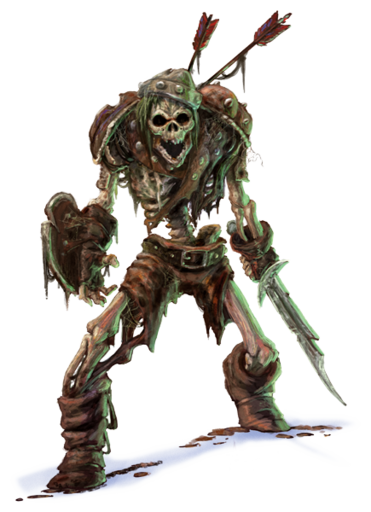
Skeletons
Skeletons arise when animated by dark magic. They heed the summons of spellcasters who call them from their stony tombs and ancient battlefields, or rise of their own accord in places saturated with death and loss, awakened by stirrings of necromantic energy or the presence of corrupting evil.Animated Dead. Whatever sinister force awakens a skeleton infuses its bones with a dark vitality, adhering joint to joint and reassembling dismantled limbs. This energy motivates a skeleton to move and think in a rudimentary fashion, though only as a pale imitation of the way it behaved in life. An animated skeleton retains no connection to its past, although resurrecting a skeleton restores it body and soul, banishing the hateful undead spirit that empowers it.
While most skeletons are the animated remains of dead humans and other humanoids, skeletal undead can be created from the bones of other creatures besides humanoids, giving rise to a host of terrifying and unique forms.
Obedient Servants. Skeletons raised by spell are bound to the will of their creator. They follow orders to the letter, never questioning the tasks their masters give them, regardless of the consequences. Because of their literal interpretation of commands and unwavering obedience, skeletons adapt poorly to changing circumstances. They can’t read, speak, emote, or communicate in any way except to nod, shake their heads, or point. Still, skeletons are able to accomplish a variety of relatively complex tasks.
A skeleton can fight with weapons and wear armor, can load and fire a catapult or trebuchet, scale a siege ladder, form a shield wall, or dump boiling oil. However, it must receive careful instructions explaining how such tasks are accomplished.
Although they lack the intellect they possessed in life, skeletons aren’t mindless. Rather than break its limbs attempting to batter its way through an iron door, a skeleton tries the handle first. If that doesn’t work, it searches for another way through or around the obstacle.
Habitual Behaviors. Independent skeletons temporarily or permanently free of a master’s control sometimes pantomime actions from their past lives, their bones echoing the rote behaviors of their former living selves. The skeleton of a miner might lift a pick and start chipping away at stone walls. The skeleton of a guard might strike up a post at a random doorway. The skeleton of a dragon might lie down on a pile of treasure, while the skeleton of a horse crops grass it can’t eat. Left alone in a ballroom, the skeletons of nobles might continue an eternally unfinished dance.
When skeletons encounter living creatures, the necromantic energy that drives them compels them to kill unless they are commanded by their masters to refrain from doing so. They attack without mercy and fight until destroyed, for skeletons possess little sense of self and even less sense of self-preservation.
Undead Nature. A skeleton doesn’t require air, food, drink, or sleep.
Actions
Shortsword: Melee Weapon Attack: +4 to hit, reach 5 ft., one target. Hit: 5 (1d6 + 2) piercing damage.Shortbow: Ranged Weapon Attack: +4 to hit, range 80/320 ft., one target. Hit: 5 (1d6 + 2) piercing damage.

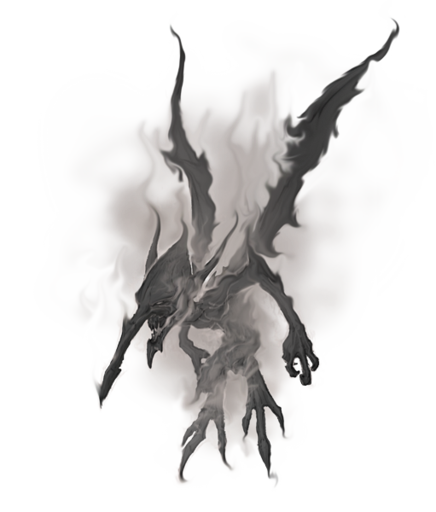
Mephits
Mephits are capricious, imp-like creatures native to the elemental planes. They come in six varieties, each one representing the mixture of two elements.Ageless tricksters, mephits gather in large numbers on the Elemental Planes and in the Elemental Chaos. They also find their way to the Material Plane, where they prefer to dwell in places where their base elements are abundant. For example, a magma mephit is composed of earth and fire, and it favors volcanic lairs, while an ice mephit, which is composed of air and water, favors frigid locales.
Elemental Nature. A mephit doesn’t require food, drink, or sleep.
Smoke Mephit
Smoke mephits are crude, lazy creatures of air and fire that billow smoke constantly. They rarely speak the truth and love to mock and mislead other creatures.Traits
Death Burst: When the mephit dies, it leaves behind a cloud of smoke that fills a 5-foot-radius sphere centered on its space. The sphere is heavily obscured. Wind disperses the cloud, which otherwise lasts for 1 minute.Innate Spellcasting (1/Day): The mephit can innately cast dancing lights, requiring no material components. Its innate spellcasting ability is Charisma.
Actions
Claws: Melee Weapon Attack: +4 to hit, reach 5 ft., one creature. Hit: 4 (1d4 + 2) slashing damage.Cinder Breath (Recharge 6): The mephit exhales a 15-foot cone of smoldering ash. Each creature in that area must succeed on a DC 10 Dexterity saving throw or be blinded until the end of the mephit’s next turn.
Variant: Summon Mephits (1/Day): Some mephits can have an action option that allows them to summon other mephits. The mephit has a 25 percent chance of summoning 1d4 mephits of its kind. A summoned mephit appears in an unoccupied space within 60 feet of its summoner, acts as an ally of its summoner, and can't summon other mephits. It remains for 1 minute, until it or its summoner dies, or until its summoner dismisses it as an action.

Snow maidens don’t speak, nor are they interested in hearing what the characters have to say. If the characters encounter snow maidens and don’t leave at once, the snow maidens attack.

Picture: Handout: Specter
A specter is the angry, unfettered spirit of a humanoid that has been prevented from passing to the afterlife. Specters no longer possess connections to who or what they were, yet are condemned to walk the world forever. Some are spawned when dark magic or the touch of a wraith rips a soul from a living body.
Beyond Redemption. When a ghost’s unfinished business is completed, it can rest at last. No such rest or redemption awaits a specter. It is doomed to the Material Plane, its only end the oblivion that comes with the destruction of its soul. Until then, it bears out its lonely life in forlorn places, carrying on forgotten through the ages of the world.
Undying Hatred. Living creatures remind the specter that life is beyond its grasp. The mere sight of the living overwhelms a specter with sorrow and wrath, which can be abated only by destroying said life. A specter kills quickly and mercilessly, for only by depriving others of life can it gain the slightest satisfaction. However, no matter how many lives it extinguishes, a specter always succumbs to its hatred and sorrow.
Dwellers in Darkness. Sunlight represents a source of life that no specter can ever hope to douse, and it pains them. When night falls, they leave their final resting places in search of living creatures to slay, knowing that few weapons can harm them in return. At the first light of dawn, they retreat back into the darkness, where they remain until night falls again.
Undead Nature. A specter doesn’t require air, food, drink, or sleep.
Variant: Poltergeist
A poltergeist is a different kind of specter — the confused, invisible spirit of an individual with no sense of how he or she died. A poltergeist expresses its rage by hurling creatures and objects using the power of its shattered psyche. The Poltergeist stat block can be found here.Traits
Incorporeal Movement: The specter can move through other creatures and objects as if they were difficult terrain. It takes 5 (1d10) force damage if it ends its turn inside an object.Sunlight Sensitivity: While in sunlight, the specter has disadvantage on attack rolls, as well as on Wisdom (Perception) checks that rely on sight.
Actions
Life Drain: Melee Spell Attack: +4 to hit, reach 5 ft., one creature. Hit: 10 (3d6) necrotic damage. The target must succeed on a DC 10 Constitution saving throw or its hit point maximum is reduced by an amount equal to the damage taken. This reduction lasts until the creature finishes a long rest. The target dies if this effect reduces its hit point maximum to 0.
If the summoner who conjured this spirit through the mirror (chapter 5, area N3p) is evil, the ghost manifests as a pair of floating, bloodshot eyes and strong, spectral hands. The hands try to wrap themselves around the summoner’s neck. The ghost attacks its summoner until one or the other drops to 0 hit points, at which point it disappears.

If the summoner who conjured this spirit through the mirror (chapter 5, area N3p) isn’t evil, the spirit assumes solid form, appearing as a darkly handsome thirty-year-old man with bloodshot eyes. He doesn’t speak, and he disappears into the ether if reduced to 0 hit points. The assassin’s summoner can command him to kill one living creature within Strahd’s domain that the summoner mentions by name. The assassin automatically knows the distance and direction to the named target. The assassin attacks any other creature that tries to prevent him from completing his assignment. Once he completes his task, the assassin disappears. If commanded to attack a creature that is either dead or undead, or if he isn’t given an appropriate name within 1 round of being summoned, the assassin disappears.

Picture: Handout: Gargoyle
The inanimate gargoyles that perch atop great buildings are inspired by these malevolent creatures of elemental earth that resemble grotesque, fiendish statues. A gargoyle lurks among masonry and ruins, as still as any stone sculpture, and delights in the terror it creates when it breaks from its suspended pose, as well as the pain it inflicts on its victims.
Animate Stone. Gargoyles cling to rocky cliffs and mountains, or roost on ledges in underground caves. They haunt city rooftops, perching vulture-like among the high stone arches and buttresses of castles and cathedrals, and they can hold themselves so still that they appear inanimate. Able to maintain this state for years, a gargoyle makes an ideal sentry.
Deadly Reputation. Gargoyles have a reputation for cruelty. Statues carved into the likenesses of gargoyles appear in the architecture of countless cultures to frighten away trespassers. Although such sculptures are only decorative, real gargoyles can hide among them to ambush unsuspecting victims. A gargoyle might alleviate the tedium of its watch by catching and tormenting birds or rodents, but its long wait only increases its craving for harming sentient creatures.
Cruel Servants. Gargoyles are easily inspired by the cunning of an intelligent master. They enjoy simple tasks such as guarding a master’s home, torturing and killing interlopers, and anything else that involves minimum effort and maximum pain and carnage.
Gargoyles sometimes serve demons for their propensity for wanton chaos and destruction. Powerful spellcasters can also easily enlist gargoyle guardians to keep watch over their gates and walls. Gargoyles have the patience and fortitude of stone, and will serve even the cruelest master for years without complaint.
Elemental Nature. A gargoyle doesn’t require air, food, drink, or sleep.
Shards of Elemental Evil
As Ogr�moch, the evil Prince of Elemental Earth, treads his stony realm, it leaves shards of broken rock in his wake. Imbued with slivers of sentience, these shards thrum with the essence of the elemental prince, growing over long years into vaguely humanoid rock formations that resolve at last into the hard, cruel shapes of gargoyles.Ogr�moch doesn’t create gargoyles deliberately, but they are a physical manifestation of his evil. Gargoyles are mockeries of the elemental air that Ogr�moch despises. They are heavy creatures of living stone, yet capable of flight. Like their creator, they possess a fundamental hatred for beings of elemental air, aarakocra in particular, and relish every opportunity to destroy such creatures.
On their home plane, gargoyles carve out earth motes that Ogr�moch hurtles into Aaqa, the domain of the aarakocra and the benevolent Wind Dukes the bird folk serve in the Elemental Plane of Air.
Traits
False Appearance: While the gargoyle remains motion less, it is indistinguishable from an inanimate statue.Actions
Multiattack: The gargoyle makes two attacks: one with its bite and one with its claws.Bite: Melee Weapon Attack: +4 to hit, reach 5 ft., one target. Hit: 5 (1d6 + 2) piercing damage.
Claws: Melee Weapon Attack: +4 to hit, reach 5 ft., one target. Hit: 5 (1d6 + 2) slashing damage.

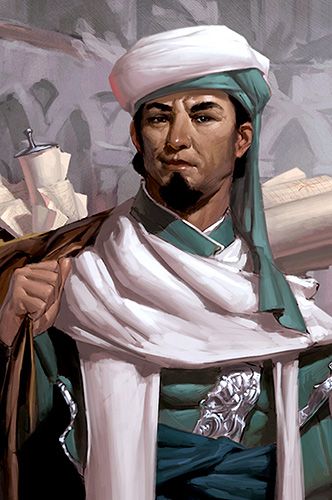
Rulers, nobles, merchants, guildmasters, and other wealthy individuals use spies to gain the upper hand in a world of cutthroat politics. A spy is trained to secretly gather information. Loyal spies would rather die than divulge information that could compromise them or their employers.
Traits
Cunning Action: On each of its turns, the spy can use a bonus action to take the Dash, Disengage, or Hide action.Sneak Attack (1/Turn): The spy deals an extra 7 (2d6) damage when it hits a target with a weapon attack and has advantage on the attack roll, or when the target is within 5 ft. of an ally of the spy that isn't incapacitated and the spy doesn't have disadvantage on the attack roll.
Actions
Multiattack: The spy makes two melee attacks.Shortsword: Melee Weapon Attack: +4 to hit, reach 5 ft., one target. Hit: 5 (1d6 + 2) piercing damage.
Hand Crossbow: Ranged Weapon Attack: +4 to hit, range 30/120 ft., one target. Hit: 5 (1d6 + 2) piercing damage.

Stanimir is a mage who leads the Vistani in the Mysterious Visitors section of chapter 1.

(no bio)

Picture: Handout: Strahd von Zarovich
Although Strahd can be encountered almost anywhere in his domain, the vampire is always encountered in the place indicated by the card reading in chapter 1, unless he has been forced into his tomb in the catacombs of Castle Ravenloft.
Strahd von Zarovich
With his mind sharp and his heart dark, Strahd von Zarovich is a formidable foe. Courage and lives beyond measure have been lost to him. See Strahd's History to understand his personality and goals.Although Strahd can be encountered almost anywhere in his domain, the vampire is always encountered in the place indicated by the card reading in chapter 1, unless he has been forced into his tomb in the catacombs of Castle Ravenloft.

Strahd Zombie
Strahd zombies are undead that serve the vampire Strahd von Zarovich. Created from the long-dead guards of Castle Ravenloft, they were called into being through dark magic by Strahd himself.Loathsome Limbs. A Strahd zombie’s gray-green flesh looks soft, and its bones seem brittle. Any good hit from a bludgeoning or slashing weapon severs part of the zombie’s body. Strahd zombies are suffused with horrible necromantic magic that allows their severed body parts to continue to attack. All parts of a Strahd zombie are considered one and the same creature, so damage to any part damages the whole creature.
Undead Nature. A Strahd zombie doesn't require air or sleep.

Picture: Handout: Strahd's Animated Armor
Constructed Nature. An animated object doesn’t require air, food, drink, or sleep.
The magic that animates an object is dispelled when the construct drops to 0 hit points. An animated object reduced to 0 hit points becomes inanimate and is too damaged to be of much use or value to anyone.
Animated Objects
Animated objects are crafted with potent magic to follow the commands of their creators. When not commanded, they follow the last order they received to the best of their ability, and can act independently to fulfill simple instructions. Some animated objects might converse fluently or adopt a persona, but most are simple automatons.Constructed Nature. An animated object doesn’t require air, food, drink, or sleep.
The magic that animates an object is dispelled when the construct drops to 0 hit points. An animated object reduced to 0 hit points becomes inanimate and is too damaged to be of much use or value to anyone.

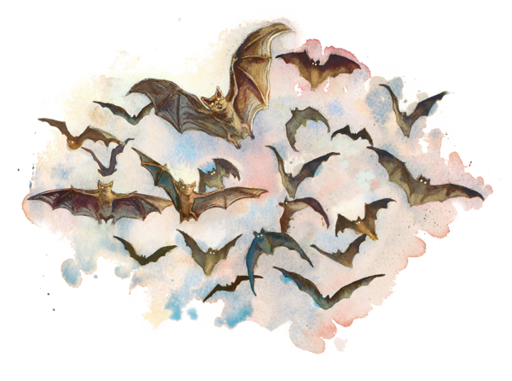
The Nature of Swarms
The swarms presented here aren’t ordinary or benign assemblies of little creatures. They form as a result of some sinister or unwholesome influence. A vampire can summon swarms of bats and rats from the darkest corners of the night, while the very presence of a mummy lord can cause scarab beetles to boil up from the sand-filled depths of its tomb. A hag might have the power to turn swarms of ravens against her enemies, while a yuan-ti abomination might have swarms of poisonous snakes slithering in its wake. Even druids can’t charm these swarms, and their aggressiveness is borderline unnatural.Traits
Echolocation: The swarm can't use its blindsight while deafened.Keen Hearing: The swarm has advantage on Wisdom (Perception) checks that rely on hearing.
Swarm: The swarm can occupy another creature's space and vice versa, and the swarm can move through any opening large enough for a Tiny bat. The swarm can't regain hit points or gain temporary hit points.
Actions
Bites (swarm has more than half HP): Melee Weapon Attack: +4 to hit, reach 0 ft., one creature in the swarm's space. Hit: 5 (2d4) piercing damage.Bites (swarm has half HP or less): Melee Weapon Attack: +4 to hit, reach 0 ft., one creature in the swarm's space. Hit: 2 (1d4) piercing damage.

The Nature of Swarms
The swarms presented here aren’t ordinary or benign assemblies of little creatures. They form as a result of some sinister or unwholesome influence. A vampire can summon swarms of bats and rats from the darkest corners of the night, while the very presence of a mummy lord can cause scarab beetles to boil up from the sand-filled depths of its tomb. A hag might have the power to turn swarms of ravens against her enemies, while a yuan-ti abomination might have swarms of poisonous snakes slithering in its wake. Even druids can’t charm these swarms, and their aggressiveness is borderline unnatural.Traits
Swarm: The swarm can occupy another creature's space and vice versa, and the swarm can move through any opening large enough for a Tiny insect. The swarm can't regain hit points or gain temporary hit points.Actions
Bites (swarm has more than half HP): Melee Weapon Attack: +3 to hit, reach 0 ft., one target in the swarm's space. Hit: 10 (4d4) piercing damage. A creature reduced to 0 hit points by a swarm of centipedes is stable but poisoned for 1 hour, even after regaining hit points, and paralyzed while poisoned in this way.Bites (swarm has half HP or less): Melee Weapon Attack: +3 to hit, reach 0 ft., one target in the swarm's space. Hit: 5 (2d4) piercing damage. A creature reduced to 0 hit points by a swarm of centipedes is stable but poisoned for 1 hour, even after regaining hit points, and paralyzed while poisoned in this way.

The Nature of Swarms
The swarms presented here aren’t ordinary or benign assemblies of little creatures. They form as a result of some sinister or unwholesome influence. A vampire can summon swarms of bats and rats from the darkest corners of the night, while the very presence of a mummy lord can cause scarab beetles to boil up from the sand-filled depths of its tomb. A hag might have the power to turn swarms of ravens against her enemies, while a yuan-ti abomination might have swarms of poisonous snakes slithering in its wake. Even druids can’t charm these swarms, and their aggressiveness is borderline unnatural.Traits
Swarm: The swarm can occupy another creature's space and vice versa, and the swarm can move through any opening large enough for a Tiny insect. The swarm can't regain hit points or gain temporary hit points.Actions
Bites (swarm has more than half HP): Melee Weapon Attack: +3 to hit, reach 0 ft., one target in the swarm's space. Hit: 10 (4d4) piercing damage.Bites (swarm has half HP or less): Melee Weapon Attack: +3 to hit, reach 0 ft., one target in the swarm's space. Hit: 5 (2d4) piercing damage.

The Nature of Swarms
The swarms presented here aren’t ordinary or benign assemblies of little creatures. They form as a result of some sinister or unwholesome influence. A vampire can summon swarms of bats and rats from the darkest corners of the night, while the very presence of a mummy lord can cause scarab beetles to boil up from the sand-filled depths of its tomb. A hag might have the power to turn swarms of ravens against her enemies, while a yuan-ti abomination might have swarms of poisonous snakes slithering in its wake. Even druids can’t charm these swarms, and their aggressiveness is borderline unnatural.Traits
Swarm: The swarm can occupy another creature's space and vice versa, and the swarm can move through any opening large enough for a Tiny snake. The swarm can't regain hit points or gain temporary hit points.Actions
Bites (swarm has more than half HP): Melee Weapon Attack: +6 to hit, reach 0 ft., one creature in the swarm's space. Hit: 7 (2d6) piercing damage. The target must make a DC 10 Constitution saving throw, taking 14 (4d6) poison damage on a failed save, or half as much damage on a successful one.Bites (swarm has half HP or less): Melee Weapon Attack: +6 to hit, reach 0 ft., one creature in the swarm's space. Hit: 3 (1d6) piercing damage. The target must make a DC 10 Constitution saving throw, taking 14 (4d6) poison damage on a failed save, or half as much damage on a successful one.

The Nature of Swarms
The swarms presented here aren’t ordinary or benign assemblies of little creatures. They form as a result of some sinister or unwholesome influence. A vampire can summon swarms of bats and rats from the darkest corners of the night, while the very presence of a mummy lord can cause scarab beetles to boil up from the sand-filled depths of its tomb. A hag might have the power to turn swarms of ravens against her enemies, while a yuan-ti abomination might have swarms of poisonous snakes slithering in its wake. Even druids can’t charm these swarms, and their aggressiveness is borderline unnatural.Traits
Keen Smell: The swarm has advantage on Wisdom (Perception) checks that rely on smell.Swarm: The swarm can occupy another creature's space and vice versa, and the swarm can move through any opening large enough for a Tiny rat. The swarm can't regain hit points or gain temporary hit points.
Actions
Bites (swarm has more than half HP): Melee Weapon Attack: +2 to hit, reach 0 ft., one target in the swarm's space. Hit: 7 (2d6) piercing damage.Bites (swarm has half HP or less): Melee Weapon Attack: +2 to hit, reach 0 ft., one target in the swarm's space. Hit: 3 (1d6) piercing damage.

The Nature of Swarms
The swarms presented here aren’t ordinary or benign assemblies of little creatures. They form as a result of some sinister or unwholesome influence. A vampire can summon swarms of bats and rats from the darkest corners of the night, while the very presence of a mummy lord can cause scarab beetles to boil up from the sand-filled depths of its tomb. A hag might have the power to turn swarms of ravens against her enemies, while a yuan-ti abomination might have swarms of poisonous snakes slithering in its wake. Even druids can’t charm these swarms, and their aggressiveness is borderline unnatural.Traits
Swarm: The swarm can occupy another creature's space and vice versa, and the swarm can move through any opening large enough for a Tiny raven. The swarm can't regain hit points or gain temporary hit points.Actions
Beaks (swarm has more than half HP): Melee Weapon Attack: +4 to hit, reach 5 ft., one target in the swarm's space. Hit: 7 (2d6) piercing damage.Beaks (swarm has half HP or less): Melee Weapon Attack: +4 to hit, reach 5 ft., one target in the swarm's space. Hit: 3 (1d6) piercing damage.

The Nature of Swarms
The swarms presented here aren’t ordinary or benign assemblies of little creatures. They form as a result of some sinister or unwholesome influence. A vampire can summon swarms of bats and rats from the darkest corners of the night, while the very presence of a mummy lord can cause scarab beetles to boil up from the sand-filled depths of its tomb. A hag might have the power to turn swarms of ravens against her enemies, while a yuan-ti abomination might have swarms of poisonous snakes slithering in its wake. Even druids can’t charm these swarms, and their aggressiveness is borderline unnatural.Traits
Swarm: The swarm can occupy another creature's space and vice versa, and the swarm can move through any opening large enough for a Tiny insect. The swarm can't regain hit points or gain temporary hit points.Spider Climb: The swarm can climb difficult surfaces, including upside down on ceilings, without needing to make an ability check.
Web Sense: While in contact with a web, the swarm knows the exact location of any other creature in contact with the same web.
Web Walker: The swarm ignores movement restrictions caused by webbing.
Actions
Bites (swarm has more than half HP): Melee Weapon Attack: +3 to hit, reach 0 ft., one target in the swarm's space. Hit: 10 (4d4) piercing damage.Bites (swarm has half HP or less): Melee Weapon Attack: +3 to hit, reach 0 ft., one target in the swarm's space. Hit: 5 (2d4) piercing damage.

The Nature of Swarms
The swarms presented here aren’t ordinary or benign assemblies of little creatures. They form as a result of some sinister or unwholesome influence. A vampire can summon swarms of bats and rats from the darkest corners of the night, while the very presence of a mummy lord can cause scarab beetles to boil up from the sand-filled depths of its tomb. A hag might have the power to turn swarms of ravens against her enemies, while a yuan-ti abomination might have swarms of poisonous snakes slithering in its wake. Even druids can’t charm these swarms, and their aggressiveness is borderline unnatural.Traits
Swarm: The swarm can occupy another creature's space and vice versa, and the swarm can move through any opening large enough for a Tiny insect. The swarm can't regain hit points or gain temporary hit points.Actions
Bites (swarm has more than half HP): Melee Weapon Attack: +3 to hit, reach 0 ft., one target in the swarm's space. Hit: 10 (4d4) piercing damage.Bites (swarm has half HP or less): Melee Weapon Attack: +3 to hit, reach 0 ft., one target in the swarm's space. Hit: 5 (2d4) piercing damage.

Picture: Handout: Szoldar Szoldarovich
Szoldar Szoldarovich and Yevgeni Krushkin are local hunters who frequent the Blue Water Inn. They kill wolves and sell the meat for a living, and their work is dangerous and bloody. Both men are grim and have haunted looks in their eyes.
These two are dour fellows, but they seldom pass up an opportunity to earn coin. If the characters are looking for guides or information about the land of Barovia, Szoldar and Yevgeni can be of service. They aren’t afraid to venture beyond Vallaki’s walls during the day, and they know the woods and valley well. They’re willing to serve as guides for 5 gp per day, or to provide directions to important landmarks in exchange for free drinks. They think it’s foolish to travel “this cursed realm” at night and won’t do so unless their payment is exorbitant (100 gp or more).
On rare occasions when he has something to say, Szoldar speaks brusquely, while Yevgeni usually parrots his friend in not so many words. Szoldar has a notch in his bow for every wolf he’s killed, while Yevgeni adds a new swatch to his wolfskin cloak every time he makes a kill. Both men have families but spend most of their time together, either drowning their sorrows or hunting in the woods. Most of the wolf heads that adorn the tavern walls are the result of their handiwork.
Szoldar Szoldarovich and Yevgeni Krushkin are local hunters who frequent the Blue Water Inn. They kill wolves and sell the meat for a living, and their work is dangerous and bloody. Both men are grim and have haunted looks in their eyes.
These two are dour fellows, but they seldom pass up an opportunity to earn coin. If the characters are looking for guides or information about the land of Barovia, Szoldar and Yevgeni can be of service. They aren’t afraid to venture beyond Vallaki’s walls during the day, and they know the woods and valley well. They’re willing to serve as guides for 5 gp per day, or to provide directions to important landmarks in exchange for free drinks. They think it’s foolish to travel “this cursed realm” at night and won’t do so unless their payment is exorbitant (100 gp or more).
On rare occasions when he has something to say, Szoldar speaks brusquely, while Yevgeni usually parrots his friend in not so many words. Szoldar has a notch in his bow for every wolf he’s killed, while Yevgeni adds a new swatch to his wolfskin cloak every time he makes a kill. Both men have families but spend most of their time together, either drowning their sorrows or hunting in the woods. Most of the wolf heads that adorn the tavern walls are the result of their handiwork.

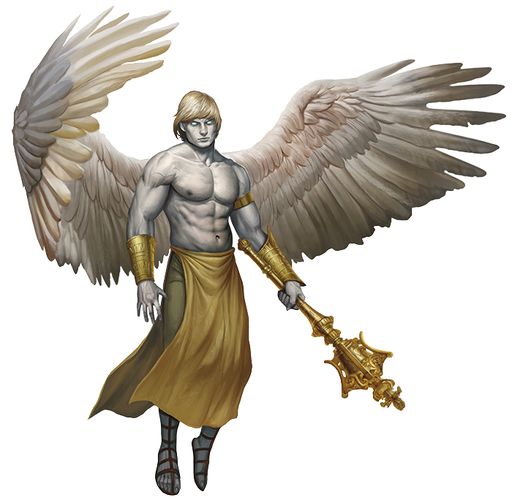
Angels
An angel is a celestial agent sent forth into the planes to further its god’s agenda for weal or woe. Its sublime beauty and presence can drive awestruck onlookers to their knees. Yet angels are destroyers too, and their appearance portends doom as often as it signals hope.Shards of the Divine. Angels are formed from the astral essence of benevolent gods and are thus divine beings of great power and foresight.
Angels act out the will of their gods with tireless devotion. Even chaotic good deities command lawful good angels, knowing that the angels’ dedication to order best allows them to fulfill divine commands. An angel follows a single driving purpose, as decreed by its deity. However, an angel is incapable of following commands that stray from the path of law and good.
An angel slays evil creatures without remorse. As the embodiment of law and good, an angel is almost never mistaken in its judgments. This quality can create a sense of superiority in an angel, a sense that comes to the fore when an angel’s task conflicts with the goals of another creature. The angel never acquiesces or gives way. When an angel is sent to aid mortals, it is sent not to serve but to command. The gods of good therefore send their angels among mortals only in response to the most dire circumstances.
Fallen Angels. An angel’s moral compass grants it a sense of infallibility that can sometimes spell its undoing. Angels are usually too wise to fall for a simple deception, but sometimes pride can lead one to commit an evil act. Whether intentional or accidental, such an act is a permanent stain that marks the angel as an outcast.
Fallen angels retain their power but lose their connection to the deities from which they were made. Most fallen angels take their banishment personally, rebelling against the powers they served by seeking rulership over a section of the Abyss or a place among other fallen in the hierarchy of the Nine Hells. Zariel, the ruler of the first layer of the Nine Hells, is such a creature. Rather than rebel, some fallen angels resign themselves to an isolated existence on the Material Plane, living in disguise as simple hermits. If they are redeemed, they can become powerful allies dedicated to justice and compassionate service.
Immortal Nature. An angel doesn’t require food, drink, or sleep.
Deva
Devas are angels that act as divine messengers or agents to the Material Plane, the Shadowfell, and the Feywild and that can assume a form appropriate to the realm they are sent to.Legend tells of angels that take mortal form for years, lending aid, hope, and courage to goodhearted folk. A deva can take any shape, although it prefers to appear to mortals as an innocuous humanoid or animal. When circumstances require that it cast off its guise, a deva is a beautiful humanoid-like creature with silvery skin. Its hair and eyes gleam with an unearthly luster, and large feathery wings unfurl from its shoulder blades.
Traits
Angelic Weapons: The deva's weapon attacks are magical. When the deva hits with any weapon, the weapon deals an extra 4d8 radiant damage (included in the attack).Innate Spellcasting: The deva's spellcasting ability is Charisma (spell save DC 17). The deva can innately cast the following spells, requiring only verbal components:
• At will: detect evil and good
• 1/day each: commune, raise dead
Magic Resistance: The deva has advantage on saving throws against spells and other magical effects.
Actions
Multiattack: The deva makes two melee attacks.Mace: Melee Weapon Attack: +8 to hit, reach 5 ft., one target. Hit: 7 (1d6 + 4) bludgeoning damage plus 18 (4d8) radiant damage.
Healing Touch (3/Day): The deva touches another creature. The target magically regains 20 (4d8 + 2) hit points and is freed from any curse, disease, poison, blindness, or deafness.
Change Shape: The deva magically polymorphs into a humanoid or beast that has a challenge rating equal to or less than its own, or back into its true form. It reverts to its true form if it dies. Any equipment it is wearing or carrying is absorbed or borne by the new form (the deva's choice).
In a new form, the deva retains its game statistics and ability to speak, but its AC, movement modes, Strength, Dexterity, and special senses are replaced by those of the new form, and it gains any statistics and capabilities (except class features, legendary actions, and lair actions) that the new form has but that it lacks.

The Mad Mage of Mount Baratok came to Barovia more than a year ago to free its people from Strahd’s tyranny, but he underestimated Strahd’s hold over the land and the creatures in it. After a battle between the two in Castle Ravenloft, Strahd drove the Mad Mage to the mountains and sent the wizard hurling over Tser Falls (chapter 2, area H). The wizard, his staff and spellbook lost, survived the fall and retreated into the mountains, hoping to regain his power, only to be driven mad by the realization that he no longer has any hope of defeating Strahd or freeing the people of the vampire’s damned realm.
The Mad Mage has forgotten his name and the world whence he came. In fact, he doesn’t remember anything that happened before the madness. He suffers from the paranoia that powerful enemies are hunting him, and that their evil agents are everywhere and watching him.
The Mad Mage has forgotten his name and the world whence he came. In fact, he doesn’t remember anything that happened before the madness. He suffers from the paranoia that powerful enemies are hunting him, and that their evil agents are everywhere and watching him.


A toad has no effective attacks. It feeds on small insects and typically dwells near water, in trees, or underground.
Standing Leap: The toad's long jump is up to 10 ft. and its high jump is up to 5 ft., with or without a running start.
Traits
Amphibious: The toad can breathe air and waterStanding Leap: The toad's long jump is up to 10 ft. and its high jump is up to 5 ft., with or without a running start.

Blight, Tree
Picture: Handout: Tree BlightBlights (as described in the Monster Manual) are evil, ambulatory plant creatures, and a tree blight is a particularly enormous variety. It looks like a dead tree or treant, 30 feet tall, with spongy wooden flesh, thorny branches, and rubbery roots that trail behind it. It has blood for sap and is so saturated with blood that it doesn’t catch fire easily.
Vicious Carnivore. A tree blight feeds on warm-blooded prey and takes perverse delight in causing carnage. It strikes with its heavy branches and crushes prey to death with its roots. It can open its gaping, tooth-filled mouth and bite a creature caught in its roots. The roots of a tree blight can be severed, though cutting them causes the blight no harm.
Blight Animosity. A tree blight will often fight alongside other kinds of blights, but it hates other tree blights and will attack them given the chance. Tree blights also hate treants, and the feeling is mutual.

Behold the legacy of Gulthias the vampire: plants with a taste for blood.
Picture: Handout: Twig Blight
Blights
Awakened plants gifted with the powers of intelligence and mobility, blights plague lands contaminated by darkness. Drinking that darkness from the soil, a blight carries out the will of ancient evil and attempts to spread that evil wherever it can.Roots of the Gulthias Tree. Legends tell of a vampire named Gulthias who worked terrible magic and raised up an abominable tower called Nightfang Spire. Gulthias was undone when a hero plunged a wooden stake through his heart, but as the vampire was destroyed, his blood infused the stake with a dreadful power. In time, tendrils of new growth sprouted from the wood, growing into a sapling infused with the vampire’s evil essence. It is said that a mad druid discovered the sapling, transplanting it to an underground grotto where it could grow. From this Gulthias tree came the seeds from which the first blights were sown.
Dark Conquest. Wherever a tree or plant is contaminated by a fragment of an evil mind or power, a Gulthias tree can rise to infest and corrupt the surrounding forest. Its evil spreads through root and soil to other plants, which perish or transform into blights. As those blights spread, they poison and uproot healthy plants, replacing them with brambles, toxic weeds, and others of their kind. In time, an infestation of blights can turn any land or forest into a place of corruption.
In forests infested with blights, trees and plants grow with supernatural speed. Vines and undergrowth rapidly spread through buildings and overrun trails and roads. After blights have killed or driven off their inhabitants, whole villages can disappear in the space of days.
Controlled by Evil. Blights are independent creatures, but most act under a Gulthias tree’s control, often displaying the habits and traits of the life force or spirit that spawned them. By attacking their progenitor’s old foes or seeking out treasures valuable to it, they carry on the legacy of long-lost evil.
Twig Blight
Twig blights can root in soil, which they do when living prey are scarce. While rooted, they resemble woody shrubs. When it pulls its roots free of the ground to move, a twig blight’s branches twist together to form a humanoid-looking body with a head and limbs.Twig blights seek out campsites and watering holes, rooting there to set up ambushes for potential victims coming to drink or rest. Huddled together in groups, twig blights blend in with an area’s natural vegetation or with piles of debris or firewood.
Given how dry they are, twig blights are particularly susceptible to fire.
Traits
False Appearance: While the blight remains motionless, it is indistinguishable from a dead shrub.Actions
Claws: Melee Weapon Attack: +3 to hit, reach 5 ft., one target. Hit: 3 (1d4 + 1) piercing damage.
"I am The Ancient, I am The Land. My beginnings are lost in the darkness of the past. I was the warrior, I was good and just. I thundered across the land like the wrath of a just god, but the war years and the killing years wore down my soul as the wind wears down stone into sand."
—Count Strahd von Zarovich
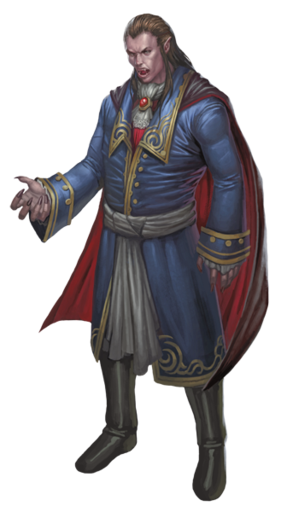
Vampires
Awakened to an endless night, vampires hunger for the life they have lost and sate that hunger by drinking the blood of the living. Vampires abhor sunlight, for its touch burns them. They never cast shadows or reflections, and any vampire wishing to move unnoticed among the living keeps to the darkness and far from reflective surfaces.Dark Desires. Whether or not a vampire retains any memories from its former life, its emotional attachments wither as once-pure feelings become twisted by undeath. Love turns into hungry obsession, while friendship becomes bitter jealousy. In place of emotion, vampires pursue physical symbols of what they crave, so that a vampire seeking love might fixate on a young beauty. A child might become an object of fascination for a vampire obsessed with youth and potential. Others surround themselves with art, books, or sinister items such as torture devices or trophies from creatures they have killed.
Born from Death. Most of a vampire’s victims become vampire spawn—ravenous creatures with a vampire’s hunger for blood, but under the control of the vampire that created them. If a true vampire allows a spawn to draw blood from its own body, the spawn transforms into a true vampire no longer under its master’s control. Few vampires are willing to relinquish their control in this manner. Vampire spawn become free-willed when their creator dies.
Chained to the Grave. Every vampire remains bound to its coffin, crypt, or grave site, where it must rest by day. If a vampire didn’t receive a formal burial, it must lie beneath a foot of earth at the place of its transition to undeath. A vampire can move its place of burial by transporting its coffin or a significant amount of grave dirt to another location. Some vampires set up multiple resting places this way.
Undead Nature. Neither a vampire nor a vampire spawn requires air.
Player Characters as Vampires
The game statistics of a player character transformed into a vampire spawn and then a vampire don’t change, except that the character’s Strength, Dexterity, and Constitution scores become 18 if they aren’t higher. In addition, the character gains the vampire’s damage resistances, darkvision, traits, and actions. Attack and damage rolls for the vampire’s attacks are based on Strength. The save DC for Charm is 8 + the vampire’s proficiency bonus + the vampire’s Charisma modifier. The character’s alignment becomes lawful evil, and the DM might take control of the character until the vampirism is reversed with a wish spell or the character is killed and brought back to life.Variants: Vampire Warriors and Spellcasters
Some vampires have martial training and battlefield experience. Their entry can be found here.Some vampires are practitioners of the arcane arts. Their entry can be found here.
A Vampire’s Lair
A vampire chooses a grand yet defensible location for its lair, such as a castle, fortified manor, or walled abbey. It hides its coffin in an underground crypt or vault guarded by vampire spawn or other loyal creatures of the night.Regional Effects
The region surrounding a vampire’s lair is warped by the creature’s unnatural presence, creating any of the following effects:• There’s a noticeable increase in the populations of bats, rats, and wolves in the region.
• Plants within 500 feet of the lair wither, and their stems and branches become twisted and thorny.
• Shadows cast within 500 feet of the lair seem abnormally gaunt and sometimes move as though alive.
• A creeping fog clings to the ground within 500 feet of the vampire’s lair. The fog occasionally takes eerie forms, such as grasping claws and writhing serpents.
If the vampire is destroyed, these effects end after 2d6 days.
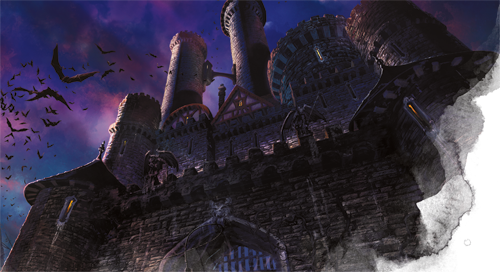
Strahd von Zarovich
A brilliant thinker and capable warrior in life, Strahd von Zarovich fought in countless battles for his people. When war and killing finally stripped him of his youth and strength, he settled in the remote valley of Barovia and built a castle on a towering pinnacle, from which he could survey his lands. His brother Sergei came to live with him in Castle Ravenloft, becoming Strahd’s adviser and constant companion.
In his brother, Strahd saw everything he had lost. Sergei was handsome and young, while Strahd had become old and scarred. Resentment colored their relationship, eventually turning into hatred. Strahd’s beloved, Tatyana, spurned him for Sergei, whom she pledged to marry.
In a desperate attempt to win Tatyana’s heart, Strahd forged a pact with dark powers that made him immortal. At the wedding of Sergei and Tatyana, he confronted his brother and killed him. Tatyana fled and flung herself from Ravenloft’s walls. Strahd’s guards, seeing him for a monster, shot him with arrows. But he did not die. He became a vampire—the first vampire, according to many sages.
In the centuries since his transformation, Strahd’s lust for life and youth have only grown. He broods in his dark castle, cursing the living for stealing away what he lost, and never admitting his hand in the tragedy he created.
In his brother, Strahd saw everything he had lost. Sergei was handsome and young, while Strahd had become old and scarred. Resentment colored their relationship, eventually turning into hatred. Strahd’s beloved, Tatyana, spurned him for Sergei, whom she pledged to marry.
In a desperate attempt to win Tatyana’s heart, Strahd forged a pact with dark powers that made him immortal. At the wedding of Sergei and Tatyana, he confronted his brother and killed him. Tatyana fled and flung herself from Ravenloft’s walls. Strahd’s guards, seeing him for a monster, shot him with arrows. But he did not die. He became a vampire—the first vampire, according to many sages.
In the centuries since his transformation, Strahd’s lust for life and youth have only grown. He broods in his dark castle, cursing the living for stealing away what he lost, and never admitting his hand in the tragedy he created.
Traits
Shapechanger: If the vampire isn't in sun light or running water, it can use its action to polymorph into a Tiny bat or a Medium cloud of mist, or back into its true form.While in bat form, the vampire can't speak, its walking speed is 5 feet, and it has a flying speed of 30 feet. Its statistics, other than its size and speed, are unchanged. Anything it is wearing transforms with it, but nothing it is carrying does. It reverts to its true form if it dies.
While in mist form, the vampire can't take any actions, speak, or manipulate objects. It is weightless, has a flying speed of 20 feet, can hover, and can enter a hostile creature's space and stop there. In addition, if air can pass through a space, the mist can do so without squeezing, and it can't pass through water. It has advantage on Strength, Dexterity, and Constitution saving throws, and it is immune to all nonmagical damage, except the damage it takes from sunlight.
Legendary Resistance (3/Day): If the vampire fails a saving throw, it can choose to succeed instead.
Misty Escape: When it drops to 0 hit points outside its resting place, the vampire transforms into a cloud of mist (as in the Shapechanger trait) instead of falling unconscious, provided that it isn't in sunlight or running water. If it can't transform, it is destroyed.
While it has 0 hit points in mist form, it can't revert to its vampire form, and it must reach its resting place within 2 hours or be destroyed. Once in its resting place, it reverts to its vampire form. It is then paralyzed until it regains at least 1 hit point. After spending 1 hour in its resting place with 0 hit points, it regains 1 hit point.
Regeneration: The vampire regains 20 hit points at the start of its turn if it has at least 1 hit point and isn't in sunlight or running water. If the vampire takes radiant damage or damage from holy water, this trait doesn't function at the start of the vampire's next turn.
Spider Climb: The vampire can climb difficult surfaces, including upside down on ceilings, without needing to make an ability check.
Vampire Weaknesses: The vampire has the following flaws:
• Forbiddance. The vampire can't enter a residence without an invitation from one of the occupants.
• Harmed by Running Water. The vampire takes 20 acid damage if it ends its turn in running water.
• Stake to the Heart. If a piercing weapon made of wood is driven into the vampire's heart while the vampire is incapacitated in its resting place, the vampire is paralyzed until the stake is removed.
• Sunlight Hypersensitivity. The vampire takes 20 radiant damage when it starts its turn in sunlight. While in sunlight, it has disadvantage on attack rolls and ability checks.
Actions
Multiattack (Vampire Form Only): The vampire makes two attacks, only one of which can be a bite attack.Unarmed Strike (Vampire Form Only): Melee Weapon Attack: +9 to hit, reach 5 ft., one creature. Hit: 8 (1d8 + 4) bludgeoning damage. Instead of dealing damage, the vampire can grapple the target, escape DC 18.
Bite (Bat or Vampire Form Only): Melee Weapon Attack: +9 to hit, reach 5 ft., one willing creature, or a creature that is grappled by the vampire, incapacitated, or restrained. Hit: 7 (1d6 + 4) piercing damage plus 10 (3d6) necrotic damage. The target's hit point maximum is reduced by an amount equal to the necrotic damage taken, and the vampire regains hit points equal to that amount. The reduction lasts until the target finishes a long rest. The target dies if this effect reduces its hit point maximum to 0. A humanoid slain in this way and then buried in the ground rises the following night as a vampire spawn under the vampire's control.
Charm: The vampire targets one humanoid it can see within 30 ft. of it. If the target can see the vampire, the target must succeed on a DC 17 Wisdom saving throw against this magic or be charmed by the vampire. The charmed target regards the vampire as a trusted friend to be heeded and protected. Although the target isn't under the vampire's control, it takes the vampire's requests or actions in the most favorable way it can, and it is a willing target for the vampire's bit attack.
Each time the vampire or the vampire's companions do anything harmful to the target, it can repeat the saving throw, ending the effect on itself on a success. Otherwise, the effect lasts 24 hours or until the vampire is destroyed, is on a different plane of existence than the target, or takes a bonus action to end the effect.
Children of the Night (1/Day): The vampire magically calls 2d4 swarms of bats or rats, provided that the sun isn't up. While outdoors, the vampire can call 3d6 wolves instead. The called creatures arrive in 1d4 rounds, acting as allies of the vampire and obeying its spoken commands. The beasts remain for 1 hour, until the vampire dies, or until the vampire dismisses them as a bonus action.
Legendary Actions
Can take 3 Legendary Actions, choosing from the options below. Only one legendary action can be used at a time, and only at the end of another creature's turn. Spent legendary actions are regained at the start of each turn.Move: The vampire moves up to its speed without provoking opportunity attacks.
Unarmed Strike: The vampire makes one unarmed strike.
Bite (Costs 2 Actions): The vampire makes one bite attack.

"I am The Ancient, I am The Land. My beginnings are lost in the darkness of the past. I was the warrior, I was good and just. I thundered across the land like the wrath of a just god, but the war years and the killing years wore down my soul as the wind wears down stone into sand."
—Count Strahd von Zarovich
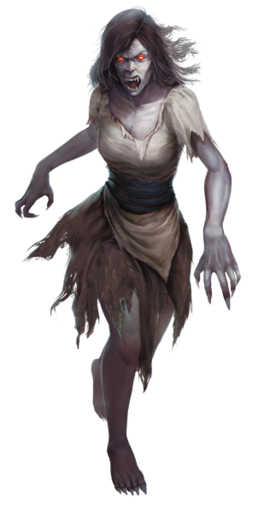
Vampires
Awakened to an endless night, vampires hunger for the life they have lost and sate that hunger by drinking the blood of the living. Vampires abhor sunlight, for its touch burns them. They never cast shadows or reflections, and any vampire wishing to move unnoticed among the living keeps to the darkness and far from reflective surfaces.Dark Desires. Whether or not a vampire retains any memories from its former life, its emotional attachments wither as once-pure feelings become twisted by undeath. Love turns into hungry obsession, while friendship becomes bitter jealousy. In place of emotion, vampires pursue physical symbols of what they crave, so that a vampire seeking love might fixate on a young beauty. A child might become an object of fascination for a vampire obsessed with youth and potential. Others surround themselves with art, books, or sinister items such as torture devices or trophies from creatures they have killed.
Born from Death. Most of a vampire’s victims become vampire spawn—ravenous creatures with a vampire’s hunger for blood, but under the control of the vampire that created them. If a true vampire allows a spawn to draw blood from its own body, the spawn transforms into a true vampire no longer under its master’s control. Few vampires are willing to relinquish their control in this manner. Vampire spawn become free-willed when their creator dies.
Chained to the Grave. Every vampire remains bound to its coffin, crypt, or grave site, where it must rest by day. If a vampire didn’t receive a formal burial, it must lie beneath a foot of earth at the place of its transition to undeath. A vampire can move its place of burial by transporting its coffin or a significant amount of grave dirt to another location. Some vampires set up multiple resting places this way.
Undead Nature. Neither a vampire nor a vampire spawn requires air.
Traits
Regeneration: The vampire regains 10 hit points at the start of its turn if it has at least 1 hit point and isn't in sunlight or running water. If the vampire takes radiant damage or damage from holy water, this trait doesn't function at the start of the vampire's next turn.Spider Climb: The vampire can climb difficult surfaces, including upside down on ceilings, without needing to make an ability check.
Vampire Weaknesses: The vampire has the following flaws:
• Forbiddance. The vampire can't enter a residence without an invitation from one of the occupants.
• Harmed by Running Water. The vampire takes 20 acid damage when it ends its turn in running water.
• Stake to the Heart. The vampire is destroyed if a piercing weapon made of wood is driven into its heart while it is incapacitated in its resting place.
• Sunlight Hypersensitivity. The vampire takes 20 radiant damage when it starts its turn in sunlight. While in sunlight, it has disadvantage on attack rolls and ability checks.
Actions
Multiattack: The vampire makes two attacks, only one of which can be a bite attack.Claws: Melee Weapon Attack: +6 to hit, reach 5 ft., one creature. Hit: 8 (2d4 + 3) slashing damage. Instead of dealing damage, the vampire can grapple the target, escape DC 13.
Bite: Melee Weapon Attack: +6 to hit, reach 5 ft., one willing creature, or a creature that is grappled by the vampire, incapacitated, or restrained. Hit: 6 (1d6 + 3) piercing damage plus 7 (2d6) necrotic damage. The target's hit point maximum is reduced by an amount equal to the necrotic damage taken, and the vampire regains hit points equal to that amount. The reduction lasts until the target finishes a long rest. The target dies if this effect reduces its hit point maximum to 0.

"Beyond the unopenable doors lay a grand hall ending before a towering stone throne, upon which sat an iron statue taller and wider than two men. In one hand it clutched an iron sword, in the other, a feather whip. We should have turned back then."
—Mordenkainen the Archmage, chronicling his party’s harrowing exploits in the dungeons below Maure Castle
Golems
Golems are made from humble materials—clay, flesh and bones, iron, or stone—but they possess astonishing power and durability. A golem has no ambitions, needs no sustenance, feels no pain, and knows no remorse. An unstoppable juggernaut, it exists to follow its creator’s orders, and it protects or attacks as that creator demands.To create a golem, one requires a manual of golems (see the Dungeon Master’s Guide). The comprehensive illustrations and instructions in a manual detail the process for creating a golem of a particular type.
Elemental Spirit in Material Form. The construction of a golem begins with the building of its body, requiring great command of the craft of sculpting, stonecutting, ironworking, or surgery. Sometimes a golem’s creator is the master of the art, but often the individual who desires a golem must enlist master artisans to do the work.
After constructing the body from clay, flesh, iron, or stone, the golem’s creator infuses it with a spirit from the Elemental Plane of Earth. This tiny spark of life has no memory, personality, or history. It is simply the impetus to move and obey. This process binds the spirit to the artificial body and subjects it to the will of the golem’s creator.
Ageless Guardians. Golems can guard sacred sites, tombs, and treasure vaults long after the deaths of their creators, carrying out their appointed tasks for all eternity while brushing off physical damage and ignoring all but the most potent spells.
A golems can be created with a special amulet or other item that allows the possessor of the item to control the golem. Golems whose creators are long dead can thus be harnessed to serve a new master.
Blind Obedience. When its creator or possessor is on hand to command it, a golem performs flawlessly. If the golem is left without instructions or is incapacitated, it continues to follow its last orders to the best of its ability. When it can’t fulfill its orders, a golem might react violently—or stand and do nothing. A golem that has been given conflicting orders sometimes alternates between them.
A golem can’t think or act for itself. Though it understands its commands perfectly, it has no grasp of language beyond that understanding, and can’t be reasoned with or tricked with words.
Constructed Nature. A golem doesn’t require air, food, drink, or sleep.
"Two of my gravediggers were caught and hanged yesterday. The other two are understandably reluctant to meet a similar fate, but I shan’t let their concerns stall my progress. I need fresh corpses, and if those bumpkins can’t get them for me, I’ll use theirs instead."
—From the diary of Evangeliza Lavain, necromancer
Flesh Golem
A flesh golem is a grisly assortment of humanoid body parts stitched and bolted together into a muscled brute imbued with formidable strength. Its brain is capable of simple reason, though its thoughts are no more sophisticated than those of a young child. The golem’s muscle tissue responds to the power of lightning, invigorating the creature with vitality and strength. Powerful enchantments protect the golem’s skin, deflecting spells and all but the most potent weapons.A flesh golem lurches with a stiff-jointed gait, as if not in complete control of its body. Its dead flesh isn’t an ideal container for an elemental spirit, which sometimes howls incoherently to vent its outrage. If the spirit breaks free of its creator’s will, the golem goes berserk until calmed, or until its shell of flesh is destroyed or completely healed.
Traits
Berserk: Whenever the golem starts its turn with 40 hit points or fewer, roll a d6. On a 6, the golem goes berserk. On each of its turns while berserk, the golem attacks the nearest creature it can see. If no creature is near enough to move to and attack, the golem attacks an object, with preference for an object smaller than itself. Once the golem goes berserk, it continues to do so until it is destroyed or regains all its hit points.The golem's creator, if within 60 feet of the berserk golem, can try to calm it by speaking firmly and persuasively. The golem must be able to hear its creator, who must take an action to make a DC 15 Charisma (Persuasion) check. If the check succeeds, the golem ceases being berserk. If it takes damage while still at 40 hit points or fewer, the golem might go berserk again.
Aversion of Fire: If the golem takes fire damage, it has disadvantage on attack rolls and ability checks until the end of its next turn.
Immutable Form: The golem is immune to any spell or effect that would alter its form.
Lightning Absorption: Whenever the golem is subjected to lightning damage, it takes no damage and instead regains a number of hit points equal to the lightning damage dealt.
Magic Resistance: The golem has advantage on saving throws against spells and other magical effects.
Magic Weapons: The golem's weapon attacks are magical.
Actions
Multiattack: The golem makes two slam attacks.Slam: Melee Weapon Attack: +7 to hit, reach 5 ft., one target. Hit: 13 (2d8 + 4) bludgeoning damage.

Veterans are professional fighters that take up arms for pay or to protect something they believe in or value. Their ranks include soldiers retired from long service and warriors who never served anyone but themselves.
Longsword (One-Handed): Melee Weapon Attack: +5 to hit, reach 5 ft., one target. Hit: 7 (1d8 + 3) slashing damage.
Longsword (Two-Handed): Melee Weapon Attack: +5 to hit, reach 5 ft., one target. Hit: 8 (1d10 + 3) slashing damage.
Shortsword: Melee Weapon Attack: +5 to hit, reach 5 ft., one target. Hit: 6 (1d6 + 3) piercing damage.
Heavy Crossbow: Ranged Weapon Attack: +3 to hit, range 100/400 ft., one target. Hit: 6 (1d10 + 1) piercing damage.
Actions
Multiattack: The veteran makes two longsword attacks. If it has a shortsword drawn, it can also make a shortsword attack.Longsword (One-Handed): Melee Weapon Attack: +5 to hit, reach 5 ft., one target. Hit: 7 (1d8 + 3) slashing damage.
Longsword (Two-Handed): Melee Weapon Attack: +5 to hit, reach 5 ft., one target. Hit: 8 (1d10 + 3) slashing damage.
Shortsword: Melee Weapon Attack: +5 to hit, reach 5 ft., one target. Hit: 6 (1d6 + 3) piercing damage.
Heavy Crossbow: Ranged Weapon Attack: +3 to hit, range 100/400 ft., one target. Hit: 6 (1d10 + 1) piercing damage.

(no bio)

Picture: Handout: Vilinus and Quasit
Vilnius wears scorched robes, his unkempt hair is half burned away, and his face and arms are covered with blisters from magic fire. He is the apprentice of Jakarion, the dead wizard in area X17 in chapter 13. After the flameskulls there incinerated his master, the wounded Vilnius retreated here. He eats vermin to survive. The amber golem has been patrolling the hallway outside (chapter 13, area X8), and Vilnius won’t leave this room until he knows the golem has been destroyed.
Vilnius wears scorched robes, his unkempt hair is half burned away, and his face and arms are covered with blisters from magic fire. He is the apprentice of Jakarion, the dead wizard in area X17 in chapter 13. After the flameskulls there incinerated his master, the wounded Vilnius retreated here. He eats vermin to survive. The amber golem has been patrolling the hallway outside (chapter 13, area X8), and Vilnius won’t leave this room until he knows the golem has been destroyed.

Behold the legacy of Gulthias the vampire: plants with a taste for blood.
Blights
Awakened plants gifted with the powers of intelligence and mobility, blights plague lands contaminated by darkness. Drinking that darkness from the soil, a blight carries out the will of ancient evil and attempts to spread that evil wherever it can.Roots of the Gulthias Tree. Legends tell of a vampire named Gulthias who worked terrible magic and raised up an abominable tower called Nightfang Spire. Gulthias was undone when a hero plunged a wooden stake through his heart, but as the vampire was destroyed, his blood infused the stake with a dreadful power. In time, tendrils of new growth sprouted from the wood, growing into a sapling infused with the vampire’s evil essence. It is said that a mad druid discovered the sapling, transplanting it to an underground grotto where it could grow. From this Gulthias tree came the seeds from which the first blights were sown.
Dark Conquest. Wherever a tree or plant is contaminated by a fragment of an evil mind or power, a Gulthias tree can rise to infest and corrupt the surrounding forest. Its evil spreads through root and soil to other plants, which perish or transform into blights. As those blights spread, they poison and uproot healthy plants, replacing them with brambles, toxic weeds, and others of their kind. In time, an infestation of blights can turn any land or forest into a place of corruption.
In forests infested with blights, trees and plants grow with supernatural speed. Vines and undergrowth rapidly spread through buildings and overrun trails and roads. After blights have killed or driven off their inhabitants, whole villages can disappear in the space of days.
Controlled by Evil. Blights are independent creatures, but most act under a Gulthias tree’s control, often displaying the habits and traits of the life force or spirit that spawned them. By attacking their progenitor’s old foes or seeking out treasures valuable to it, they carry on the legacy of long-lost evil.
Vine Blight
Appearing as masses of slithering creepers, vine blights hide in undergrowth and wait for prey to draw near. By animating the plants around them, vine blights entangle and hinder their foes before attacking.Vine blights are the only blights capable of speech. Through its connection to the evil spirit of the Gulthias tree it serves, a vine blight speaks in a fractured version of its dead master’s voice, taunting victims or bargaining with powerful foes.
Traits
False Appearance: While the blight remains motionless, it is indistinguishable from a tangle of vines.Actions
Constrict: Melee Weapon Attack: +4 to hit, reach 10 ft., one target. Hit: 9 (2d6 + 2) bludgeoning damage, and a Large or smaller target is grappled, escape DC 12. Until this grapple ends, the target is restrained, and the blight can’t constrict another target.Entangling Plants (Recharge 5–6): Grasping roots and vines sprout in a 15-foot radius centered on the blight, withering away after 1 minute. For the duration, that area is difficult terrain for nonplant creatures. In addition, each creature of the blight’s choice in that area when the plants appear must succeed on a DC 12 Strength saving throw or become restrained. A creature can use its action to make a DC 12 Strength check, freeing itself or another entangled creature within reach on a success.

Vistani
The Vistani (singular: Vistana) are wanderers who live outside civilization, traveling about in horse-drawn, barrel-topped wagons called vardos, which they build themselves. Compared to Barovians, they are flamboyant. Vistani dress in bright clothes, laugh often, and drink heartily. As much as they feel at home in Strahd’s dreary land, they know they can leave it whenever they please and aren’t damned to spend eternity there.Vistani are silversmiths, coppersmiths, haberdashers, cooks, weavers, musicians, entertainers, storytellers, toolmakers, and horse traders. They also earn money by telling fortunes and selling information. They spend whatever they earn to support a lavish lifestyle, display their wealth openly as a sign of prosperity, and share their good fortune with family and friends.
Each family or clan of Vistani is its own little gerontocracy, with the oldest member ruling the roost. This elder carries the bulk of the responsibility for enforcing traditions, settling disputes, setting the course for the group’s travels, and preserving the Vistani way of life. Vistani elders make all the important decisions, but whether by choice or because of their age, tend to speak in cryptic, flowing riddles.
Vistani families and clans are closely knit. They resolve disagreements through contests that end with reconciliatory singing, dancing, and storytelling. Although they can seem lazy and irresponsible to outsiders, the Vistani are serious people, quick to act when their lives or traditions are threatened. They are merciless when they believe they must be. Vistani who knowingly bring harm or misfortune to others of their kind are banished—the worst punishment a Vistana can imagine, even worse than death.

Vistani
The Vistani (singular: Vistana) are wanderers who live outside civilization, traveling about in horse-drawn, barrel-topped wagons called vardos, which they build themselves. Compared to Barovians, they are flamboyant. Vistani dress in bright clothes, laugh often, and drink heartily. As much as they feel at home in Strahd’s dreary land, they know they can leave it whenever they please and aren’t damned to spend eternity there.Vistani are silversmiths, coppersmiths, haberdashers, cooks, weavers, musicians, entertainers, storytellers, toolmakers, and horse traders. They also earn money by telling fortunes and selling information. They spend whatever they earn to support a lavish lifestyle, display their wealth openly as a sign of prosperity, and share their good fortune with family and friends.
Each family or clan of Vistani is its own little gerontocracy, with the oldest member ruling the roost. This elder carries the bulk of the responsibility for enforcing traditions, settling disputes, setting the course for the group’s travels, and preserving the Vistani way of life. Vistani elders make all the important decisions, but whether by choice or because of their age, tend to speak in cryptic, flowing riddles.
Vistani families and clans are closely knit. They resolve disagreements through contests that end with reconciliatory singing, dancing, and storytelling. Although they can seem lazy and irresponsible to outsiders, the Vistani are serious people, quick to act when their lives or traditions are threatened. They are merciless when they believe they must be. Vistani who knowingly bring harm or misfortune to others of their kind are banished—the worst punishment a Vistana can imagine, even worse than death.

Vistani
The Vistani (singular: Vistana) are wanderers who live outside civilization, traveling about in horse-drawn, barrel-topped wagons called vardos, which they build themselves. Compared to Barovians, they are flamboyant. Vistani dress in bright clothes, laugh often, and drink heartily. As much as they feel at home in Strahd’s dreary land, they know they can leave it whenever they please and aren’t damned to spend eternity there.Vistani are silversmiths, coppersmiths, haberdashers, cooks, weavers, musicians, entertainers, storytellers, toolmakers, and horse traders. They also earn money by telling fortunes and selling information. They spend whatever they earn to support a lavish lifestyle, display their wealth openly as a sign of prosperity, and share their good fortune with family and friends.
Each family or clan of Vistani is its own little gerontocracy, with the oldest member ruling the roost. This elder carries the bulk of the responsibility for enforcing traditions, settling disputes, setting the course for the group’s travels, and preserving the Vistani way of life. Vistani elders make all the important decisions, but whether by choice or because of their age, tend to speak in cryptic, flowing riddles.
Vistani families and clans are closely knit. They resolve disagreements through contests that end with reconciliatory singing, dancing, and storytelling. Although they can seem lazy and irresponsible to outsiders, the Vistani are serious people, quick to act when their lives or traditions are threatened. They are merciless when they believe they must be. Vistani who knowingly bring harm or misfortune to others of their kind are banished—the worst punishment a Vistana can imagine, even worse than death.

Vistani
The Vistani (singular: Vistana) are wanderers who live outside civilization, traveling about in horse-drawn, barrel-topped wagons called vardos, which they build themselves. Compared to Barovians, they are flamboyant. Vistani dress in bright clothes, laugh often, and drink heartily. As much as they feel at home in Strahd’s dreary land, they know they can leave it whenever they please and aren’t damned to spend eternity there.Vistani are silversmiths, coppersmiths, haberdashers, cooks, weavers, musicians, entertainers, storytellers, toolmakers, and horse traders. They also earn money by telling fortunes and selling information. They spend whatever they earn to support a lavish lifestyle, display their wealth openly as a sign of prosperity, and share their good fortune with family and friends.
Each family or clan of Vistani is its own little gerontocracy, with the oldest member ruling the roost. This elder carries the bulk of the responsibility for enforcing traditions, settling disputes, setting the course for the group’s travels, and preserving the Vistani way of life. Vistani elders make all the important decisions, but whether by choice or because of their age, tend to speak in cryptic, flowing riddles.
Vistani families and clans are closely knit. They resolve disagreements through contests that end with reconciliatory singing, dancing, and storytelling. Although they can seem lazy and irresponsible to outsiders, the Vistani are serious people, quick to act when their lives or traditions are threatened. They are merciless when they believe they must be. Vistani who knowingly bring harm or misfortune to others of their kind are banished—the worst punishment a Vistana can imagine, even worse than death.

Vistani
The Vistani (singular: Vistana) are wanderers who live outside civilization, traveling about in horse-drawn, barrel-topped wagons called vardos, which they build themselves. Compared to Barovians, they are flamboyant. Vistani dress in bright clothes, laugh often, and drink heartily. As much as they feel at home in Strahd’s dreary land, they know they can leave it whenever they please and aren’t damned to spend eternity there.Vistani are silversmiths, coppersmiths, haberdashers, cooks, weavers, musicians, entertainers, storytellers, toolmakers, and horse traders. They also earn money by telling fortunes and selling information. They spend whatever they earn to support a lavish lifestyle, display their wealth openly as a sign of prosperity, and share their good fortune with family and friends.
Each family or clan of Vistani is its own little gerontocracy, with the oldest member ruling the roost. This elder carries the bulk of the responsibility for enforcing traditions, settling disputes, setting the course for the group’s travels, and preserving the Vistani way of life. Vistani elders make all the important decisions, but whether by choice or because of their age, tend to speak in cryptic, flowing riddles.
Vistani families and clans are closely knit. They resolve disagreements through contests that end with reconciliatory singing, dancing, and storytelling. Although they can seem lazy and irresponsible to outsiders, the Vistani are serious people, quick to act when their lives or traditions are threatened. They are merciless when they believe they must be. Vistani who knowingly bring harm or misfortune to others of their kind are banished—the worst punishment a Vistana can imagine, even worse than death.

Vistani
The Vistani (singular: Vistana) are wanderers who live outside civilization, traveling about in horse-drawn, barrel-topped wagons called vardos, which they build themselves. Compared to Barovians, they are flamboyant. Vistani dress in bright clothes, laugh often, and drink heartily. As much as they feel at home in Strahd’s dreary land, they know they can leave it whenever they please and aren’t damned to spend eternity there.Vistani are silversmiths, coppersmiths, haberdashers, cooks, weavers, musicians, entertainers, storytellers, toolmakers, and horse traders. They also earn money by telling fortunes and selling information. They spend whatever they earn to support a lavish lifestyle, display their wealth openly as a sign of prosperity, and share their good fortune with family and friends.
Each family or clan of Vistani is its own little gerontocracy, with the oldest member ruling the roost. This elder carries the bulk of the responsibility for enforcing traditions, settling disputes, setting the course for the group’s travels, and preserving the Vistani way of life. Vistani elders make all the important decisions, but whether by choice or because of their age, tend to speak in cryptic, flowing riddles.
Vistani families and clans are closely knit. They resolve disagreements through contests that end with reconciliatory singing, dancing, and storytelling. Although they can seem lazy and irresponsible to outsiders, the Vistani are serious people, quick to act when their lives or traditions are threatened. They are merciless when they believe they must be. Vistani who knowingly bring harm or misfortune to others of their kind are banished—the worst punishment a Vistana can imagine, even worse than death.

Vistani
The Vistani (singular: Vistana) are wanderers who live outside civilization, traveling about in horse-drawn, barrel-topped wagons called vardos, which they build themselves. Compared to Barovians, they are flamboyant. Vistani dress in bright clothes, laugh often, and drink heartily. As much as they feel at home in Strahd’s dreary land, they know they can leave it whenever they please and aren’t damned to spend eternity there.Vistani are silversmiths, coppersmiths, haberdashers, cooks, weavers, musicians, entertainers, storytellers, toolmakers, and horse traders. They also earn money by telling fortunes and selling information. They spend whatever they earn to support a lavish lifestyle, display their wealth openly as a sign of prosperity, and share their good fortune with family and friends.
Each family or clan of Vistani is its own little gerontocracy, with the oldest member ruling the roost. This elder carries the bulk of the responsibility for enforcing traditions, settling disputes, setting the course for the group’s travels, and preserving the Vistani way of life. Vistani elders make all the important decisions, but whether by choice or because of their age, tend to speak in cryptic, flowing riddles.
Vistani families and clans are closely knit. They resolve disagreements through contests that end with reconciliatory singing, dancing, and storytelling. Although they can seem lazy and irresponsible to outsiders, the Vistani are serious people, quick to act when their lives or traditions are threatened. They are merciless when they believe they must be. Vistani who knowingly bring harm or misfortune to others of their kind are banished—the worst punishment a Vistana can imagine, even worse than death.

Picture: Handout: Vladimir Horngaard
Enemies of Strahd. Vladimir found himself fighting Strahd’s armies time and again as they swept across the land. When it became clear that Strahd couldn’t be stopped, the knights of the order led hundreds of refugees to Argynvost’s valley, but Strahd tracked them to their sanctuary and overwhelmed them with a vast force. Vladimir, whom Argynvost had made a field commander, couldn’t hold back the evil tide and was killed, only after the heartbreak of witnessing Strahd himself slay Vladimir’s beloved, his fellow knight Sir Godfrey Gwilym. With the battle won, Strahd surrounded Argynvostholt. Rather than cower in his lair, Argynvost emerged and battled Strahd’s armies to the bitter end.
Deadly Vengeance. Unwilling to accept his failure, Vladimir returned as a revenant. So great was his hatred of Strahd and his thirst for vengeance that those feelings fueled the spirits of many of his fellow knights—including Godfrey—to come back as revenants as well. Vladimir continued to wage the hopeless war, even as Strahd tightened his grip on the valley.
When Strahd became a vampire, Vladimir and his revenants should have gone to their eternal rest. But Strahd’s deeds were so heinous that Barovia and the knight’s spirits became trapped behind curtains of mist.
Vladimir Horngaard
Vladimir Horngaard joined the Order of the Silver Dragon at a young age and quickly earned the friendship of its founder, the silver dragon Argynvost. When he became a knight of the order, he traveled to distant lands to wage war against the forces of evil. The dragon stayed home and, in the guise of a human noble named Lord Argynvost, brought new initiates into the order.Enemies of Strahd. Vladimir found himself fighting Strahd’s armies time and again as they swept across the land. When it became clear that Strahd couldn’t be stopped, the knights of the order led hundreds of refugees to Argynvost’s valley, but Strahd tracked them to their sanctuary and overwhelmed them with a vast force. Vladimir, whom Argynvost had made a field commander, couldn’t hold back the evil tide and was killed, only after the heartbreak of witnessing Strahd himself slay Vladimir’s beloved, his fellow knight Sir Godfrey Gwilym. With the battle won, Strahd surrounded Argynvostholt. Rather than cower in his lair, Argynvost emerged and battled Strahd’s armies to the bitter end.
Deadly Vengeance. Unwilling to accept his failure, Vladimir returned as a revenant. So great was his hatred of Strahd and his thirst for vengeance that those feelings fueled the spirits of many of his fellow knights—including Godfrey—to come back as revenants as well. Vladimir continued to wage the hopeless war, even as Strahd tightened his grip on the valley.
When Strahd became a vampire, Vladimir and his revenants should have gone to their eternal rest. But Strahd’s deeds were so heinous that Barovia and the knight’s spirits became trapped behind curtains of mist.

"I am The Ancient, I am The Land. My beginnings are lost in the darkness of the past. I was the warrior, I was good and just. I thundered across the land like the wrath of a just god, but the war years and the killing years wore down my soul as the wind wears down stone into sand."
—Count Strahd von Zarovich
Vampires
Awakened to an endless night, vampires hunger for the life they have lost and sate that hunger by drinking the blood of the living. Vampires abhor sunlight, for its touch burns them. They never cast shadows or reflections, and any vampire wishing to move unnoticed among the living keeps to the darkness and far from reflective surfaces.Dark Desires. Whether or not a vampire retains any memories from its former life, its emotional attachments wither as once-pure feelings become twisted by undeath. Love turns into hungry obsession, while friendship becomes bitter jealousy. In place of emotion, vampires pursue physical symbols of what they crave, so that a vampire seeking love might fixate on a young beauty. A child might become an object of fascination for a vampire obsessed with youth and potential. Others surround themselves with art, books, or sinister items such as torture devices or trophies from creatures they have killed.
Born from Death. Most of a vampire’s victims become vampire spawn—ravenous creatures with a vampire’s hunger for blood, but under the control of the vampire that created them. If a true vampire allows a spawn to draw blood from its own body, the spawn transforms into a true vampire no longer under its master’s control. Few vampires are willing to relinquish their control in this manner. Vampire spawn become free-willed when their creator dies.
Chained to the Grave. Every vampire remains bound to its coffin, crypt, or grave site, where it must rest by day. If a vampire didn’t receive a formal burial, it must lie beneath a foot of earth at the place of its transition to undeath. A vampire can move its place of burial by transporting its coffin or a significant amount of grave dirt to another location. Some vampires set up multiple resting places this way.
Undead Nature. Neither a vampire nor a vampire spawn requires air.
Traits
Regeneration: The vampire regains 10 hit points at the start of its turn if it has at least 1 hit point and isn't in sunlight or running water. If the vampire takes radiant damage or damage from holy water, this trait doesn't function at the start of the vampire's next turn.Spider Climb: The vampire can climb difficult surfaces, including upside down on ceilings, without needing to make an ability check.
Vampire Weaknesses: The vampire has the following flaws:
• Forbiddance. The vampire can't enter a residence without an invitation from one of the occupants.
• Harmed by Running Water. The vampire takes 20 acid damage when it ends its turn in running water.
• Stake to the Heart. The vampire is destroyed if a piercing weapon made of wood is driven into its heart while it is incapacitated in its resting place.
• Sunlight Hypersensitivity. The vampire takes 20 radiant damage when it starts its turn in sunlight. While in sunlight, it has disadvantage on attack rolls and ability checks.
Actions
Multiattack: The vampire makes two attacks, only one of which can be a bite attack.Claws: Melee Weapon Attack: +6 to hit, reach 5 ft., one creature. Hit: 8 (2d4 + 3) slashing damage. Instead of dealing damage, the vampire can grapple the target, escape DC 13.
Bite: Melee Weapon Attack: +6 to hit, reach 5 ft., one willing creature, or a creature that is grappled by the vampire, incapacitated, or restrained. Hit: 6 (1d6 + 3) piercing damage plus 7 (2d6) necrotic damage. The target's hit point maximum is reduced by an amount equal to the necrotic damage taken, and the vampire regains hit points equal to that amount. The reduction lasts until the target finishes a long rest. The target dies if this effect reduces its hit point maximum to 0.

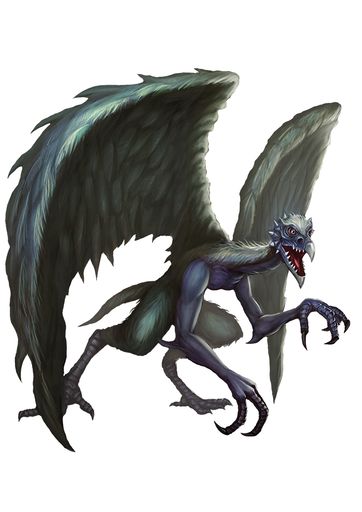
Picture: Handout: Vrock
Demons
Spawned in the Infinite Layers of the Abyss, demons are the embodiment of chaos and evil—engines of destruction barely contained in monstrous form. Possessing no compassion, empathy, or mercy, they exist only to destroy.Spawn of Chaos. The Abyss creates demons as extensions of itself, spontaneously forming fiends out of filth and carnage. Some are unique monstrosities, while others represent uniform strains virtually identical to each other. Other demons (such as manes) are created from mortal souls shunned or cursed by the gods, or which are otherwise trapped in the Abyss.
Capricious Elevation. Demons respect power and power alone. A greater demon commands shrieking mobs of lesser demons because it can destroy any lesser demon that dares to refuse its commands. A demon’s status grows with the blood it spills; the more enemies that fall before it, the greater it becomes.A demon might spawn as a manes, then become a dretch, and eventually transform to a vrock after untold time spent fighting and surviving in the Abyss. Such elevations are rare, however, for most demons are destroyed before they attain significant power. The greatest of those that do survive make up the ranks of the demon lords that threaten to tear the Abyss apart with their endless warring.
By expending considerable magical power, demon lords can raise lesser demons into greater forms, though such promotions never stem from a demon’s deeds or accomplishments. Rather, a demon lord might warp a manes into a quasit when it needs an invisible spy, or turn an army of dretches into hezrous when marching against a rival lord. Demon lords only rarely elevate demons to the highest ranks, fearful of inadvertently creating rivals to their own power.
Abyssal Invasions. Wherever they wander across the Abyss, demons search for portals to the other planes. They crave the chance to slip free of their native realm and spread their dark influence across the multiverse, undoing the works of the gods, tearing down civilizations, and reducing the cosmos to despair and ruin.
Some of the darkest legends of the mortal realm are built around the destruction wrought by demons set loose in the world. As such, even nations embroiled in bitter conflict will set their differences aside to help contain an outbreak of demons, or to seal off abyssal breaches before these fiends can break free.
Signs of Corruption. Demons carry the stain of abyssal corruption with them, and their mere presence changes the world for the worse. Plants wither and die in areas where abyssal breaches and demons appear. Animals shun the sites where a demon has made a kill. The site of a demonic infestation might be fouled by a stench that never abates, by areas of bitter cold or burning heat, or by permanent shadows that mark the places where these fiends lingered.
Eternal Evil. Outside the Abyss, death is a minor nuisance that no demon fears. Mundane weapons can’t stop these fiends, and many demons are resistant to the energy of the most potent spells. When a lucky hero manages to drop a demon in combat, the fiend dissolves into foul ichor. It then instantly reforms in the Abyss, its mind and essence intact even as its hatred is inflamed. The only way to truly destroy a demon is to seek it in the Abyss and kill it there.
Protected Essence. A powerful demon can take steps to safeguard its life essence, using secret methods and abyssal metals to create an amulet into which part of that essence is ceded. If the demon’s abyssal form is ever destroyed, the amulet allows the fiend to reform at a time and place of its choosing.
Obtaining a demonic amulet is a dangerous enterprise, and simply seeking such a device risks drawing the attention of the demon that created it. A creature possessing a demonic amulet can exact favors from the demon whose life essence the amulet holds—or inflict great pain if the fiend resists. If an amulet is destroyed, the demon that created it is trapped in the Abyss for a year and a day.
Demonic Cults. Despite the dark risks involved in dealing with fiends, the mortal realm is filled with creatures that covet demonic power. Demon lords manipulate these mortal servants into performing ever greater acts of depravity, furthering the demon lord’s ambitions in exchange for magic and other boons. However, a demon regards any mortals in its service as tools to use and then discard at its whim, consigning their mortal souls to the Abyss.
Demon Summoning. Few acts are as dangerous as summoning a demon, and even mages who bargain freely with devils fear the fiends of the Abyss. Though demons yearn to sow chaos on the Material Plane, they show no gratitude when brought there, raging against their prisons and demanding release.
Those who would risk summoning a demon might do so to wrest information from it, press it into service, or send it on a mission that only a creature of absolute evil can complete. Preparation is key, and experienced summoners know the specific spells and magic items that can force a demon to bend to another’s will. If a single mistake is made, a demon that breaks free shows no mercy as it makes its summoner the first victim of its wrath.
Bound Demons. The Book of Vile Darkness, the Black Scrolls of Ahm, and the Demonomicon of Iggwilv are the foremost authorities on demonic matters. These ancient tomes describe techniques that can trap the essence of a demon on the Material Plane, placing it within a weapon, idol, or piece of jewelry and preventing the fiend’s return to the Abyss.
An object that binds a demon must be specially prepared with unholy incantations and innocent blood. It radiates a palpable evil, chilling and fouling the air around it. A creature that handles such an object experiences unsettling dreams and wicked impulses, but is able to control the demon whose essence is trapped within the object. Destroying the object frees the demon, which immediately seeks revenge against its binder.
Demonic Possession. No matter how secure its bindings, a powerful demon often finds a way to escape an object that holds it. When a demonic essence emerges from its container, it can possess a mortal host. Sometimes a fiend employs stealth to hide a successful possession. Other times, it unleashes the full brunt of its fiendish drives through its new form.
As long as the demon remains in possession of its host, the soul of that host is in danger of being dragged to the Abyss with the demon if it is exorcised from the flesh, or if the host dies. If a demon possesses a creature and the object binding the demon is destroyed, the possession lasts until powerful magic is used to drive the demonic spirit out of its host.
Demon True Names
Though demons all have common names, every demon lord and every demon of type 1 through 6 has a true name that it keeps secret. A demon can be forced to disclose its true name if charmed, and ancient scrolls and tomes are said to exist that list the true names of the most powerful demons.A mortal who learns a demon’s true name can use powerful summoning magic to call the demon from the Abyss and exercise some measure of control over it. However, most demons brought to the Material Plane in this manner do everything in their power to wreak havoc or sow discord and strife.
Demon Lords
The chaotic power of the Abyss rewards demons of particular ruthlessness and ingenuity with a dark blessing, transforming them into unique fiends whose power can rival the gods. These demon lords rule through cunning or brute force, hoping to one day claim the prize of absolute control over all the Abyss.Reward for Outsiders. Although most demon lords rise up from the vast and uncountable mobs of demons rampaging across the Abyss, the plane also rewards outsiders that conquer any of its infinite layers. The elven goddess Lolth became a demon lord after Corellon Larethian cast her into the Abyss for betraying elvenkind. Sages claim that the Dark Prince Graz’zt originated on some other plane before stealing his abyssal title from another long-forgotten demon lord.
Power and Control. The greatest sign of a demon lord’s power is its ability to reshape an abyssal realm. A layer of the Abyss controlled by a demon lord becomes a twisted reflection of that fiend’s vile personality, and demon lords seldom leave their realms for fear of allowing another creature to reshape and seize it.
As with other demons, a demon lord that dies on another plane has its essence return to the Abyss, where it reforms into a new body. Likewise, a demon lord that dies in the Abyss is permanently destroyed. Most demon lords keep a portion of their essence safely stored away to prevent such a fate.
Baphomet
The demon lord Baphomet, also known as the Horned King and the Prince of Beasts, rules over minotaurs and other savage creatures. If he had his way, civilization would crumble and all races would embrace their base animal savagery.The Prince of Beasts appears as a huge, black-furred minotaur with iron horns, red eyes, and a blood-soaked mouth. His iron crown is topped with the rotting heads of his enemies, while his dark armor is set with spikes and skull-like serrations. He carries a huge glaive named Heartcleaver, but often hurls it into the fray so as to face his enemies with horns and hooves.
Demogorgon
The Sibilant Beast and the self-styled Prince of Demons, Demogorgon yearns for nothing less than undoing the order of the multiverse. An insane assemblage of features and drives, the Prince of Demons inspires fear and hatred among other demons and demon lords.Demogorgon towers three times the height of a human, his body as sinuous as a snake’s and as powerful as a great ape’s. Suckered tentacles take the place of his arms. His saurian lower torso ends in webbed and clawed feet, and a forked tail whose whip-like tips are armed with cruel blades. The Prince of Demons has two baleful baboon heads, both of them mad. It is only the conflict between the two halves of his dual nature that keeps the demon lord’s ambitions in check.
Graz’zt
The demon lord Graz’zt appears as a darkly handsome figure nearly nine feet tall. Those who refer to the Dark Prince as the most humanoid of the demon lords vastly underestimate the capacity for evil in his scheming heart.Graz’zt is a striking physical specimen, whose demonic nature shows in his ebon skin, pointed ears, yellow fangs, crown of horns, and six-fingered hands. He delights in finery, pageantry, and sating his decadent desires with subjects and consorts alike, among whom incubi and succubi are often his favorites.
Juiblex
The demon lord of slimes and oozes, Juiblex is a stew of noxious fluids that lurks in the abyssal depths. The wretched Faceless Lord cares nothing for cultists or mortal servants, and its sole desire is to turn all creatures into formless copies of its horrid self.In its resting state, Juiblex spreads out in a noxious mass, bubbling and filling the air with a profound stench. On the rare occasions when creatures confront the demon lord, Juiblex draws itself up into a shuddering cone of slime striated with veins of black and green. Baleful red eyes swim within its gelatinous body, while dripping pseudopods of ooze lash out hungrily at any creature they can reach.
Lolth
The Demon Queen of Spiders is the evil matron of the drow. Her every thought is touched by malice, and the depth of her viciousness can surprise even her most faithful priestesses. She directs her faithful while she weaves plots across the worlds of the Material Plane, looking forward to the time when her drow followers bring those worlds under her control.Lolth appears as a lithe, imperious drow matriarch when she manifests to her followers in the mortal realm, which she does with unusual frequency. When battle breaks out—or if she has a reason to remind her followers to fear her—Lolth’s lower body transforms into that of a huge demonic spider, whose spike-tipped legs and mandibles tear foes apart.
Orcus
Known as the Demon Prince of Undeath and the Blood Lord, the demon lord Orcus is worshiped by the undead and by living creatures that channel the power of undeath. A brooding and nihilistic entity, Orcus yearns to make the multiverse a place of death and darkness, forever unchanging except by his will.The Demon Prince of Undeath is a foul and corpulent creature, with a humanoid torso, powerful goat legs, and the desiccated head of a ram. His sore-ridden body stinks of disease, but his decaying head and glowing red eyes are as a creature already dead. Great black bat wings sprout from his back, stirring reeking air as he moves.
Orcus wields a malevolent artifact known as the Wand of Orcus, a mace-like rod of obsidian topped by a humanoid skull. He surrounds himself with undead, and living creatures not under his control are anathema to him.
Yeenoghu
Known as the Gnoll Lord and the Beast of Butchery, the demon lord Yeenoghu hungers for slaughter and senseless destruction. Gnolls are his mortal instruments, and he drives them to ever-greater atrocities in his name. Delighting in sorrow and hopelessness, the Gnoll Lord yearns to turn the world into a wasteland in which the last surviving gnolls tear each other apart for the right to feast upon the dead.Yeenoghu appears as a huge, scarred gnoll with a spiky crest of black spines, and eyes that burn with emerald flame. His armor is a patchwork of shields and breastplates claimed from fallen foes, and decorated by those foes’ flayed skins. Yeenoghu can summon a triple flail he calls the Butcher, which he wields to deadly effect or wills to fly independently into battle as he tears foes apart with teeth and claws.
Other Demon Lords
No one knows the full number of demon lords that rage in the Abyss. Given the infinite depths of that plane, powerful demons constantly rise to become demon lords, then fall almost as quickly. Among the demon lords whose power has endured long enough for demonologists to name them are Fraz-Urb’luu, the Prince of Deception; Kostchtchie, the Prince of Wrath; Pazuzu, Prince of the Lower Aerial Kingdoms; and Zuggtmoy, Lady of Fungi.Vrock
Vrocks are dull-witted, capricious fiends that live only to create pain and carnage. A vrock resembles a giant hybrid of humanoid and vulture, its gnarled, bestial body and broad wings stinking of offal.Vrocks gobble humanoid flesh whenever they can, stunning potential prey with an ear-splitting shriek, then swooping down to attack with beak and claw. Vrocks can shake their wings, releasing clouds of toxic spores.
Coveting pretty things, vrocks turn against each other for the chance to lay claim to cheap jewelry or ornamental stones. Despite their love of treasure, vrocks are difficult to bribe, seeing no reason to bargain when they can simply take what they want from a would-be bargainer’s corpse.
Demon Types
Demonologists organize the chaotic distribution of demons into broad categories of power known as types. Most demons fit into one of six major types, with the weakest categorized as Type 1 and the strongest as Type 6. Demons outside the six main types are categorized as minor demons and demon lords.Demons by Type
| Type | Examples |
| 1 | barlgura, shadow demon, vrock |
| 2 | chasme, hezrou |
| 3 | glabrezu, yochlol |
| 4 | nalfeshnee |
| 5 | marilith |
| 6 | balor, goristro |
Traits
Magic Resistance: The vrock has advantage on saving throws against spells and other magical effects.Actions
Multiattack: The vrock makes two attacks: one with its beak and one with its talons.Beak: Melee Weapon Attack: +6 to hit, reach 5 ft., one target. Hit: 10 (2d6 + 3) piercing damage.
Talons: Melee Weapon Attack: +6 to hit, reach 5 ft., one target. Hit: 14 (2d10 + 3) slashing damage.
Spores (Recharge 6): A 15-foot-radius cloud of toxic spores extends out from the vrock. The spores spread around corners. Each creature in that area must succeed on a DC 14 Constitution saving throw or become poisoned. While poisoned in this way, a target takes 5 (1d10) poison damage at the start of each of its turns. A target can repeat the saving throw at the end of each of its turns, ending the effect on itself on a success. Emptying a vial of holy water on the target also ends the effect on it.
Stunning Screech (1/Day): The vrock emits a horrific screech. Each creature within 20 feet of it that can hear it and that isn't a demon must succeed on a DC 14 Constitution saving throw or be stunned until the end of the vrock's next turn .
Variant: Summon Demon (1/Day): The demon chooses what to summon and attempts a magical summoning. A vrock has a 30 percent chance of summoning 2d4 dretches or one vrock. A summoned demon appears in an unoccupied space within 60 feet of its summoner, acts as an ally of its summoner, and can't summon other demons. It remains for 1 minute, until it or its summoner dies, or until its summoner dismisses it as an action.

Variant: Warhorse Armor
An armored warhorse has an AC based on the type of barding worn (see the Player’s Handbook for more information on barding). The horse’s AC includes its Dexterity modifier, where applicable. Barding doesn’t alter the horse’s challenge rating.| AC | Barding |
| 12 | Leather |
| 13 | Studded leather |
| 14 | Ring mail |
| 15 | Scale mail |
| 16 | Chain mail |
| 17 | Splint |
| 18 | Plate |
Traits
Trampling Charge: If the horse moves at least 20 ft. straight toward a creature and then hits it with a hooves attack on the same turn, that target must succeed on a DC 14 Strength saving throw or be knocked prone. If the target is prone, the horse can make another attack with its hooves against it as a bonus action.Actions
Hooves: Melee Weapon Attack: +6 to hit, reach 5 ft., one target. Hit: 11 (2d6 + 4) bludgeoning damage.
Skeletons
Skeletons arise when animated by dark magic. They heed the summons of spellcasters who call them from their stony tombs and ancient battlefields, or rise of their own accord in places saturated with death and loss, awakened by stirrings of necromantic energy or the presence of corrupting evil.Animated Dead. Whatever sinister force awakens a skeleton infuses its bones with a dark vitality, adhering joint to joint and reassembling dismantled limbs. This energy motivates a skeleton to move and think in a rudimentary fashion, though only as a pale imitation of the way it behaved in life. An animated skeleton retains no connection to its past, although resurrecting a skeleton restores it body and soul, banishing the hateful undead spirit that empowers it.
While most skeletons are the animated remains of dead humans and other humanoids, skeletal undead can be created from the bones of other creatures besides humanoids, giving rise to a host of terrifying and unique forms.
Obedient Servants. Skeletons raised by spell are bound to the will of their creator. They follow orders to the letter, never questioning the tasks their masters give them, regardless of the consequences. Because of their literal interpretation of commands and unwavering obedience, skeletons adapt poorly to changing circumstances. They can’t read, speak, emote, or communicate in any way except to nod, shake their heads, or point. Still, skeletons are able to accomplish a variety of relatively complex tasks.
A skeleton can fight with weapons and wear armor, can load and fire a catapult or trebuchet, scale a siege ladder, form a shield wall, or dump boiling oil. However, it must receive careful instructions explaining how such tasks are accomplished.
Although they lack the intellect they possessed in life, skeletons aren’t mindless. Rather than break its limbs attempting to batter its way through an iron door, a skeleton tries the handle first. If that doesn’t work, it searches for another way through or around the obstacle.
Habitual Behaviors. Independent skeletons temporarily or permanently free of a master’s control sometimes pantomime actions from their past lives, their bones echoing the rote behaviors of their former living selves. The skeleton of a miner might lift a pick and start chipping away at stone walls. The skeleton of a guard might strike up a post at a random doorway. The skeleton of a dragon might lie down on a pile of treasure, while the skeleton of a horse crops grass it can’t eat. Left alone in a ballroom, the skeletons of nobles might continue an eternally unfinished dance.
When skeletons encounter living creatures, the necromantic energy that drives them compels them to kill unless they are commanded by their masters to refrain from doing so. They attack without mercy and fight until destroyed, for skeletons possess little sense of self and even less sense of self-preservation.
Undead Nature. A skeleton doesn’t require air, food, drink, or sleep.
Actions
Hooves: Melee Weapon Attack: +6 to hit, reach 5 ft., one target. Hit: 11 (2d6 + 4) bludgeoning damage.
Wereraven
Wereravens are secretive and extraordinarily cautious lycanthropes that trust one another but are wary of just about everyone else. Although skilled at blending into society, they keep mostly to themselves, respect local laws, and strive to do good whenever possible.In their human and hybrid forms, wereravens favor light weapons. They are reluctant to make bite attacks in raven form for fear of spreading their curse to those who don’t deserve it or who would abuse it.
A Kindness of Wereravens. Wereravens refer to their tightly knit groups as kindnesses. A kindness of wereravens usually numbers between seven and twelve individuals. Not surprisingly, wereravens get along well with ravens and often hide in plain sight among them.
Charitable Collectors. Wereravens like to collect shiny trinkets and precious baubles. They are fond of sharing their wealth with those in need and, in their humanoid forms, modestly give money to charity. They take steps to keep magic items out of evil hands by stashing them in secret hiding places.
Characters as Wereravens. The Monster Manual has rules for characters afflicted with lycanthropy. The following text applies to wereraven characters specifically.
A character cursed with wereraven lycanthropy gains a Dexterity of 15 if his or her score isn’t already higher. Attack and damage rolls for the wereraven’s bite are based on whichever is higher of the character’s Strength and Dexterity. The bite of a wereraven in raven form deals 1 piercing damage (no ability modifier applies to this damage) and carries the curse of lycanthropy; see the Player Characters as Lycanthropes for details.

"The Company of the Black Moon—they used to be adventurers loyal to the realm. Now they roam the woods as a pack of werewolves. The king has promised estates, titles, and gold to anyone who can undo the curse afflicting them. I, for one, have no interest in such rewards."
—Thornstaff, elf druid
Picture: Handout: Werewolf
Lycanthropes
One of the most ancient and feared of all curses, lycanthropy can transform the most civilized humanoid into a ravening beast. In its natural humanoid form, a creature cursed by lycanthropy appears as its normal self. Over time, however, many lycanthropes acquire features suggestive of their animal form. In that animal form, a lycanthrope resembles a powerful version of a normal animal. On close inspection, its eyes show a faint spark of unnatural intelligence and might glow red in the dark.Evil lycanthropes hide among normal folk, emerging in animal form at night to spread terror and bloodshed, especially under a full moon. Good lycanthropes are reclusive and uncomfortable around other civilized creatures, often living alone in wilderness areas far from villages and towns.Curse of Lycanthropy. A humanoid creature can be afflicted with the curse of lycanthropy after being wounded by a lycanthrope, or if one or both of its parents are lycanthropes. A remove curse spell can rid an afflicted lycanthrope of the curse, but a natural born lycanthrope can be freed of the curse only with a wish.
A lycanthrope can either resist its curse or embrace it. By resisting the curse, a lycanthrope retains its normal alignment and personality while in humanoid form. It lives its life as it always has, burying deep the bestial urges raging inside it. However, when the full moon rises, the curse becomes too strong to resist, transforming the individual into its beast form—or into a horrible hybrid form that combines animal and humanoid traits. When the moon wanes, the beast within can be controlled once again. Especially if the cursed creature is unaware of its condition, it might not remember the events of its transformation, though those memories often haunt a lycanthrope as bloody dreams.
Some individuals see little point in fighting the curse and accept what they are. With time and experience, they learn to master their shapechanging ability and can assume beast form or hybrid form at will. Most lycanthropes that embrace their bestial natures succumb to bloodlust, becoming evil, opportunistic creatures that prey on the weak.
Werewolf
A werewolf is a savage predator. In its humanoid form, a werewolf has heightened senses, a fiery temper, and a tendency to eat rare meat. Its wolf form is a fearsome predator, but its hybrid form is more terrifying by far—a furred and well-muscled humanoid body topped by a ravening wolf’s head. A werewolf can wield weapons in hybrid form, though it prefers to tear foes apart with its powerful claws and bite.Most werewolves flee civilized lands not long after becoming afflicted. Those that reject the curse fear what will happen if they remain among their friends and family. Those that embrace the curse fear discovery and the consequences of their murderous acts. In the wild, werewolves form packs that also include wolves and dire wolves.
Variant: Nonhuman Lycanthropes
The statistics presented in this section assume a base creature of human. However, you can also use the statistics to represent nonhuman lycanthropes, adding verisimilitude by allowing a nonhuman lycanthrope to retain one or more of its humanoid racial traits. For example, an elf werewolf might have the Fey Ancestry trait.Player Characters as Lycanthropes
A character who becomes a lycanthrope retains his or her statistics except as specified by lycanthrope type. The character gains the lycanthrope’s speeds in nonhumanoid form, damage immunities, traits, and actions that don’t involve equipment. The character is proficient with the lycanthrope’s natural attacks, such as its bite or claws, which deal damage as shown in the lycanthrope’s statistics. The character can’t speak while in animal form.A humanoid hit by an attack that carries the curse of lycanthropy must succeed on a Constitution saving throw (DC 8 + the lycanthrope’s proficiency bonus + the lycanthrope’s Constitution modifier) or be cursed. If the character embraces the curse, his or her alignment becomes the one defined for the lycanthrope. The DM is free to decide that a change in alignment places the character under DM control until the curse of lycanthropy is removed.
The following information applies to specific lycanthropes.
Werebear. The character gains a Strength of 19 if his or her score isn’t already higher, and a +1 bonus to AC while in bear or hybrid form (from natural armor). Attack and damage rolls for the natural weapons are based on Strength.
Wereboar. The character gains a Strength of 17 if his or her score isn’t already higher, and a +1 bonus to AC while in boar or hybrid form (from natural armor). Attack and damage rolls for the tusks are based on Strength. For the Charge trait, the DC is 8 + the character’s proficiency bonus + Strength modifier.
Wererat. The character gains a Dexterity of 15 if his or her score isn’t already higher. Attack and damage rolls for the bite are based on whichever is higher of the character’s Strength and Dexterity.
Weretiger. The character gains a Strength of 17 if his or her score isn’t already higher. Attack and damage rolls for the natural weapons are based on Strength. For the Pounce trait, the DC is 8 + the character’s proficiency bonus + Strength modifier.
Werewolf. The character gains a Strength of 15 if his or her score isn’t already higher, and a +1 bonus to AC while in wolf or hybrid form (from natural armor). Attack and damage rolls for the natural weapons are based on Strength.
Traits
Shapechanger: The werewolf can use its action to polymorph into a wolf-humanoid hybrid or into a wolf, or back into its true form, which is humanoid. Its statistics, other than its AC, are the same in each form. Any equipment it is wearing or carrying isn't transformed. It reverts to its true form if it dies.Keen Hearing and Smell: The werewolf has advantage on Wisdom (Perception) checks that rely on hearing or smell.
Actions
Multiattack (Humanoid or Hybrid Form Only): The werewolf makes two attacks: one with its bite and one with its claws or spear.Bite (Wolf or Hybrid Form Only): Melee Weapon Attack: +4 to hit, reach 5 ft., one target. Hit: 6 (1d8 + 2) piercing damage. If the target is a humanoid, it must succeed on a DC 12 Constitution saving throw or be cursed with werewolf lycanthropy.
Claws (Hybrid Form Only): Melee Weapon Attack: +4 to hit, reach 5 ft., one creature. Hit: 7 (2d4 + 2) slashing damage.
Spear (Humanoid Form Only; Melee; One-Handed): Melee Weapon Attack: +4 to hit, reach 5 ft., one creature. Hit: 5 (1d6 + 2) piercing damage.
Spear (Humanoid Form Only; Melee; Two-Handed): Melee Weapon Attack: +4 to hit, reach 5 ft., one creature. Hit: 6 (1d8 + 2) piercing damage.
Spear (Humanoid Form Only; Ranged): Ranged Weapon Attack: +4 to hit, range 20/60 ft., one creature. Hit: 5 (1d6 + 2) piercing damage.

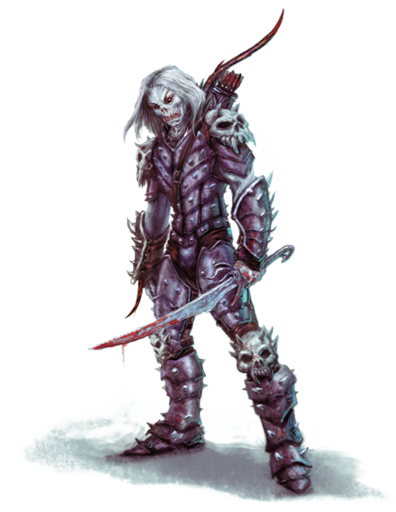
Picture: Handout: Wight
The word “wight” meant “person” in days of yore, but the name now refers to evil undead who were once mortals driven by dark desire and great vanity. When death stills such a creature’s heart and snuffs its living breath, its spirit cries out to the demon lord Orcus or some vile god of the underworld for a reprieve: undeath in return for eternal war on the living. If a dark power answers the call, the spirit is granted undeath so that it can pursue its own malevolent agenda.
Wights possess the memories and drives of their formerly living selves. They will heed the call of whatever dark entity transformed them into undead, swearing oaths to appease their new lord while retaining their autonomy. Never tiring, a wight can pursue its goals relentlessly and without distraction.
Life Eaters. Neither dead nor alive, a wight exists in a transitional state between one world and the next. The bright spark it possessed in life is gone, and in its place is a yearning to consume that spark in all living things. When a wight attacks, this life essence glows like white-hot embers to its dark eyes, and the wight’s cold touch can drain the spark through flesh, clothing, and armor.
Shadow of the Grave. Wights flee from the world by day, away from the light of the sun, which they hate. They retreat to barrow mounds, crypts, and tombs where they dwell. Their lairs are silent, desolate places, surrounded by dead plants, noticeably blackened, and avoided by bird and beast.
Humanoids slain by a wight can rise as zombies under its control. Motivated by hunger for living souls and driven by the same desire for power that awakened them in undeath, some wights serve as shock troops for evil leaders, including wraiths. As soldiers, they are able to plan but seldom do so, relying on their hunger for destruction to overwhelm any creature that stands before them.
Undead Nature. A wight doesn’t require air, food, drink, or sleep.
Traits
Sunlight Sensitivity: While in sunlight, the wight has disadvantage on attack rolls, as well as on Wisdom (Perception) checks that rely on sight.Actions
Multiattack: The wight makes two longsword attacks or two longbow attacks. It can use its Life Drain in place of one longsword attack.Life Drain: Melee Weapon Attack: +4 to hit, reach 5 ft., one creature. Hit: 5 (1d6 + 2) necrotic damage. The target must succeed on a DC 13 Constitution saving throw or its hit point maximum is reduced by an amount equal to the damage taken. This reduction lasts until the target finishes a long rest. The target dies if this effect reduces its hit point maximum to 0.
A humanoid slain by this attack rises 24 hours later as a zombie under the wight's control, unless the humanoid is restored to life or its body is destroyed. The wight can have no more than twelve zombies under its control at one time.
Longsword (One-Handed): Melee Weapon Attack: +4 to hit, reach 5 ft., one target. Hit: 6 (1d8 + 2) slashing damage.
Longsword (Two-Handed): Melee Weapon Attack: +4 to hit, reach 5 ft., one target. Hit: 7 (1d10 + 2) slashing damage.
Longbow: Ranged Weapon Attack: +4 to hit, range 150/600 ft., one target. Hit: 6 (1d8 + 2) piercing damage.

Picture: Handout: Will-o'-Wisp
Will-o’-wisps are malevolent, wispy balls of light that haunt lonely places and battlefields, bound by dark fate or dark magic to feed on fear and despair.
Hope and Doom. Will-o’-wisps look like bobbing lantern lights in the distance, although they can choose to alter their colors, or wink out completely. When they activate their lights, will-o’-wisps offer hope, hinting of safety to creatures that follow them.
Will-o’-wisps lure unwary creatures into quicksand pits, monster lairs, and other dangerous places so that they can feed on the suffering of their prey and revel in their death screams. An evil being that falls prey to a will-o’-wisp might become a wisp itself, its woeful spirit coalescing above its lifeless corpse like a flickering flame.
Consumed by Despair. Will-o’-wisps are the souls of evil beings that perished in anguish or misery as they wandered forsaken lands permeated with powerful magic. They thrive in swampy bogs and bone-strewn battlefields where the oppressive weight of sorrow stoops even heavier than the low-hanging mist and fog. Trapped in these desolate places of lost hope and memory, will-o’-wisps lure other creatures toward dismal fates and feed on their misery.
Agents of Evil. Will-o’-wisps rarely speak, but when they do, their voices sound like faint or distant whispers. In the miserable domains they haunt, will-o’-wisps sometimes form symbiotic relationships with their wicked neighbors. Hags, oni, black dragons, and evil cultists work with will-o’-wisps to draw creatures into ambush. As their evil allies surround and slaughter creatures, the wisps hover above them, drinking the agony of a last breath and savoring the sensation as the light of life goes out in a creature’s eyes.
Undead Nature. A will-o’-wisp doesn’t require air, drink, or sleep.
Traits
Consume Life: As a bonus action, the will-o’-wisp can target one creature it can see within 5 feet of it that has 0 hit points and is still alive. The target must succeed on a DC 10 Constitution saving throw against this magic or die. If the target dies, the will-o’-wisp regains 10 (3d6) hit points.Ephemeral: The will-o’-wisp can’t wear or carry anything.
Incorporeal Movement: The will-o’-wisp can move through other creatures and objects as if they were difficult terrain. It takes 5 (1d10) force damage if it ends its turn inside an object.
Variable Illumination: The will-o’-wisp sheds bright light in a 5- to 20-foot radius and dim light for an additional number of feet equal to the chosen radius. The will-o’-wisp can alter the radius as a bonus action.
Actions
Shock: Melee Spell Attack: +4 to hit, reach 5 ft., one creature. Hit: 9 (2d8) lightning damage.Invisibility: The will-o’-wisp and its light magically become invisible until it attacks or uses its Consume Life, or until its concentration ends (as if concentrating on a spell).

Traits
Keen Hearing and Smell: The wolf has advantage on Wisdom (Perception) checks that rely on hearing or smell.Pack Tactics: The wolf has advantage on an attack roll against a creature if at least one of the wolf's allies is within 5 ft. of the creature and the ally isn't incapacitated.
Actions
Bite: Melee Weapon Attack: +4 to hit, reach 5 ft., one target. Hit: 7 (2d4 + 2) piercing damage. If the target is a creature, it must succeed on a DC 11 Strength saving throw or be knocked prone.
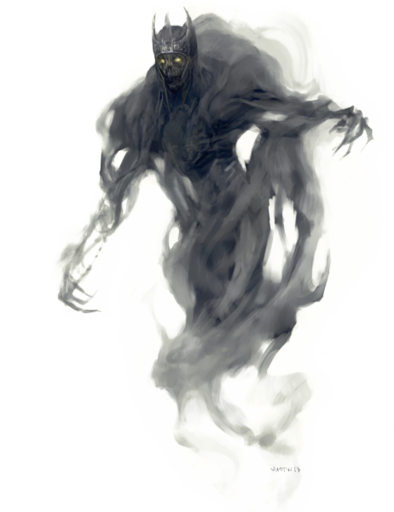
Picture: Handout: Wraith
A wraith is malice incarnate, concentrated into an incorporeal form that seeks to quench all life. The creature is suffused with negative energy, and its mere passage through the world leaves nearby plants blackened and withered. Animals flee from its presence. Even small fires can be extinguished by the sucking oblivion of the wraith’s horrifying existence.
Vile Oblivion. When a mortal humanoid lives a debased life or enters into a fiendish pact, it consigns its soul to eternal damnation in the Lower Planes. However, sometimes the soul becomes so suffused with negative energy that it collapses in on itself and ceases to exist the instant before it can shuffle off to some horrible afterlife. When this occurs, the spirit becomes a soulless wraith—a malevolent void trapped on the plane where it died. Almost nothing of the wraith’s former existence is preserved; in this new form, it exists only to annihilate other life.
Bereft of Body. A wraith can move through solid creatures and objects as easily as a mortal creature moves through fog.
A wraith might retain a few memories of its mortal life as shadowy echoes. However, even the strongest events and emotions become little more than faint impressions, fleeting as half-remembered dreams. A wraith might pause to stare at something that fascinated it in life, or it might curb its wrath in acknowledgment of a past friendship. Such moments come rarely, however, because most wraiths despise what they were as a reminder of what they have become.
Undead Commanders. A wraith can make an undead servant from the spirit of a humanoid creature that has recently suffered a violent death. Such a fragment of woe becomes a specter, spiteful of all that lives.
Wraiths sometimes rule the legions of the dead, plotting the doom of living creatures. When they emerge from their tombs to do battle, life and hope shrivel before them. Even if a wraith’s armies are forced to retreat, the lands its forces occupied are so blasted and withered that those who live there often starve and die.
Undead Nature. A wraith doesn’t require air, food, drink, or sleep.
Traits
Incorporeal Movement: The wraith can move through other creatures and objects as if they were difficult terrain. It takes 5 (1d10) force damage if it ends its turn inside an object.Sunlight Sensitivity: While in sunlight, the wraith has disadvantage on attack rolls, as well as on Wisdom (Perception) checks that rely on sight.
Actions
Life Drain: Melee Weapon Attack: +6 to hit, reach 5 ft., one creature. Hit: 21 (4d8 + 3) necrotic damage. The target must succeed on a DC 14 Constitution saving throw or its hit point maximum is reduced by an amount equal to the damage taken. This reduction lasts until the target finishes a long rest. The target dies if this effect reduces its hit point maximum to 0.Create Specter: The wraith targets a humanoid within 10 feet of it that has been dead for no longer than 1 minute and died violently. The target's spirit rises as a specter in the space of its corpse or in the nearest unoccupied space. The specter is under the wraith's control. The wraith can have no more than seven specters under its control at one time.

Picture: Handout: Yevgeni Krushkin
Szoldar Szoldarovich and Yevgeni Krushkin are local hunters who frequent the Blue Water Inn. They kill wolves and sell the meat for a living, and their work is dangerous and bloody. Both men are grim and have haunted looks in their eyes.
These two are dour fellows, but they seldom pass up an opportunity to earn coin. If the characters are looking for guides or information about the land of Barovia, Szoldar and Yevgeni can be of service. They aren’t afraid to venture beyond Vallaki’s walls during the day, and they know the woods and valley well. They’re willing to serve as guides for 5 gp per day, or to provide directions to important landmarks in exchange for free drinks. They think it’s foolish to travel “this cursed realm” at night and won’t do so unless their payment is exorbitant (100 gp or more).
On rare occasions when he has something to say, Szoldar speaks brusquely, while Yevgeni usually parrots his friend in not so many words. Szoldar has a notch in his bow for every wolf he’s killed, while Yevgeni adds a new swatch to his wolfskin cloak every time he makes a kill. Both men have families but spend most of their time together, either drowning their sorrows or hunting in the woods. Most of the wolf heads that adorn the tavern walls are the result of their handiwork.
Szoldar Szoldarovich and Yevgeni Krushkin are local hunters who frequent the Blue Water Inn. They kill wolves and sell the meat for a living, and their work is dangerous and bloody. Both men are grim and have haunted looks in their eyes.
These two are dour fellows, but they seldom pass up an opportunity to earn coin. If the characters are looking for guides or information about the land of Barovia, Szoldar and Yevgeni can be of service. They aren’t afraid to venture beyond Vallaki’s walls during the day, and they know the woods and valley well. They’re willing to serve as guides for 5 gp per day, or to provide directions to important landmarks in exchange for free drinks. They think it’s foolish to travel “this cursed realm” at night and won’t do so unless their payment is exorbitant (100 gp or more).
On rare occasions when he has something to say, Szoldar speaks brusquely, while Yevgeni usually parrots his friend in not so many words. Szoldar has a notch in his bow for every wolf he’s killed, while Yevgeni adds a new swatch to his wolfskin cloak every time he makes a kill. Both men have families but spend most of their time together, either drowning their sorrows or hunting in the woods. Most of the wolf heads that adorn the tavern walls are the result of their handiwork.

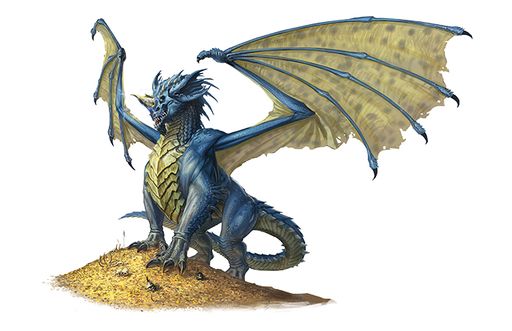
Picture: Handout: Blue Dragon
Dragons
True dragons are winged reptiles of ancient lineage and fearsome power. They are known and feared for their predatory cunning and greed, with the oldest dragons accounted as some of the most powerful creatures in the world. Dragons are also magical creatures whose innate power fuels their dreaded breath weapons and other preternatural abilities.Many creatures, including wyverns and dragon turtles, have draconic blood. However, true dragons fall into the two broad categories of chromatic and metallic dragons. The black, blue, green, red, and white dragons are selfish, evil, and feared by all. The brass, bronze, copper, gold, and silver dragons are noble, good, and highly respected by the wise.
Though their goals and ideals vary tremendously, all true dragons covet wealth, hoarding mounds of coins and gathering gems, jewels, and magic items. Dragons with large hoards are loath to leave them for long, venturing out of their lairs only to patrol or feed.
True dragons pass through four distinct stages of life, from lowly wyrmlings to ancient dragons, which can live for over a thousand years. In that time, their might can become unrivaled and their hoards can grow beyond price.
Dragon Age Categories
| Category | Size | Age Range |
| Wyrmling | Medium | 5 years or less |
| Young | Large | 6-100 years |
| Adult | Huge | 101-800 years |
| Ancient | Gargantuan | 801 years or more |
Variant: Dragons as Innate Spellcasters
Dragons are innately magical creatures that can master a few spells as they age, using this variant.A young or older dragon can innately cast a number of spells equal to its Charisma modifier. Each spell can be cast once per day, requiring no material components, and the spell’s level can be no higher than one-third the dragon’s challenge rating (rounded down). The dragon’s bonus to hit with spell attacks is equal to its proficiency bonus + its Charisma bonus. The dragon’s spell save DC equals 8 + its proficiency bonus + its Charisma modifier.
Chromatic Dragons
The black, blue, green, red, and white dragons represent the evil side of dragonkind. Aggressive, gluttonous, and vain, chromatic dragons are dark sages and powerful tyrants feared by all creatures—including each other.Driven by Greed. Chromatic dragons lust after treasure, and this greed colors their every scheme and plot. They believe that the world’s wealth belongs to them by right, and a chromatic dragon seizes that wealth without regard for the humanoids and other creatures that have “stolen” it. With its piles of coins, gleaming gems, and magic items, a dragon’s hoard is the stuff of legend. However, chromatic dragons have no interest in commerce, amassing wealth for no other reason than to have it.
Creatures of Ego. Chromatic dragons are united by their sense of superiority, believing themselves the most powerful and worthy of all mortal creatures. When they interact with other creatures, it is only to further their own interests. They believe in their innate right to rule, and this belief is the cornerstone of every chromatic dragon’s personality and worldview. Trying to humble a chromatic dragon is like trying to convince the wind to stop blowing. To these creatures, humanoids are animals, fit to serve as prey or beasts of burden, and wholly unworthy of respect.
Dangerous Lairs. A dragon’s lair serves as the seat of its power and a vault for its treasure. With its innate toughness and tolerance for severe environmental effects, a dragon selects or builds a lair not for shelter but for defense, favoring multiple entrances and exits, and security for its hoard.
Most chromatic dragon lairs are hidden in dangerous and remote locations to prevent all but the most audacious mortals from reaching them. A black dragon might lair in the heart of a vast swamp, while a red dragon might claim the caldera of an active volcano. In addition to the natural defenses of their lairs, powerful chromatic dragons use magical guardians, traps, and subservient creatures to protect their treasures.
Queen of Evil Dragons. Tiamat the Dragon Queen is the chief deity of evil dragonkind. She dwells on Avernus, the first layer of the Nine Hells. As a lesser god, Tiamat has the power to grant spells to her worshipers, though she is loath to share her power. She epitomizes the avarice of evil dragons, believing that the multiverse and all its treasures will one day be hers and hers alone.
Tiamat is a gigantic dragon whose five heads reflect the forms of the chromatic dragons that worship her—black, blue, green, red, and white. She is a terror on the battlefield, capable of annihilating whole armies with her five breath weapons, her formidable spellcasting, and her fearsome claws.
Tiamat’s most hated enemy is Bahamut the Platinum Dragon, with whom she shares control of the faith of dragonkind. She also holds a special enmity for Asmodeus, who long ago stripped her of the rule of Avernus and who continues to curb the Dragon Queen’s power.
Blue Dragon
Vain and territorial, blue dragons soar through the skies over deserts, preying on caravans and plundering herds and settlements in the verdant lands beyond the desert’s reach. These dragons can also be found in dry steppes, searing badlands, and rocky coasts. They guard their territories against all potential competitors, especially brass dragons.A blue dragon is recognized by its dramatic frilled ears and the massive ridged horn atop its blunt head. Rows of spikes extend back from its nostrils to line its brow, and cluster on its jutting lower jaw.
A blue dragon’s scales vary in color from an iridescent azure to a deep indigo, polished to a glossy finish by the desert sands. As the dragon ages, its scales become thicker and harder, and its hide hums and crackles with static electricity. These effects intensify when the dragon is angry or about to attack, giving off an odor of ozone and dusty air.
Vain and Deadly. A blue dragon will not stand for any remark or insinuation that it is weak or inferior, taking great pleasure in lording its power over humanoids and other lesser creatures.
A blue dragon is a patient and methodical combatant. When fighting on its own terms, it turns combat into an extended affair of hours or even days, attacking from a distance with volleys of lightning, then flying well out of harm’s reach as it waits to attack again.
Desert Predators. Though they sometimes eat cacti and other desert plants to sate their great hunger, blue dragons are carnivores. They prefer to dine on herd animals, cooking those creatures with their lightning breath before gorging themselves. Their dining habits make blue dragons an enormous threat to desert caravans and nomadic tribes, which become convenient collections of food and treasure to a dragon’s eye.
When it hunts, a blue dragon buries itself in the desert sand so that only the horn on its nose pokes above the surface, appearing to be an outcropping of stone. When prey draws near, the dragon rises up, sand pouring from its wings like an avalanche as it attacks.
Overlords and Minions. Blue dragons covet valuable and talented creatures whose service reinforces their sense of superiority. Bards, sages, artists, wizards, and assassins can become valuable agents for a blue dragon, which rewards loyal service handsomely.
A blue dragon keeps its lair secret and well protected, and even its most trusted servants are rarely allowed within. It encourages ankhegs, giant scorpions, and other creatures of the desert to dwell near its lair for additional security. Older blue dragons sometimes attract air elementals and other creatures to serve them.
Hoarders of Gems. Though blue dragons collect anything that looks valuable, they are especially fond of gems. Considering blue to be the most noble and beautiful of colors, they covet sapphires, favoring jewelry and magic items adorned with those gems.
A blue dragon buries its most valuable treasures deep in the sand, while scattering a few less valuable trinkets in plainer sight over hidden sinkholes to punish and eliminate would-be thieves.
A Blue Dragon’s Lair
Blue dragons make their lairs in barren places, using their lightning breath and their burrowing ability to carve out crystallized caverns and tunnels beneath the sands.Thunderstorms rage around a legendary blue dragon’s lair, and narrow tubes lined with glassy sand ventilate the lair, all the while avoiding the deadly sinkholes that are the dragon’s first line of defense.
A blue dragon will collapse the caverns that make up its lair if that lair is invaded. The dragon then burrows out, leaving its attackers to be crushed and suffocated. When it returns later, it collects its possessions—along with the wealth of the dead intruders.
Lair Actions
On initiative count 20 (losing initiative ties), the dragon takes a lair action to cause one of the following effects; the dragon can’t use the same effect two rounds in a row:- Part of the ceiling collapses above one creature that the dragon can see within 120 feet of it. The creature must succeed on a DC 15 Dexterity saving throw or take 10 (3d6) bludgeoning damage and be knocked prone and buried. The buried target is restrained and unable to breathe or stand up. A creature can take an action to make a DC 10 Strength check, ending the buried state on a success.
- A cloud of sand swirls about in a 20-foot-radius sphere centered on a point the dragon can see within 120 feet of it. The cloud spreads around corners. Each creature in the cloud must succeed on a DC 15 Constitution saving throw or be blinded for 1 minute. A creature can repeat the saving throw at the end of each of its turns, ending the effect on itself on a success.
- Lightning arcs, forming a 5-foot-wide line between two of the lair’s solid surfaces that the dragon can see. They must be within 120 feet of the dragon and 120 feet of each other. Each creature in that line must succeed on a DC 15 Dexterity saving throw or take 10 (3d6) lightning damage.
Regional Effects
The region containing a legendary blue dragon’s lair is warped by the dragon’s magic, which creates one or more of the following effects:- Thunderstorms rage within 6 miles of the lair.
- Dust devils scour the land within 6 miles of the lair. A dust devil has the statistics of an air elemental, but it can’t fly, has a speed of 50 feet, and has an Intelligence and Charisma of 1 (−5).
- Hidden sinkholes form in and around the dragon’s lair. A sinkhole can be spotted from a safe distance with a successful DC 20 Wisdom (Perception) check. Otherwise, the first creature to step on the thin crust covering the sinkhole must succeed on a DC 15 Dexterity saving throw or fall 1d6 � 10 feet into the sinkhole.
If the dragon dies, the dust devils disappear immediately, and the thunderstorms abate within 1d10 days. Any sinkholes remain where they are.
Actions
Multiattack: The dragon makes three attacks: one with its bite and two with its claws.Bite: Melee Weapon Attack: +9 to hit, reach 10 ft., one target. Hit: 16 (2d10 + 5) piercing damage plus 5 (1d10) lightning damage.
Claw: Melee Weapon Attack: +9 to hit, reach 5 ft., one target. Hit: 12 (2d6 + 5) slashing damage.
Lightning Breath (Recharge 5-6): The dragon exhales lightning in an 60-foot line that is 5 feet wide. Each creature in that line must make a DC 16 Dexterity saving throw, taking 55 (10d10) lightning damage on a failed save, or half as much damage on a successful one.

"After Beek died, we cast an Animate Dead spell on his corpse. It was fun for a while, but the zombie started to smell real bad, so we doused it in oil and set it on fire. Beek would’ve found that hilarious."
—Fonkin Hoddypeak, on friendship
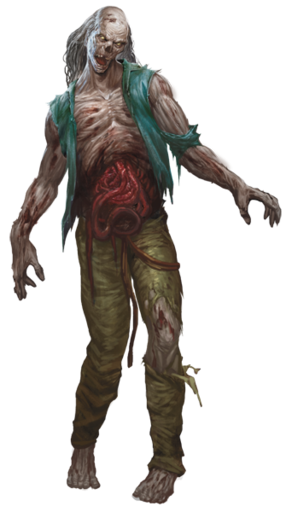
Zombies
From somewhere in the darkness, a gurgling moan is heard. A form lurches into view, dragging one foot as it raises bloated arms and broken hands. The zombie advances, driven to kill anyone too slow to escape its grasp.Dark Servants. Sinister necromantic magic infuses the remains of the dead, causing them to rise as zombies that do their creator’s bidding without fear or hesitation. They move with a jerky, uneven gait, clad in the moldering apparel they wore when put to rest, and carrying the stench of decay.
Most zombies are made from humanoid remains, though the flesh and bones of any formerly living creature can be imbued with a semblance of life. Necromantic magic, usually from spells, animates a zombie. Some zombies rise spontaneously when dark magic saturates an area. Once turned into a zombie, a creature can’t be restored to life except by powerful magic, such as a resurrection spell.
A zombie retains no vestiges of its former self, its mind devoid of thought and imagination. A zombie left without orders simply stands in place and rots unless something comes along that it can kill. The magic animating a zombie imbues it with evil, so left without purpose, it attacks any living creature it encounters.
Hideous Forms. Zombies appear as they did in life, showing the wounds that killed them. However, the magic that creates these vile creatures often takes time to run its course. Dead warriors might rise from a battlefield, eviscerated and bloated after days in the sun. The muddy cadaver of a peasant could claw its way from the ground, riddled with maggots and worms. A zombie might wash ashore or rise from a marsh, swollen and reeking after weeks in the water.
Mindless Soldiers. Zombies take the most direct route to any foe, unable to comprehend obstacles, tactics, or dangerous terrain. A zombie might stumble into a fast-flowing river to reach foes on a far shore, clawing at the surface as it is battered against rocks and destroyed. To reach a foe below it, a zombie might step out of an open window. Zombies stumble through roaring infernos, into pools of acid, and across fields littered with caltrops without hesitation.
A zombie can follow simple orders and distinguish friends from foes, but its ability to reason is limited to shambling in whatever direction it is pointed, pummeling any enemy in its path. A zombie armed with a weapon uses it, but the zombie won’t retrieve a dropped weapon or other tool until told to do so.
Undead Nature. A zombie doesn’t require air, food, drink, or sleep.
Traits
Undead Fortitude: If damage reduces the zombie to 0 hit points, it must make a Constitution saving throw with a DC of 5 + the damage taken, unless the damage is radiant or from a critical hit. On a success, the zombie drops to 1 hit point instead.Actions
Slam: Melee Weapon Attack: +3 to hit, reach 5 ft., one target. Hit: 4 (1d6 + 1) bludgeoning damage.
"The Company of the Black Moon—they used to be adventurers loyal to the realm. Now they roam the woods as a pack of werewolves. The king has promised estates, titles, and gold to anyone who can undo the curse afflicting them. I, for one, have no interest in such rewards."
—Thornstaff, elf druid
Picture: Handout: Zuleika Toranescu
Lycanthropes
One of the most ancient and feared of all curses, lycanthropy can transform the most civilized humanoid into a ravening beast. In its natural humanoid form, a creature cursed by lycanthropy appears as its normal self. Over time, however, many lycanthropes acquire features suggestive of their animal form. In that animal form, a lycanthrope resembles a powerful version of a normal animal. On close inspection, its eyes show a faint spark of unnatural intelligence and might glow red in the dark.Evil lycanthropes hide among normal folk, emerging in animal form at night to spread terror and bloodshed, especially under a full moon. Good lycanthropes are reclusive and uncomfortable around other civilized creatures, often living alone in wilderness areas far from villages and towns.Curse of Lycanthropy. A humanoid creature can be afflicted with the curse of lycanthropy after being wounded by a lycanthrope, or if one or both of its parents are lycanthropes. A remove curse spell can rid an afflicted lycanthrope of the curse, but a natural born lycanthrope can be freed of the curse only with a wish.
A lycanthrope can either resist its curse or embrace it. By resisting the curse, a lycanthrope retains its normal alignment and personality while in humanoid form. It lives its life as it always has, burying deep the bestial urges raging inside it. However, when the full moon rises, the curse becomes too strong to resist, transforming the individual into its beast form—or into a horrible hybrid form that combines animal and humanoid traits. When the moon wanes, the beast within can be controlled once again. Especially if the cursed creature is unaware of its condition, it might not remember the events of its transformation, though those memories often haunt a lycanthrope as bloody dreams.
Some individuals see little point in fighting the curse and accept what they are. With time and experience, they learn to master their shapechanging ability and can assume beast form or hybrid form at will. Most lycanthropes that embrace their bestial natures succumb to bloodlust, becoming evil, opportunistic creatures that prey on the weak.
Werewolf
A werewolf is a savage predator. In its humanoid form, a werewolf has heightened senses, a fiery temper, and a tendency to eat rare meat. Its wolf form is a fearsome predator, but its hybrid form is more terrifying by far—a furred and well-muscled humanoid body topped by a ravening wolf’s head. A werewolf can wield weapons in hybrid form, though it prefers to tear foes apart with its powerful claws and bite.Most werewolves flee civilized lands not long after becoming afflicted. Those that reject the curse fear what will happen if they remain among their friends and family. Those that embrace the curse fear discovery and the consequences of their murderous acts. In the wild, werewolves form packs that also include wolves and dire wolves.
Variant: Nonhuman Lycanthropes
The statistics presented in this section assume a base creature of human. However, you can also use the statistics to represent nonhuman lycanthropes, adding verisimilitude by allowing a nonhuman lycanthrope to retain one or more of its humanoid racial traits. For example, an elf werewolf might have the Fey Ancestry trait.Player Characters as Lycanthropes
A character who becomes a lycanthrope retains his or her statistics except as specified by lycanthrope type. The character gains the lycanthrope’s speeds in nonhumanoid form, damage immunities, traits, and actions that don’t involve equipment. The character is proficient with the lycanthrope’s natural attacks, such as its bite or claws, which deal damage as shown in the lycanthrope’s statistics. The character can’t speak while in animal form.A humanoid hit by an attack that carries the curse of lycanthropy must succeed on a Constitution saving throw (DC 8 + the lycanthrope’s proficiency bonus + the lycanthrope’s Constitution modifier) or be cursed. If the character embraces the curse, his or her alignment becomes the one defined for the lycanthrope. The DM is free to decide that a change in alignment places the character under DM control until the curse of lycanthropy is removed.
The following information applies to specific lycanthropes.
Werebear. The character gains a Strength of 19 if his or her score isn’t already higher, and a +1 bonus to AC while in bear or hybrid form (from natural armor). Attack and damage rolls for the natural weapons are based on Strength.
Wereboar. The character gains a Strength of 17 if his or her score isn’t already higher, and a +1 bonus to AC while in boar or hybrid form (from natural armor). Attack and damage rolls for the tusks are based on Strength. For the Charge trait, the DC is 8 + the character’s proficiency bonus + Strength modifier.
Wererat. The character gains a Dexterity of 15 if his or her score isn’t already higher. Attack and damage rolls for the bite are based on whichever is higher of the character’s Strength and Dexterity.
Weretiger. The character gains a Strength of 17 if his or her score isn’t already higher. Attack and damage rolls for the natural weapons are based on Strength. For the Pounce trait, the DC is 8 + the character’s proficiency bonus + Strength modifier.
Werewolf. The character gains a Strength of 15 if his or her score isn’t already higher, and a +1 bonus to AC while in wolf or hybrid form (from natural armor). Attack and damage rolls for the natural weapons are based on Strength.
Traits
Shapechanger: The werewolf can use its action to polymorph into a wolf-humanoid hybrid or into a wolf, or back into its true form, which is humanoid. Its statistics, other than its AC, are the same in each form. Any equipment it is wearing or carrying isn't transformed. It reverts to its true form if it dies.Keen Hearing and Smell: The werewolf has advantage on Wisdom (Perception) checks that rely on hearing or smell.
Actions
Multiattack (Humanoid or Hybrid Form Only): The werewolf makes two attacks: one with its bite and one with its claws or spear.Bite (Wolf or Hybrid Form Only): Melee Weapon Attack: +4 to hit, reach 5 ft., one target. Hit: 6 (1d8 + 2) piercing damage. If the target is a humanoid, it must succeed on a DC 12 Constitution saving throw or be cursed with werewolf lycanthropy.
Claws (Hybrid Form Only): Melee Weapon Attack: +4 to hit, reach 5 ft., one creature. Hit: 7 (2d4 + 2) slashing damage.
Spear (Humanoid Form Only; Melee; One-Handed): Melee Weapon Attack: +4 to hit, reach 5 ft., one creature. Hit: 5 (1d6 + 2) piercing damage.
Spear (Humanoid Form Only; Melee; Two-Handed): Melee Weapon Attack: +4 to hit, reach 5 ft., one creature. Hit: 6 (1d8 + 2) piercing damage.
Spear (Humanoid Form Only; Ranged): Ranged Weapon Attack: +4 to hit, range 20/60 ft., one creature. Hit: 5 (1d6 + 2) piercing damage.

Picture: Handout: Zygfrek Belview
Sound Mimicry. Mongrelfolk have misshapen mouths and vocal cords. They speak fragmented Common mixed with various animal cries and nonsense. They can effectively imitate sounds made by beasts and humanoids that they’ve heard. Mongrelfolk aren’t sophisticated enough to use these sounds as a covert form of communication, but they can use the sounds to lure enemies into a trap or otherwise distract them.
Outcasts. Mongrelfolk are seldom welcome in other humanoid societies, where they are abused, enslaved, or shunned. They typically live on the fringes of civilization in ruins, deserted buildings, or other places that other humanoid races once lived in or built. They tend to be timid and skittish outside their homes and fiercely territorial within their lairs.
Camouflage Experts. Mongrelfolk often hide their deformities under cloaks and cowls. In this way, they can sometimes pass as stout humans or thin dwarves. They are fond of camouflage, attaching leaves and twigs to their cloaks, making brown paint to cover their skin, and weaving grass nets under which they can hide. They use such camouflage while hunting in the wild or while standing guard outside their lairs. Until it is seen, a camouflaged mongrelfolk has advantage on Stealth checks made to hide.
Horrific Offspring. It’s possible to restore a mongrelfolk to its original form using a greater restoration spell, but the same can’t be said for a mongrelfolk’s offspring. Only mongrelfolk that are made by magic can be restored to their original forms. Mongrelfolk that are born are true mongrelfolk and not the subjects of a spell or an effect that can be undone.
Mongrelfolk can breed with other humanoids, but nearly all children born to such parents are mongrelfolk. (About one child in every hundred is born looking like its non-mongrelfolk parent.)
Mongrelfolk
Mongrelfolk are humanoids that have undergone, or whose ancestors underwent, horrific magical transformations, to the extent that they retain only a fraction of their original being. Their humanoid bodies incorporate the features of various beasts. For example, one mongrelfolk might have the basic body shape of a dwarf with a head that combines the features of a cat and a lizard, one arm that ends in a crab’s pincer, and one leg that ends in a cloven hoof. Another might have the skin and horns of a cow, the eyes of a spider, frog’s legs, and a scaly lizard’s tail. Each mongrelfolk’s mad combination of humanoid and animal forms results in its having a slow, awkward gait.Sound Mimicry. Mongrelfolk have misshapen mouths and vocal cords. They speak fragmented Common mixed with various animal cries and nonsense. They can effectively imitate sounds made by beasts and humanoids that they’ve heard. Mongrelfolk aren’t sophisticated enough to use these sounds as a covert form of communication, but they can use the sounds to lure enemies into a trap or otherwise distract them.
Outcasts. Mongrelfolk are seldom welcome in other humanoid societies, where they are abused, enslaved, or shunned. They typically live on the fringes of civilization in ruins, deserted buildings, or other places that other humanoid races once lived in or built. They tend to be timid and skittish outside their homes and fiercely territorial within their lairs.
Camouflage Experts. Mongrelfolk often hide their deformities under cloaks and cowls. In this way, they can sometimes pass as stout humans or thin dwarves. They are fond of camouflage, attaching leaves and twigs to their cloaks, making brown paint to cover their skin, and weaving grass nets under which they can hide. They use such camouflage while hunting in the wild or while standing guard outside their lairs. Until it is seen, a camouflaged mongrelfolk has advantage on Stealth checks made to hide.
Horrific Offspring. It’s possible to restore a mongrelfolk to its original form using a greater restoration spell, but the same can’t be said for a mongrelfolk’s offspring. Only mongrelfolk that are made by magic can be restored to their original forms. Mongrelfolk that are born are true mongrelfolk and not the subjects of a spell or an effect that can be undone.
Mongrelfolk can breed with other humanoids, but nearly all children born to such parents are mongrelfolk. (About one child in every hundred is born looking like its non-mongrelfolk parent.)